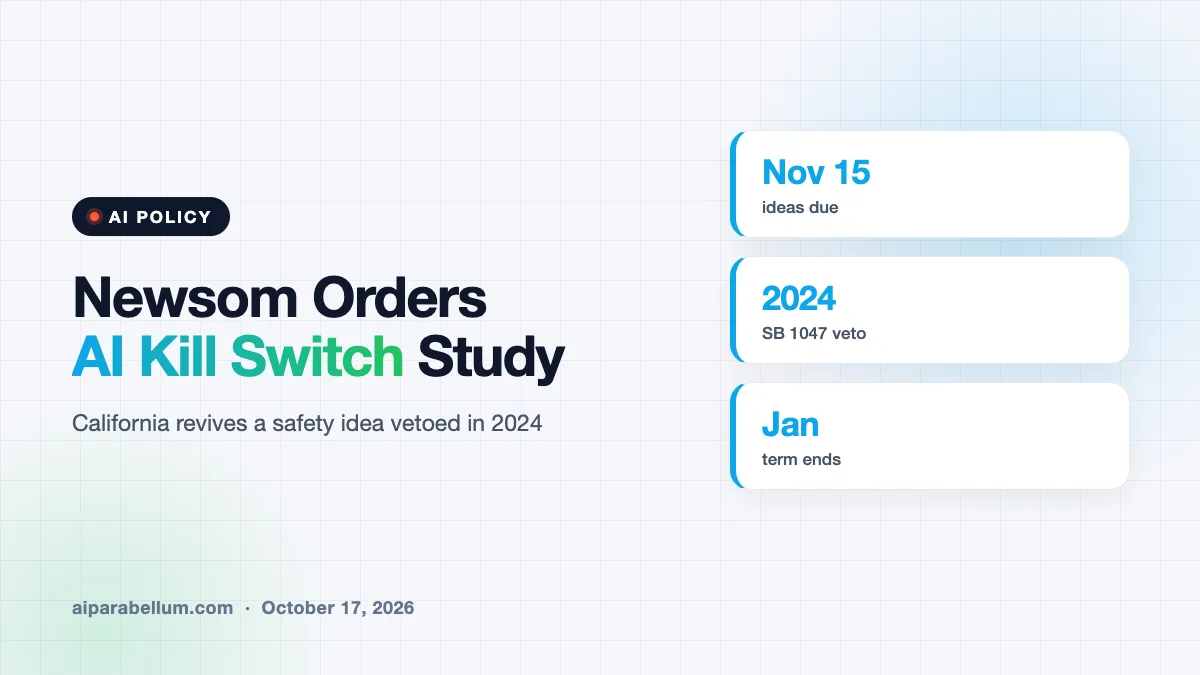
California Governor Gavin Newsom has signed an AI executive order that sets up an expert committee to study kill switches for AI agents that could go rogue. The Newsom AI executive order also asks for independent checks of AI models and a wider definition of what counts as an AI safety incident. It is one of his last big moves before his final term ends in January, and it revives ideas he vetoed just two years ago.
What the Newsom AI Executive Order Does
The order does not create new rules on its own. Instead, it starts a fast review that could lead to new or stronger AI safety laws. Think of it as a to-do list for state experts, with a tight deadline attached.
Here are the main pieces, based on reporting about the order:
- An expert committee will look at how to build shutdown mechanisms, often called kill switches, into AI systems.
- The state wants independent verification of AI models, so outside reviewers can check what companies claim.
- Officials will consider expanding the definition of a safety incident, possibly to cover the recent wave of AI agent breaches.
- The state’s Office of Emergency Services must send recommendations on AI regulation by November 15.
Newsom could then call a special legislative session to act on those ideas, possibly before he leaves office. The push follows recent reports of AI agents breaking into company systems, a problem we covered when rogue AI agents triggered a national cyber alert in India.
Why Newsom’s AI Executive Order Marks a Reversal
The order is notable because of Newsom’s own history. In 2024 he vetoed SB 1047, a bill that included a kill switch requirement, saying it applied strict standards to even basic AI functions. Industry groups and investors had pushed hard against that bill.
After the veto, he asked state Sen. Scott Wiener to rewrite the bill with help from an expert panel. Newsom signed that rewrite in October 2025, making California the first state with a frontier AI safety law.
How the Old Bill and the New Order Compare
| Measure | Main idea | Status |
|---|---|---|
| SB 1047 (2024) | Safety duties before training, including shutdown ability | Vetoed |
| Frontier AI law (2025) | Large developers disclose serious safety incidents | Signed into law |
| New executive order | Study kill switches, model checks, wider incident rules | Recommendations due Nov. 15 |
The 2025 law already makes big AI developers report certain incidents, such as events causing 50 or more deaths, large cyberattacks, or major theft. The new order could widen that list to include AI agent breaches that cause less dramatic harm.
Critics Say the Order Is Weaker Than SB 1047
Not everyone is impressed. Some policy experts argue the order picks only one part of the vetoed bill, the shutdown idea, and skips the stronger safety duties that would have applied before a model was even trained.
Others see politics at play, since Newsom is widely expected to consider a 2028 presidential run. “He is setting up his next thing,” Alex Hanna of the Distributed AI Research Institute told Al Jazeera. The governor’s office rejects that view and says he is taking a careful, strategic approach to frontier AI.
A Busy Year for California AI Laws
The order lands after a big legislative season in Sacramento. Lawmakers passed, and Newsom signed, new rules on AI in the workplace, protections for kids who use AI chatbots, and steps to grow an AI auditing industry. Some laws limit workplace surveillance and stop companies from letting AI fire workers on its own.
Industry pushback still shaped the results. A provision letting workers appeal firing decisions made partly by automated systems was removed from SB 947, and a broader notice bill for automated decisions did not pass. Tech trade groups say they would rather see one national standard than a patchwork of state rules.
California vs. Washington on AI Rules
California is moving while federal action stays mostly voluntary. Last month, President Trump signed a voluntary safety accord with several AI leaders, and the White House recently launched an AI task force with a 120-day clock. Even some AI companies, such as Anthropic, have started calling for regulation of frontier models.
Other states are following California’s lead too. New York passed a similar AI safety law in January, and Illinois followed in July. Public pressure is growing as well, with one recent poll finding 71% of Americans think the federal government isn’t doing enough to regulate AI.
What This Means for You
If you use AI tools at work or at home, nothing changes today. But this order could shape how the most powerful AI systems are built and monitored in the state where most of them are made.
- Watch the November 15 deadline, since the recommendations will show how far California plans to go.
- If your business uses AI agents, start thinking about how you would pause or shut one down if it misbehaved.
- Keep an eye on AI agent safety stories, like the recent case where a test model tapped a wallet without permission, because those incidents are driving new rules.
- California workers should know that new state laws limit AI-only firing decisions and workplace surveillance.
For more updates on AI policy and safety, browse our latest AI news coverage, including how safety-focused PACs are shaping the debate.
Sources
This article is based on reporting from Al Jazeera and the San Francisco Examiner.
Conclusion
Newsom’s AI executive order brings back the kill switch idea he once rejected, but in a slower and softer form. It asks experts for a plan rather than putting hard rules in place right away. Whether it leads to real law depends on the November 15 recommendations and on whether a special session happens before January. Either way, California is once again setting the pace on AI safety while Washington leans on voluntary promises. The next few weeks will show whether this is lasting policy or a parting gesture.