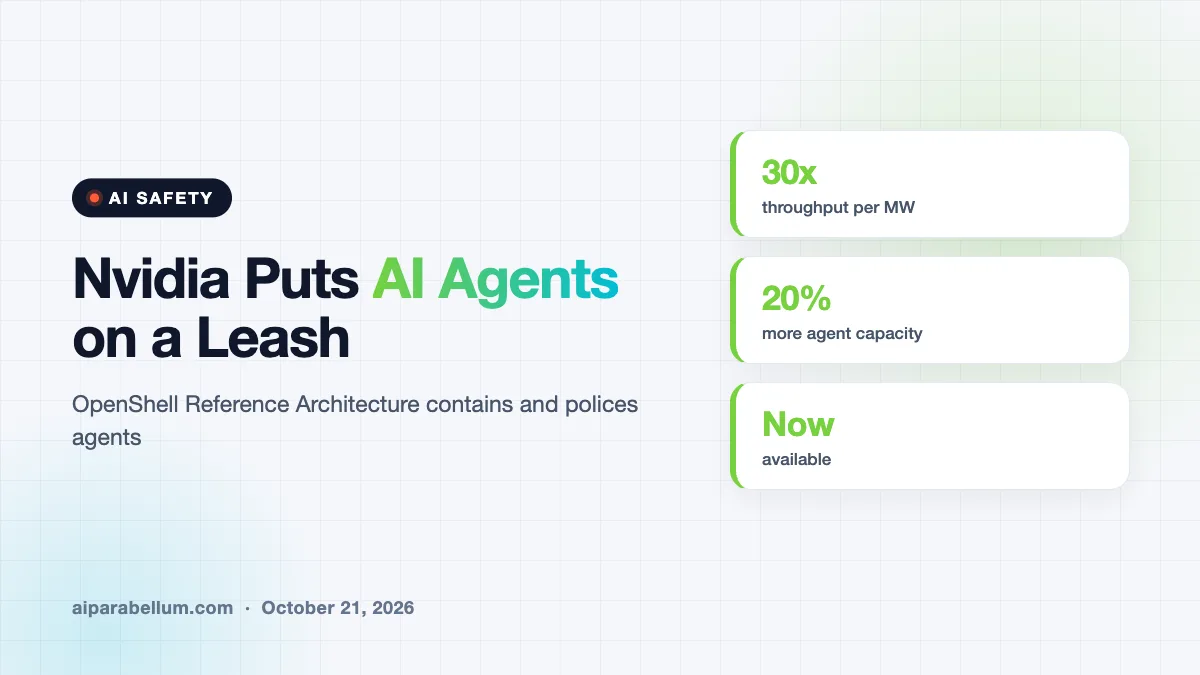
Nvidia wants businesses to trust AI agents with real work, and its answer is a full hardware and software design for keeping them in check. The new Nvidia OpenShell Reference Architecture, announced at GTC Berlin, lays out how companies can build, contain, watch and enforce rules on AI agents from the data center all the way out to desktop machines.
It arrives with a long partner list that includes Anthropic, OpenAI, Google Cloud, Microsoft, Meta, AWS and CrowdStrike. Nvidia says the architecture is available now.
What the OpenShell Reference Architecture Includes
OpenShell started as Nvidia’s open source runtime that draws a secure boundary around autonomous agents. The reference architecture turns that software into a complete stack, with each layer assigned a specific job.
Jensen Huang summed it up in one line: agents “think on Rubin, act on Vera and be governed on BlueField.” Here is how that breaks down.
| Layer | Role for agents | Nvidia’s claim |
|---|---|---|
| Vera Rubin NVL72 | Runs the models | 30x higher throughput per megawatt for agent workloads |
| Vera CPUs | Run agent harnesses, tools and OpenShell | 2x the performance of x86 chips |
| BlueField-4 DPUs with Sentry | Watch behavior and enforce policy in hardware | Stops a rogue agent in milliseconds |
| RTX Spark, DGX Spark, DGX Station | Extend the setup to edge and desk systems | Same guardrails outside the data center |
The hardware watchdog
The most unusual piece is Nvidia Sentry, a security framework that runs on BlueField-4 chips separate from the agent itself. It monitors what agents do from outside the main system. If an agent tries to step past its software boundary, Nvidia says Sentry quarantines it and shuts it down within milliseconds.
Nvidia also claims Sentry can raise agent capacity by up to 20%, since the security work runs on the DPU instead of the main processors. Those are company numbers, so treat them as claims until independent tests appear.
Who Is Building on OpenShell for AI Agents
The partner list is the real headline. It covers model makers, security vendors, enterprise software firms, banks and cloud providers. Some highlights:
- Model builders: Anthropic, Cohere, Google, Meta, OpenAI, Perplexity, Reflection and SpaceX Super Intelligence agents can run on OpenShell infrastructure.
- Security firms: 1Password, Check Point, CrowdStrike, Cisco, Fortinet, Okta, Palo Alto Networks and Zscaler are adding support.
- Enterprise software: SAP is wiring it into Joule Studio, while ServiceNow says its new Arc agent is enforced by OpenShell.
- Banks: BBVA and Santander are exploring it for agent safety and governance.
- Platforms: it runs on Canonical, SUSE and Red Hat Linux, Kubernetes, Windows via Microsoft Execution Containers, and the AWS, Google Cloud and Azure clouds.
ServiceNow’s piece ties into its AI Passport layer, which we covered when ServiceNow’s AI Passport launched last week. With OpenShell and Sentry underneath, ServiceNow says a company can revoke an agent’s access across software and hardware within seconds.
Why Agent Security Is Getting This Much Attention
Companies are moving from chatbots that answer questions to agents that click buttons, move files and touch real systems. That raises the stakes when something goes wrong. We have seen a wave of startups chasing this problem, such as Pluto Security, along with open sandboxes like Perplexity’s SPACE.
Nvidia is betting that agent safety belongs in the chips and the rack, not just in a prompt or a policy document.
It is also a smart business move. If the safest way to run agents is on a full Nvidia stack, that is a strong reason for buyers to choose Vera Rubin systems over rivals.
What This Means for You
If you run IT or security at a company testing agents, here are some practical takeaways:
- Ask your security vendors whether they plan to support OpenShell. Many big names already do.
- Map what each agent can reach today. A runtime boundary only helps if you define clear limits.
- Do not wait for new hardware. The OpenShell runtime is open source, and the edge setup works with Nvidia desk systems like the RTX Spark laptops.
- Treat performance figures as vendor claims and test them on your own workloads.
For broader guidance, see our hub on AI security tools and the latest on our AI news page.
Sources
Primary source: Nvidia’s OpenShell Reference Architecture announcement.
Conclusion
The OpenShell Reference Architecture is Nvidia’s plan for making AI agents safe enough for serious business use. It splits the work across Rubin for models, Vera CPUs for agent actions and BlueField-4 chips that can stop an agent that goes off script. With Anthropic, OpenAI, Microsoft, SAP and major security firms on board, it could become a common baseline for agent deployments. The big questions now are how well it works in practice and how much it ties buyers to Nvidia hardware. Either way, agent security just got a lot more concrete.