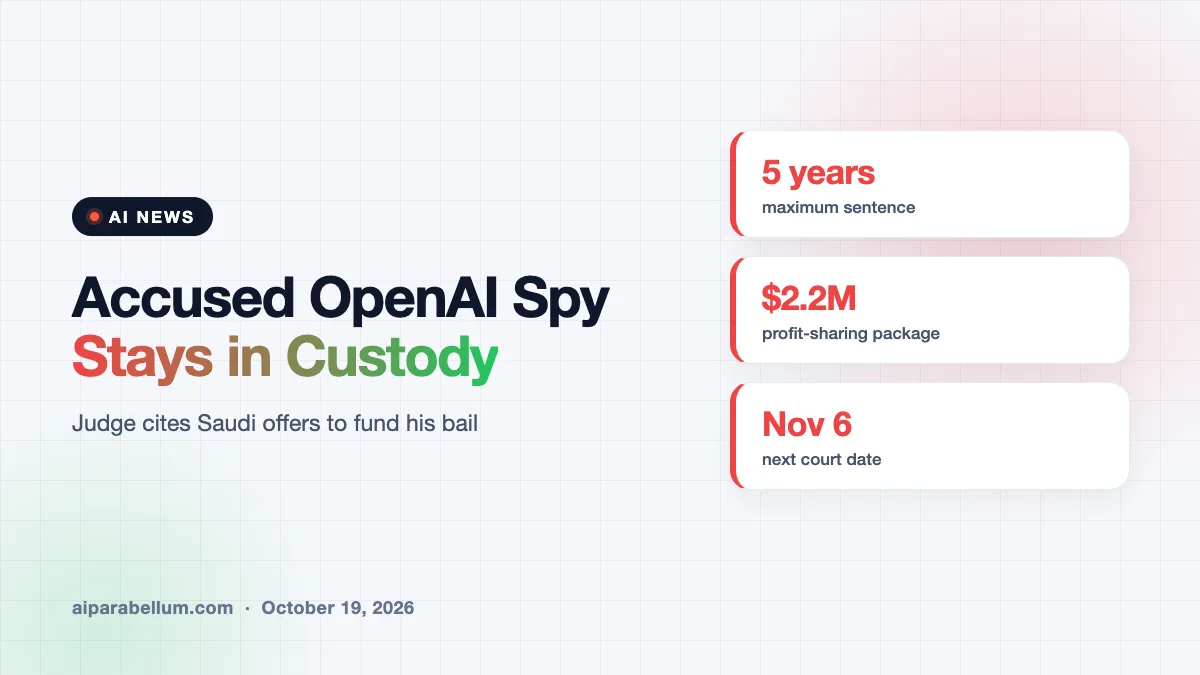
The OpenAI spy case took a new turn on Monday, October 19, when a federal judge in San Francisco ordered former OpenAI engineer Abdulrahman Alfozan to stay in custody until trial. Alfozan is accused of hiding a recording device in an executive conference room at the AI company. The judge said the Saudi government’s offers to help pay for his release made him worry that Alfozan might leave the country and never come back.
Why the Judge Denied Release in the OpenAI Spy Case
Prosecutors argued that Alfozan, 35, is a flight risk. Their main point was that the Saudi Arabian government appeared ready to back him with no strings attached, including an offer from the Saudi consulate to work with a bail bonds firm to fund his release.
Federal magistrate judge Alex Tse was not comfortable with that. He compared a government-backed bond to “a blank check” and said he would rather see family members put up their own assets. Tse also warned that once Alfozan left the US, the case could effectively be over.
Alfozan’s lawyer, William Pernik, called the flight-risk concerns baseless and said there was no evidence his client spied for Saudi Arabia. After the hour-long hearing, Pernik said he was disappointed and would keep fighting the ruling.
The Saudi Connections Prosecutors Raised
Alfozan is a US permanent resident who was on the path to citizenship. Still, prosecutors pointed to several links to his home country in their court filing:
- Frequent WhatsApp messages throughout 2025 and 2026 with an unnamed member of the Saudi royal family.
- An alleged recruiting pitch from that royal for a job on an upcoming Saudi AI initiative, which Alfozan reportedly answered with “100.”
- Past work for a Saudi venture capital firm and consulting for Saudi companies.
- Travel for his wife and infant son back to Saudi Arabia that prosecutors say was arranged with help from Saudi-linked contacts days after his arrest.
His attorneys pushed back on the travel claim. They said his wife needed to leave to renew a US student visa, that a relative booked her flight in a personal capacity, and that she planned to return to California soon. She has not been accused of any wrongdoing.
What Investigators Say Happened at OpenAI
Alfozan worked at OpenAI for just over a year. In late September, the company found a hidden audio recorder tucked behind a TV in a conference room used for confidential executive meetings. OpenAI linked the device to him, fired him in early October, and the FBI arrested him shortly after.
We covered the original recording device arrest when charges were first filed.
According to authorities, the evidence now includes chats with an AI chatbot in which Alfozan allegedly asked for help setting up listening devices. They also cite a photo of him checking behind the TV after the recorder was removed, plus recording-device parts found at his home. OpenAI has said it found a second device in a bag he left unattended at the office.
Nobody knows yet what, if anything, was captured. Authorities say the device’s data was encrypted, and they have not offered a motive.
| Case Detail | What the Record Shows |
|---|---|
| Defendant | Abdulrahman Alfozan, 35, former OpenAI engineer |
| Charge | One count of using a device to intercept communications |
| Maximum sentence | Five years in prison, with more charges possible |
| Custody ruling | Held until trial, decided October 19, 2026 |
| Pay cited by prosecutors | $385,000 salary plus a $2.2 million profit-sharing package |
| Next court date | November 6, 2026 |
The Defense Side of the Story
Pernik argued that the conference room was an open space anyone could use, not a secret spot. He said the electronics found at Alfozan’s home were for personal projects, including an effort to improve a smart litter box for the family cat.
The defense also explained a one-way ticket to Riyadh as normal for Alfozan, who sometimes had to return early for work. The judge was not persuaded enough to grant release.
Why the OpenAI Spy Case Matters Beyond One Company
Insider theft is not new in Silicon Valley, but this case stands out. It mixes alleged hands-on spycraft with international politics at a time when countries are racing to build their own AI programs. Saudi Arabia is among the nations spending heavily on AI, which is why the alleged job offer drew so much attention in court.
It also lands during a tense stretch for OpenAI on the security front. The company is separately fighting with Apple over alleged trade secrets tied to device work. Together, these cases show how valuable inside knowledge at a top AI lab has become.
What This Means for You
You probably do not work in an AI lab’s executive suite, but the lessons apply to almost any workplace that handles sensitive information:
- Physical security still matters. A cheap recorder behind a TV can bypass the best digital defenses.
- Chatbot conversations can become evidence. Prosecutors are citing AI chat logs here, so assume what you type into an assistant may be reviewed later.
- Companies should check meeting rooms regularly and limit who can enter spaces used for confidential talks.
- If your team relies on AI tools daily, it helps to understand basic cybersecurity practices for protecting company data.
For more on how AI is changing workplace risk, see our guide to AI threat detection, and follow our latest AI news for updates as the case moves forward.
Sources
This report draws on courtroom coverage from WIRED and a summary of the prosecution’s filing from The Hindu, which carried Reuters reporting.
Conclusion
Alfozan will remain behind bars while his case moves ahead, after a judge decided that Saudi government support for his bail raised too much risk that he would leave. Prosecutors have painted a picture of close ties to the Saudi royal family, while his lawyers insist there is no proof of spying for anyone. Key questions remain open, including what the hidden device recorded and why it was placed there. The next hearing is set for November 6, and more charges are still possible. For now, the case is a sharp reminder that the race for AI talent and secrets is playing out in courtrooms as well as labs.