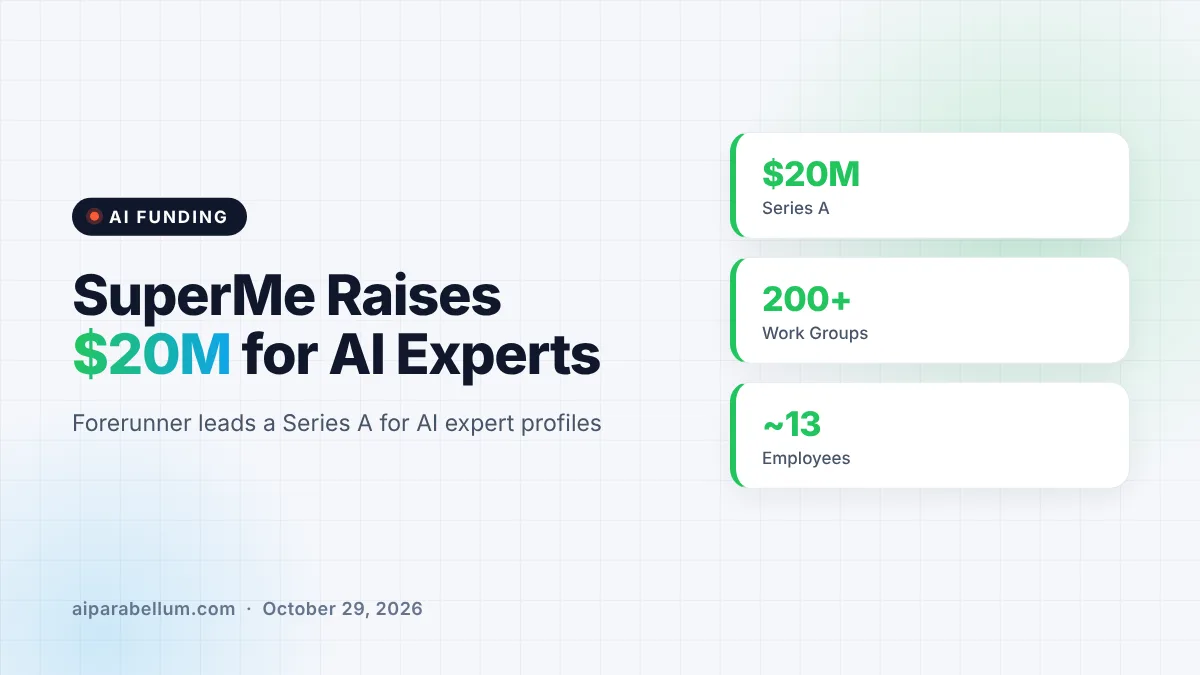
SuperMe, a startup that turns real professionals into AI expert profiles you can chat with, has raised a $20 million Series A. Forerunner’s Kirsten Green led the round, and Greylock Partners joined in. The company says the money will help it add more experts, sharpen how it matches questions to them, and make the network easier to reach from the AI tools people already use.
What SuperMe Announced Today
The funding news landed on October 29, 2026, almost a year after SuperMe first opened to the public. Alongside the raise, the company highlighted two changes it has shipped since launch. You can now pull several expert profiles into one group chat, and you can reach the network from inside Claude, ChatGPT and similar tools.
SuperMe was founded in 2024 by Casey Winters and Ludo Antonov. Winters held executive roles at Grubhub, Pinterest and Eventbrite, while Antonov led engineering teams at startups including Pinterest, Lyft and Whatnot. The team is small, at about 13 people, with offices in San Francisco and Ho Chi Minh City.
| Detail | What We Know |
|---|---|
| Round | $20 million Series A |
| Lead investor | Kirsten Green at Forerunner |
| Other investor | Greylock Partners |
| Founded | 2024, by Casey Winters and Ludo Antonov |
| Team size | About 13 employees |
| Price today | Free, with a question cap and paid tier planned |
How AI Expert Profiles Work
Each SuperMe profile is built from the knowledge of a real person, such as a startup investor or a product leader. When you type a question, the platform decides which experts fit best and opens a group chat with their AI profiles. You can also skip the group and ask one profile directly.
The group chat is the bigger shift. SuperMe says the profiles discuss your problem with each other, so you can see where they agree and where they split. You can watch the back-and-forth live or just read a summary of the main points at the end.
Where the Knowledge Comes From
To build a profile, SuperMe scans public material like LinkedIn posts, YouTube videos, Substack articles, blogs and podcast appearances. Experts can also connect work apps such as Google Drive, Notion, Gmail and the Granola meeting notetaker. The company admits some of this data includes personal details and trade secrets, but says it keeps that private context out of answers.
That promise matters a lot here. A profile is only useful if it shares real lessons, yet it must not leak what an expert’s old employer would want kept quiet.
Using AI Expert Profiles Inside Claude and ChatGPT
SuperMe supports MCP, the Model Context Protocol, which is a common standard that lets chatbots plug into outside tools and data. In practice, that means you can be mid-conversation in Claude AI or ChatGPT itself and ask SuperMe for advice from operators who faced a similar call. You keep all the context you already built up instead of pasting it somewhere new.
The company gave a few sample uses on its own blog:
- Reading the results of a product test that improved some numbers and hurt others
- Comparing two job offers and deciding what to negotiate
- Planning a new feature before handing it to a coding agent
- Stress-testing a startup pitch deck before meeting investors
Users have also set up more than 200 “Work Groups,” which are saved lists of trusted experts on a topic. This fits a wider trend of AI agents connecting to outside services rather than living in one app.
Why Investors Are Betting on Expert Networks
Winters described the idea as opening up the hidden networks in Silicon Valley, where the best people for niche skills are known only to insiders. The pitch to experts is that their knowledge can earn them recognition without more calls or social posts. SuperMe calls this a “passive engine” for reputation, since people who find a profile helpful can reach out to the real person about jobs or projects.
Green, the lead investor, told reporters the timing is right because there will be many lessons to share as people learn to work alongside AI. For context, other recent rounds like Suki’s $90M raise show investors are still putting real money behind AI products that act on behalf of people.
Open Questions
The service is free right now. SuperMe plans to limit how many questions you can ask before you have to pay, and it is still working out how to reward experts for adding more knowledge. How it handles accuracy, and whether an AI profile truly reflects what a person would say, will shape how much users trust it.
What This Means for You
If you often wish you could ask a seasoned founder or hiring manager a quick question, this is the kind of tool built for you. Here is how to approach it:
- Treat answers as a starting point, not final advice, since an AI profile is not the person.
- Try a group chat on decisions with real tradeoffs, where seeing disagreement helps most.
- If you use Claude or ChatGPT for work, the MCP link can save you from re-explaining your situation.
- If you are an expert, check what data you connect and what your profile is allowed to share.
You can browse more AI business tools or catch up on the latest AI news updates to see how this fits the bigger picture.
Sources
Primary source: SuperMe’s Series A announcement. Additional reporting from TechCrunch.
Conclusion
SuperMe’s $20 million Series A gives a small team room to grow a different kind of professional network, one where you talk to AI versions of experienced people. The group chat feature and MCP support inside Claude and ChatGPT are smart moves that meet users where they already work. The big tests ahead are trust and pricing: whether these profiles give advice that holds up, and whether people will pay once the free questions run out. If SuperMe gets those right, asking an expert could become as easy as opening a chat window.