
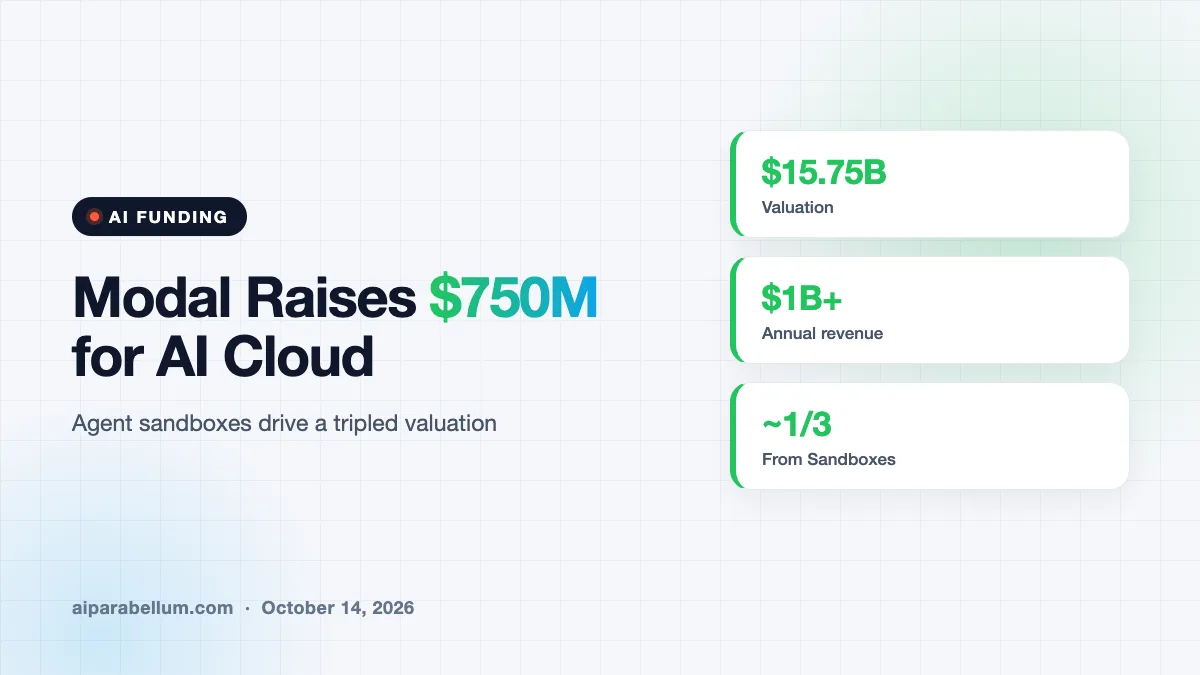
Modal, a startup that rents out cloud computing built for AI work, has raised $750 million in new funding at a $15.75 billion valuation. That AI cloud valuation is more than three times what the company was worth after its last round in May. The jump comes as more companies need safe, fast places to run AI agents and the code those agents write.
Inside the $750M Series D
Accel led the Series D round, and Kleiner Perkins joined the deal. About six of Modal’s existing investors also put in more money.
The company says its annualized revenue has more than tripled since May and now tops $1 billion. In other words, Modal is growing about as fast as its valuation, which is not always true of hot AI startups.
| Detail | What we know |
|---|---|
| Amount raised | $750 million (Series D) |
| Lead investor | Accel |
| Other backers | Kleiner Perkins plus about six existing investors |
| New valuation | $15.75 billion |
| Change since May | More than triple |
| Annualized revenue | Over $1 billion, per the company |
What the AI Cloud Startup Actually Sells
Modal does not own its own data centers. Instead, it rents hardware from more than 20 cloud providers and packages it into simpler services for developers. If one of those clouds has trouble, customer jobs can keep running on the others.
Sandboxes for AI Agents
Nearly a third of Modal’s revenue comes from a product called Sandboxes. These are hosted containers, which are small, walled-off computing spaces where an AI agent can run code without touching anything else.
Modal says its system can start tens of thousands of these containers every second. In a recent internal test, the company says it ran one million containers at the same time.
A few features stand out for teams building AI agent tools:
- Sidecars: helper containers, such as a hallucination filter, run on the same server as the agent to cut delays.
- Secret Injection: agents can log in to outside apps without ever seeing the actual passwords.
- Fast scaling: a custom scheduler spreads startup requests across many servers at once.
Training and Inference Services
Beyond sandboxes, Modal lets developers spin up clusters of graphics chips for model training with fairly short scripts. Its Endpoints service hosts AI models so apps can call them, and customers can pick from a library of open-source models if they don’t want to build their own.
The company plans to spend part of the new money on tools for reinforcement learning and post-training. Those are the later stages of building a model, where developers improve its reasoning, safety, and cost.
Why AI Cloud Demand Is Surging
The big story here is AI agents. When an agent writes and runs code, it needs an isolated space so a bad command or a rogue action cannot damage real systems. That safety need is turning sandboxes into a fast-growing business.
Security worries around agents are also driving other recent deals, such as the funding for Pluto Security and Harmonic Security. Investors appear to be betting that agents will move from demos into everyday company work.
Every AI agent that writes code needs somewhere safe to run it. Modal is betting that renting out those safe spaces will be as big a business as renting out the chips themselves.
What This Means for You
Most people will never log in to Modal directly. But the apps and assistants you use may run on it, and growth like this tends to make AI features cheaper and quicker to launch.
- If you build with AI, compare sandbox and inference pricing across several providers before you commit.
- Run any agent that writes code in an isolated space, never on your main machine or servers.
- Keep agents away from raw passwords and keys; use tools that pass credentials without exposing them.
- Watch for multi-cloud setups, which can keep your app running when one provider goes down.
If you are just getting started, our guide to developer AI tools is a good place to look. You can also see how agents are replacing older integration software, and the hardware side of this trend in local AI agents. For more updates, browse the latest AI news.
Sources
This article is based on reporting from SiliconANGLE, which covered the funding round, Modal’s revenue figures, and details of its Sandboxes, training, and Endpoints services.
Conclusion
Modal’s $750 million raise at a $15.75 billion valuation shows how much money is flowing into the plumbing behind AI agents. The company says revenue has passed $1 billion a year, with sandboxes for agent code making up nearly a third of it. Next, it plans to add tools for reinforcement learning and post-training. For developers and businesses, the takeaway is simple: running agents safely is becoming its own industry, and the options for doing it well are growing fast.
