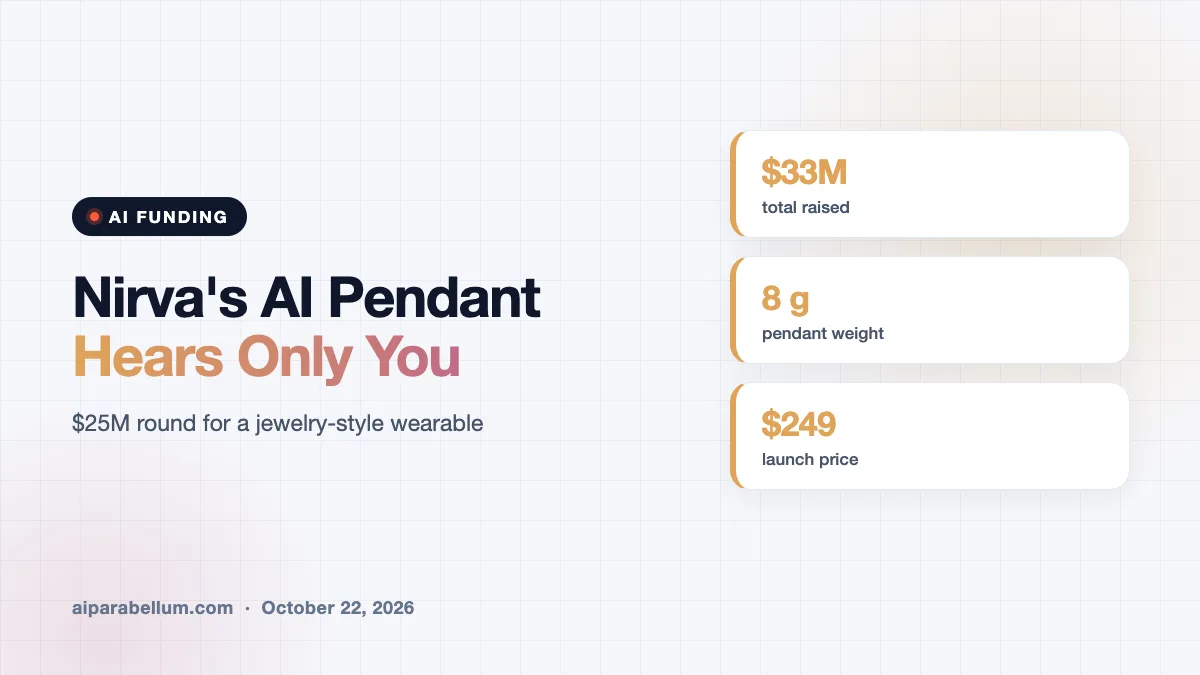
Nirva, a young startup building an AI pendant that listens only to the person wearing it, announced a new $25 million pre-Series A round on October 22, 2026. The fresh money adds to an $8 million raise from earlier this year and brings the company’s total funding to $33 million. The Nirva AI pendant is set to open for orders in November at $249.
What the Nirva AI Pendant Actually Does
The device is a small piece of jewelry that weighs about eight grams. You can wear it as a pendant or switch it to a bracelet, and the battery lasts up to three days on one charge. It is always on, quietly picking up your own speech through the day.
That last part is the twist. Most ambient gadgets record everything around you, much like a meeting recorder. Nirva says its device keeps only the wearer’s voice and filters out the people nearby.
How it learns your voice
During setup, you record short samples of your voice. The pendant uses those samples to build a model of how you sound, and it uses that model to ignore everyone else in the room. The company says it then builds an ongoing picture of you from what you say.
Funding Details and the Team Behind Nirva
Here is a quick look at the numbers and key facts reported so far.
| Detail | What we know |
|---|---|
| New round | $25 million pre-Series A |
| Earlier funding | $8 million, from investors including Lightspeed and South Park Commons |
| Total raised | $33 million |
| Founded | 2025 |
| Price | $249 |
| Weight and battery | About 8 grams, up to 3 days per charge |
| Timing | Orders open in November, early shipments by end of 2026 |
The founders are Wei Lyu and Jason Chen, who both worked at Meta Reality Labs, and Hanying Hu, who previously started a fashion and jewelry brand. That mix explains the pitch: a wearable that looks like jewelry first and a gadget second. Lyu, the CEO, says the company plans to release more devices over time.
Privacy Is the Big Selling Point
Always-on recording makes a lot of people uneasy, and smart glasses have only raised those worries for bystanders. Nirva’s answer is to record only the wearer, so friends and coworkers are not captured. That is a different promise from most AI meeting notes tools, which aim to capture everyone.
The company also says that, by default, it does not keep audio or transcripts after it processes a conversation. Before the audio is thrown away, it measures tone, pitch, volume and speaking speed. Those signals feed the emotional insights shown in the app.
Our take: filtering out bystanders is a smart answer to the creepiness problem, but you still have to trust the company’s default settings and its data handling.
Insights Instead of To-Do Lists
Nirva calls itself a personal insights company rather than a productivity tool. Its companion app looks at your speech and suggests patterns about your mood, your communication style, the people you spend time with and the places you visit. It also surfaces reminders and action items.
Lyu shared one example with reporters: the app once nudged her to thank her mother for something she had forgotten. The goal, the company says, is to help people understand themselves better and show up for others. That puts it closer to an AI companion app than a note taker.
A crowded ambient AI market
Nirva is entering a busy field. Several companies are chasing the same idea of an always-listening helper:
- Amazon’s Bee, which just launched a new wrist-worn device in its AI wearables lineup
- Ambi, an always-listening assistant startup led by a former Plaud executive
- Taya, a jewelry-focused wearable from former Apple employees
- Friend, another startup building a companion gadget
Apple also added Voice Intelligence features with its September iPhone launch, so the big platforms are moving into the same space.
What This Means for You
If you are curious about ambient AI but hate the idea of recording other people, Nirva is one of the first products built around that concern. Still, it has not shipped yet, so there are no independent reviews of how well the voice filter works.
- Wait for hands-on reviews before preordering, especially to test how reliably it ignores other voices.
- Check the default privacy settings and what data, if any, leaves the device.
- Think about whether you want insights about your mood, or a plain personal AI assistant for tasks.
- Read up on privacy protection methods so you know what questions to ask any always-on device maker.
For more stories like this, browse our latest AI news coverage.
Sources
Funding details and company comments come from TechCrunch.
Conclusion
Nirva’s $25 million round gives the startup a total of $33 million to bring its eight-gram AI pendant to market. Its main idea is simple: listen only to the wearer and throw away the audio after analysis. That could ease some of the privacy fears that follow always-on gadgets. Orders open in November at $249, with early units due by year end. Whether the voice filter and insights hold up in daily life is the real test still ahead.