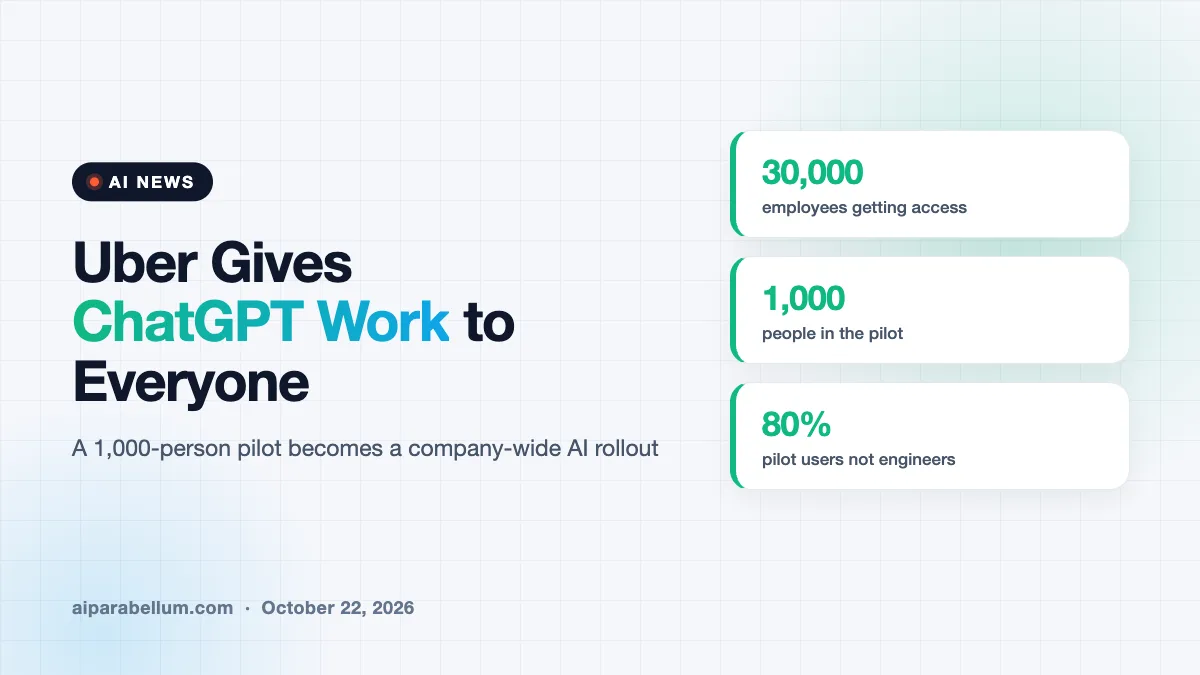
Uber is giving ChatGPT Work to every one of its roughly 30,000 employees worldwide, turning a small internal pilot into a company-wide rollout. The move comes as Uber and OpenAI expand their partnership, which also covers an AI assistant for drivers and a new way to book rides by voice.
For anyone watching how big companies adopt AI, this is a useful signal. Uber isn’t limiting the tool to engineers, and it hasn’t locked in a single plan for how people should use it.
How the Uber ChatGPT Work Rollout Came Together
ChatGPT Work is OpenAI’s enterprise-focused AI agent, introduced in July so corporate teams could hand it everyday workflows. Uber first tested it with about 1,000 employees earlier this year. It has now scaled that pilot to the whole company.
The pilot group came from across the business, including finance, operations and product. Uber’s VP of engineering, Sumanth Sukumar, told TechCrunch that around 80% of those early users were not engineers.
According to Sukumar, pilot users leaned on the agent for a few common jobs:
- Digging into complex operations data to spot trends and suggest next steps
- Localizing training materials for different markets and languages
- Building personal, interactive dashboards to manage daily work
Room to experiment, not a fixed playbook
Uber says its approach is to put strong AI tools in front of everyone and let teams figure out what works. Earlier this year, it paired 30 AI engineers with teams across the company and gave them two weeks to automate key parts of their jobs. Those “AI pods” showed leadership how much value appears when technical skill meets deep knowledge of a specific role.
The company did not share what the rollout costs. Instead, it plans to watch how employees use ChatGPT Work, which workflows they build and whether it helps them work better, then use those results to guide future AI spending.
Beyond the Office: AI for Drivers and Riders
The partnership reaches well past internal productivity. OpenAI describes how Uber uses its models to power Uber Assistant, a helper for drivers and couriers. It turns earnings trends and demand heatmaps into simple advice about where and when to drive.
Drivers can ask follow-up questions in plain language, such as whether an airport run is worth it right now. Uber says the assistant helps new drivers ramp up much faster than learning through hundreds of trips. Experienced drivers also kept coming back to it, which suggests it is more than an onboarding tool.
Under the hood, Uber built a multi-agent system that routes each request to the best-suited model. Smaller, faster models handle quick classification, while larger reasoning models take on harder questions. An internal layer called AI Guard screens prompts and answers for safety, privacy and policy compliance.
Booking a ride by voice
Uber is also using OpenAI’s Realtime API for voice. Riders can tap a microphone icon in the “where to” search bar and describe a trip in natural speech, such as a large group heading to the airport with lots of luggage. The system can then suggest a fitting option, like a bigger vehicle, and recognize saved places like “home.”
OpenAI notes that voice booking is rolling out over the coming weeks. Uber Assistant is in an experimental rollout across the US driver network, with hundreds of thousands of drivers now able to try beta versions.
Uber ChatGPT Work and Partnership at a Glance
| Piece of the deal | Who it serves | Status |
|---|---|---|
| ChatGPT Work | All 30,000 or so Uber employees | Expanding from a 1,000-person pilot to the whole company |
| Uber Assistant | Drivers and couriers | Beta for hundreds of thousands of US drivers |
| Voice booking | Riders | Rolling out over the coming weeks |
| AI Guard | Internal safety layer | Screens prompts and responses |
Why This Matters in the Enterprise AI Race
OpenAI has been pushing hard to grow its business customer base as it competes with Anthropic for corporate deals. A company-wide deployment at a global brand like Uber is the kind of reference customer that helps win more contracts. If you want to see how the main assistants compare, our assistant comparison guide breaks down the differences.
The heavy share of non-engineers in the pilot also stands out. It suggests the biggest gains may come from finance, operations and training teams, not just developers. That lines up with a broader shift toward AI agents handling routine business workflows.
What This Means for You
Whether you run a team or just use AI at work, Uber’s playbook offers a few practical lessons:
- Start with a mixed pilot. Uber’s test group spanned many departments, which revealed uses engineers alone might have missed.
- Measure before you mandate. Uber plans to track real workflows and outcomes instead of forcing one way of working.
- Pair experts with domain teams. The “AI pods” approach shows how a short sprint can uncover quick wins.
- Build guardrails early. A screening layer like AI Guard helps keep answers accurate and on-policy.
If you are weighing tools for your own company, our roundup of AI business tools is a good place to start. You can also explore what ChatGPT can do today and follow more stories on our AI news page.
Takeaway: Uber is betting that giving everyone the same AI tool, then studying what they build, beats handing out a rigid plan.
Sources
Primary source: OpenAI’s Uber partnership story. Additional reporting from TechCrunch.
Conclusion
Uber’s decision to put ChatGPT Work in the hands of all 30,000 employees moves its OpenAI partnership from a pilot to a core part of how the company operates. Alongside Uber Assistant for drivers and upcoming voice booking for riders, it shows AI spreading across both the office and the app. The company has not shared costs, and it says it will judge success by how people actually use the tool. For other businesses, the lesson is simple: test broadly, measure honestly and let real workflows guide the next step.