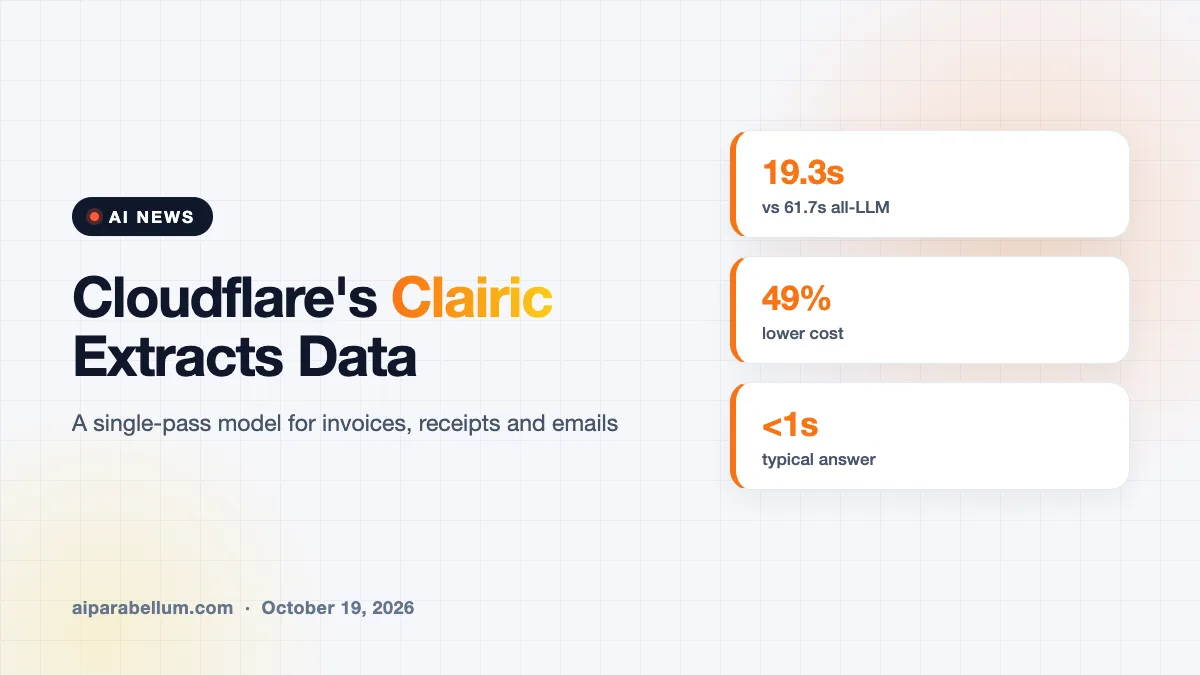
Cloudflare has launched Clairic, a new AI model built to pull exact values like order numbers, dates and dollar totals out of emails, receipts and other messy documents. The Cloudflare Clairic model is in preview on Workers AI now, and the company says open weights will follow soon. Its pitch is simple: for this kind of job, a small single-pass model can beat a big chatbot on speed, cost and reliability.
What Cloudflare Clairic Actually Does
You send Clairic a piece of text, plus up to four optional images, and a list of fields you want filled in. Each field gets a name, a type and an optional plain-language hint. The model then returns one typed answer per field, such as a number with two decimals, an ISO date or an exact span of text with its position in the source.
Every answer comes with a confidence score and a “p_null” value, which is the odds that the information simply isn’t there. If a field is missing, Clairic returns null instead of making something up. That makes it easier to decide which results you can trust and which need a human check.
Cloudflare groups the outputs into four kinds:
- Extracted values: text copied straight from the input, like a customer name or order ID.
- Computed values: numbers, dates and durations worked out from the input, such as price plus tax.
- Estimated values: figures the text doesn’t state but hints at, returned as a range with a median and an 80% interval.
- Forecasted values: next steps in a time series, each with its own 80% interval.
Why a Single-Pass Model Is Different
Chatbots write answers one token at a time, which costs money and opens the door to typos, broken JSON or invented numbers. Clairic skips that step entirely. It reads the input in one forward pass and fills every field at once, so asking for thirty fields costs about the same as asking for three.
Cloudflare calls this a “System One” model, borrowing the fast-thinking idea from Daniel Kahneman’s book. It only charges for input tokens, and the company says it usually answers in under a second. Clairic joins Clef, an earlier Cloudflare decision model that picks among fixed options and gives a probability for each.
The big idea here is division of labor: let small, fast models handle the facts and the choices, and save the chatbot for writing words.
Clairic vs. an All-LLM Pipeline
To show how the pieces fit, Cloudflare ran a damaged-product support email through two setups. In one, Clairic pulled out the facts, Clef chose between a refund and a repair, and the GLM-5.3 language model wrote the reply. In the other, GLM-5.3 did all three steps on its own.
| Measure | Clairic + Clef + LLM | LLM Only (GLM-5.3) |
|---|---|---|
| Total time | 19.3 seconds | 61.7 seconds |
| Extraction and decision time | Under 1 second combined | About 38 seconds |
| Cost | About 49% lower | Baseline |
| Repair estimate across runs | Identical every time | Changed each run |
Cloudflare says both setups got the facts and the final decision right with GLM-5.3. The difference was speed, cost and consistency. These are the company’s own test results, so treat them as a vendor benchmark until outside testers weigh in.
Where the Cloudflare Clairic Preview Falls Short
Cloudflare is upfront that this is an early checkpoint. One- and two-step math like totals, differences and date gaps looks reliable, but longer chains of calculations are not. The company’s advice is to let Clairic grab the values and let your own code do the heavy math.
Estimates also need real evidence in the input, like comparable sales or history. Forecasting is basic and not meant to replace a dedicated time-series model. In a 21-day test on public airport screening counts, Cloudflare says Clairic was off by 3.3% on average, with most misses landing on a holiday weekend the data didn’t flag.
What This Means for You
If you build apps or automations that read invoices, receipts or support emails, this is worth a look. Many teams lean on a large chatbot for data entry work, then wrap it in retries and validation to catch errors. A purpose-built extractor could cut that cost and complexity, much like tools such as a document checker aim to tame paperwork.
Here are a few practical points to keep in mind:
- Start with simple fields like totals, dates and IDs, where Cloudflare says the model is strongest.
- Use the confidence scores and null results to route shaky answers to a person.
- Keep multi-step math in your own code for now.
- Watch for the open-weights release if you want to run it outside Cloudflare.
For teams building AI agent workflows, the bigger trend is clear. Instead of one giant model doing everything, we’re seeing stacks of small specialist models feeding a chatbot cleaner inputs. That approach shows up in data analytics tools and in customer support agents alike.
Cloudflare also notes a security upside. In its demo, the language model never sees the raw customer email, only a short summary of typed values. That leaves less room for prompt injection hidden inside incoming messages.
Sources
Primary source: Cloudflare’s Clairic announcement. Additional reporting from The Decoder. For more launches like this, browse our latest AI news.
Conclusion
Clairic is a small but telling launch. Cloudflare is betting that a lot of everyday AI work, like reading invoices and support emails, doesn’t need a chatbot at all, just a fast model that returns clean, typed answers with honest confidence scores. The preview has clear limits on math and forecasting, and the speed and cost numbers come from Cloudflare’s own tests. Still, if open weights arrive as promised, developers will have a cheap new building block for document-heavy automation.