
AI can save time when writing a blog post, but a fast first draft does not tell you how much sooner the finished article will be ready. Your actual AI writing time savings depend on research, editing, fact-checking, images, and publishing—not just how quickly words appear.
A useful answer starts with two different findings: a writing experiment reported a 40% reduction in task time, while a blogging survey showed a 24-minute difference between AI users and nonusers. Neither number guarantees your results, but both help put dramatic productivity claims in perspective.
What Research Says About AI Writing Time Savings
You need to separate controlled writing tasks from the full process of producing a blog post. You also need to distinguish an experiment from a survey, which can reveal a pattern without proving what caused it.
A Writing Experiment Found 40% Less Task Time
In a 2023 experiment by Shakked Noy and Whitney Zhang, access to an AI chatbot reduced the time spent on professional writing tasks by 40%. Independent evaluators also rated output quality 18% higher, according to MIT’s study summary.
The assignments were short workplace tasks, such as emails and cover letters, rather than complete blog posts. They did not require the same factual accuracy or company-specific context that your article may need.
As Noy explains, real-world gains may be smaller because “you need to spend time fact-checking and writing the prompts.” Treat the finding as evidence of potential, rather than a promise that your publishing process will shrink by 40%.
A Blogging Survey Showed a 24-Minute Difference
Orbit Media’s 2025 content-marketing research reported average article-writing times of 3 hours 48 minutes without AI and 3 hours 24 minutes with AI. That is a 24-minute gap, or about 10.5% less time compared with the non-AI group.
This comparison used survey responses, not random assignment to identical blog tasks. Differences in experience, article complexity, and working habits could also affect the result, so you cannot attribute the entire gap to AI.
Keep the date in view, too: these are 2025 survey figures, not a live benchmark for every current writing tool. Your own measured workflow is a better planning tool than either a survey average or a product demonstration.
Why a Five-Minute Draft Is Not a Five-Minute Blog Post
A generated draft still needs a purpose, evidence, and a reason for someone to read it. You may spend longer fixing weak arguments than you would have spent writing a clear explanation from your own notes.
Track these stages separately when evaluating writing assistants:
- Choosing the angle and understanding the reader’s question.
- Finding reliable sources and gathering original examples.
- Creating the brief, outline, and draft.
- Checking facts and editing for accuracy, structure, and voice.
- Preparing images, internal links, metadata, and the published layout.
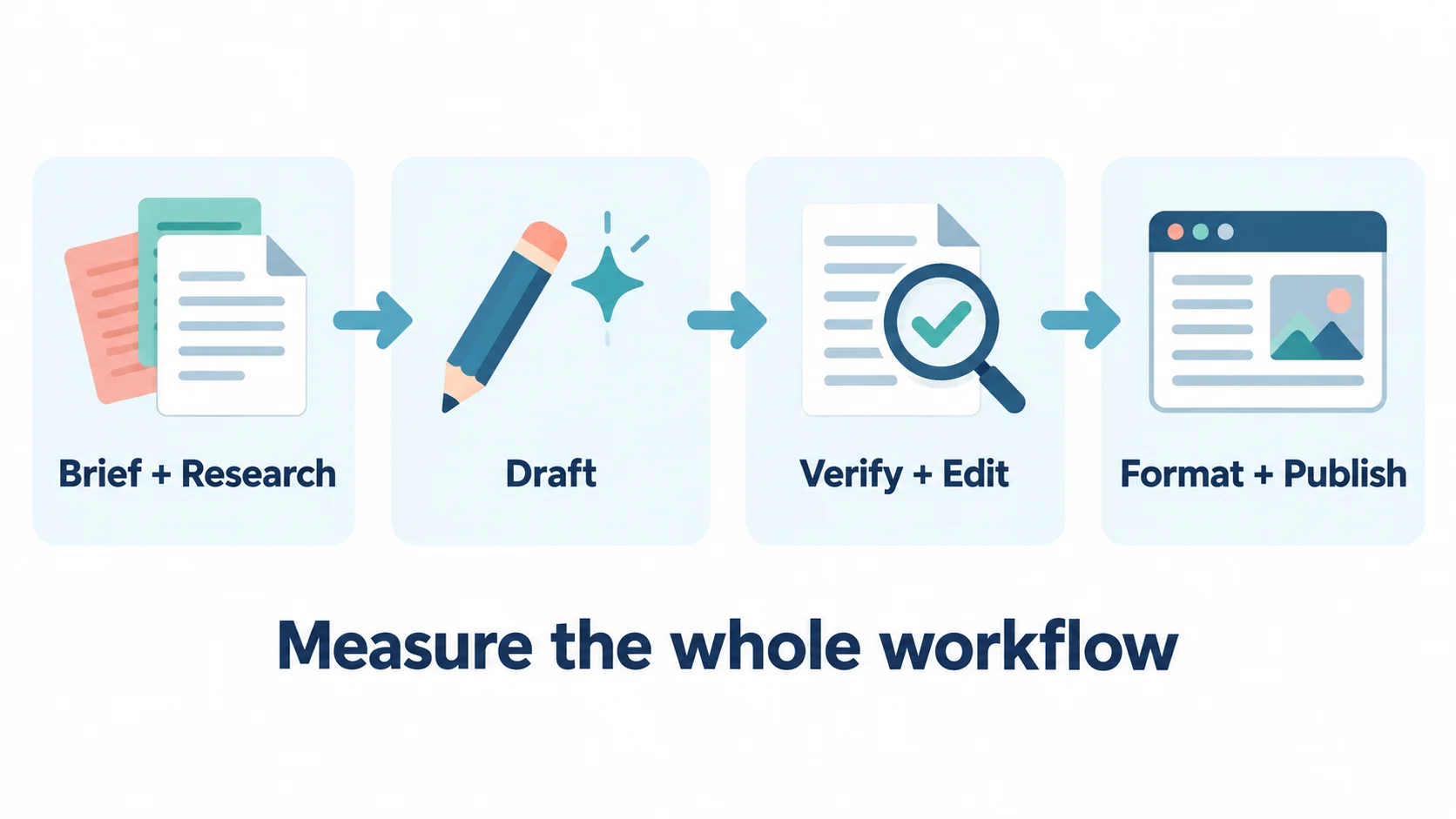
Separate hands-on time from elapsed time. You might spend 90 minutes actively working on an article that takes two days to finish because you are waiting for an interview response or approval.
If you improve the drafting stage but leave a long approval queue unchanged, the post may reach publication no sooner. Record both measures when turnaround time matters.
A Realistic Example of Blog Writing Time With AI
The table below is an illustrative budget for a roughly 1,500-word educational post on a familiar topic. These numbers are planning assumptions, not measured results or industry averages; replace them with your own timings.
| Task | Without AI | With AI assistance | Difference |
|---|---|---|---|
| Research and source collection | 45 minutes | 40 minutes | 5 minutes saved |
| Brief and outline | 20 minutes | 15 minutes | 5 minutes saved |
| First draft, including prompts and retries | 70 minutes | 30 minutes | 40 minutes saved |
| Fact-checking | 20 minutes | 30 minutes | 10 minutes added |
| Editing and original examples | 35 minutes | 30 minutes | 5 minutes saved |
| Images, SEO fields, and publishing | 30 minutes | 30 minutes | No change |
| Total | 220 minutes | 175 minutes | 45 minutes saved |
In this example, drafting becomes about 57% quicker, but the full workflow becomes only about 20% quicker. Additional fact-checking uses up some of the drafting gain.
The formula is simple: time saved equals your non-AI total minus your AI-assisted total. Divide the saved minutes by your non-AI total and multiply by 100 to calculate the percentage reduction.
If you finish eight comparable posts per month and save 45 minutes on each, that would free up six hours. It is a conditional calculation, not a prediction of what you will achieve.
Where AI Can Save You the Most Writing Time
Turning Good Notes Into an Outline
You can give AI a clear question, approved source notes, and the points you need to cover. Asking it to organize that material is easier to review than asking it to invent an entire article from a broad keyword.
Use content brainstorming to explore a few angles, then choose one before drafting. Generating dozens of alternatives creates another selection task.
Drafting Familiar, Repeatable Sections
Short definitions, transitions, and explanations based on supplied facts are useful places to test assistance. Keep original opinions, firsthand observations, and customer examples grounded in material you actually have.
Draft one section first and check the direction before expanding. If the opening misses your reader’s problem, producing another thousand words rarely fixes that mismatch.
Handling Focused Editing and Metadata
Ask for specific changes, such as removing repeated points or shortening an unclear paragraph. Strong prompt writing makes the review manageable because you know what should have changed.
You can also request a few title and meta description options after the article is complete. Check that the chosen wording accurately represents the page and fits your site’s length requirements.
When AI Can Make a Blog Post Take Longer
Your savings can disappear when the draft sounds plausible but requires extensive repair. A factual error hidden inside a polished paragraph can take longer to detect than an obvious gap in your notes.
- Unfamiliar subjects: you need extra research to judge whether the explanation is correct.
- Original reporting: interviews, testing, and collecting evidence still take time.
- Current comparisons: prices, specifications, and availability need direct verification.
- Distinctive voice: repeated rewrites may flatten the style you wanted to preserve.
- Unclear instructions: an undefined audience produces material you later discard.
Set a practical stopping rule: after two unsuccessful revisions of a short section, consider rewriting it yourself. That is a workflow choice, not a research-backed threshold, but it can prevent an endless prompt-and-repair loop.
Fix recurring style issues in your brief, including overused em dashes or stock introductions. Correcting the same pattern in every paragraph wastes the time you hoped to save.
How to Measure Your Actual AI Writing Time Savings
Run a small personal comparison before changing your publishing targets. Use several posts with similar length, topic difficulty, and research requirements so one unusually easy assignment does not decide the result.
- Define “finished”: sources checked, examples included, images ready, links working, and layout reviewed.
- Record your usual process on several posts without AI assistance.
- Use assistance on several comparable posts and alternate the workflows where practical.
- Log prompting, retries, verification, editing, and publishing as separate tasks.
- Compare median total times and note any differences in errors or revision requests.
Avoid drafting the same article manually and then with AI for your main comparison. The second attempt benefits from research and decisions you already made, which makes the result harder to interpret.
Track one-time setup separately, including your style guide and reusable prompt. For example, 60 minutes of setup spread across ten articles adds six minutes to the cost of each article.
A spreadsheet or timer is enough; you do not need several new productivity tools to run the test. Keep the measurement process simple enough to maintain.
A Short Prompt for a Faster, Easier-to-Check Draft
Use this after you have gathered your sources and chosen the angle. Replace the brackets with actual information, and save the brief if it works well.
Help draft a blog post for [audience] answering [specific question].
Use only the facts and examples in these approved notes: [notes].
Follow this outline: [outline].
Match these voice examples: [short examples].
Use US English and short paragraphs.
Do not invent statistics, quotations, links, or firsthand experience.
Mark missing evidence as SOURCE NEEDED.
Draft one section first. List unsupported claims separately.
Wait for feedback before continuing.
Open the original sources yourself when checking the output. Asking the same tool whether its answer is accurate does not replace verification.
Conclusion
AI can reduce blog writing time, but your real saving is the difference between two equally finished, equally useful articles. Measure the entire workflow, include cleanup and setup, and keep research findings separate from personal estimates. Start with outlines, controlled drafting, and focused edits, then expand assistance where your own time log shows a benefit.