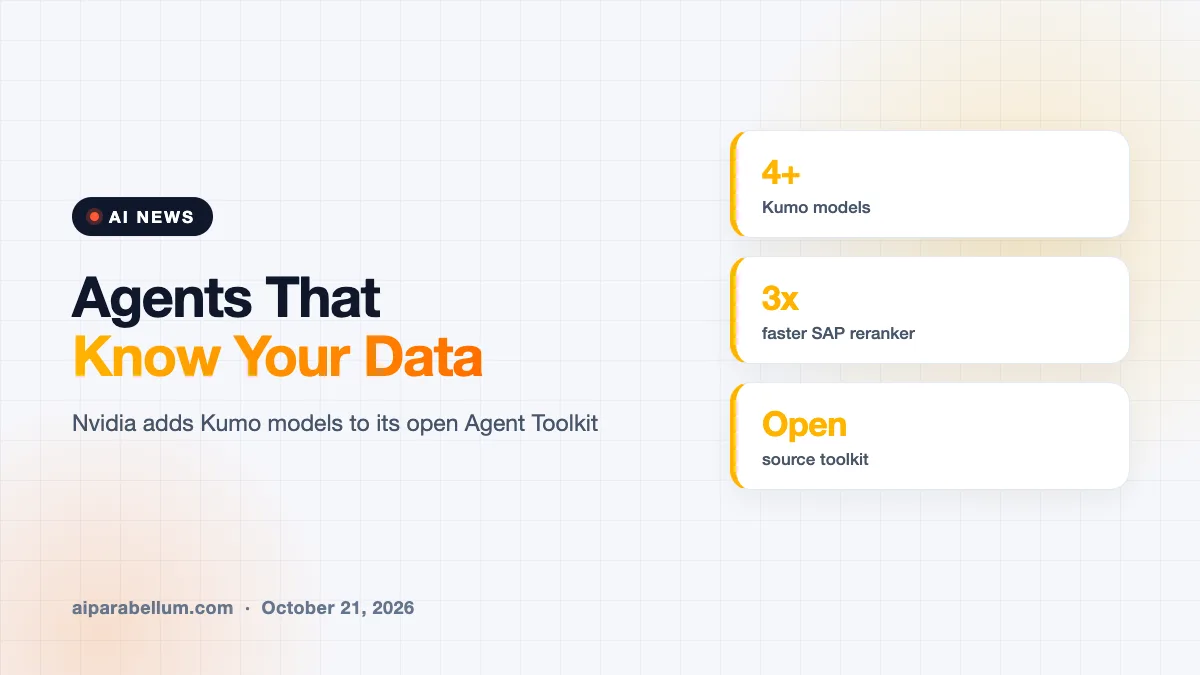
An AI agent is only as good as what it knows about your company. That is the idea behind Nvidia’s latest expansion of its open source Nvidia Agent Toolkit, which adds a new Agent Knowledge Foundation, a family of Kumo models and fresh tools to help enterprise agents pull answers from company data.
The update landed at GTC Berlin alongside a wave of other Nvidia news. Big names like Palantir, Databricks, Snowflake, SAP and ServiceNow are already using pieces of it.
What Is New in the Nvidia Agent Toolkit
The toolkit is Nvidia’s open stack for building agents, covering models, the harness that runs them, the runtime and the data tools. This release focuses on the data side. Nvidia grouped the additions into three buckets:
- Agent Knowledge Foundation, built on Nvidia’s CUDA-X data libraries
- Open models, including Nemotron Retriever and the new Kumo family
- Tools and skills such as NeMo Relay and NeMo Compass
It also leans on OpenShell, Nvidia’s secure runtime that limits what agents can touch. A new NemoClaw blueprint gives builders a step-by-step starting point for making agents better at their jobs over time.
Turning raw data into business concepts
The standout piece is a new library called Auto-Ontology. It takes messy company data and maps it to familiar ideas like customers, products and orders, then shows how they connect. Nvidia says companies can use the foundation without moving data, rebuilding workflows or changing their governance rules.
Meet the Kumo Models for Enterprise Agents
Kumo is a family of open structured-data models. Instead of reading paragraphs, they work with tables, linked records and time-based data, which is where most business facts actually live.
| Model | What it helps agents do |
|---|---|
| Kumo Tabular | Work with spreadsheet-style data |
| Kumo Relational | Reason across linked database tables |
| Kumo Time Series | Read patterns in data over time |
| Kumo Forecast | Make predictions from past trends |
| Nemotron Retriever | Find the right documents faster and more accurately |
Nvidia also mentions a Kumo Anomaly model, which Databricks pairs with its Genie Ontology to power context-aware agents.
Who Is Already Using the Nvidia Agent Toolkit
Nvidia shared several early results, all company-reported. Nvidia’s own supply chain team uses the foundation through Palantir Foundry and AIP to predict outcomes from internal data. Snowflake is letting customers run the Kumo Engine and Kumo Relational models inside Snowflake Notebooks.
On the search side, Nvidia says SAP’s fine-tuned reranker ran nearly 3x faster with Nemotron Retriever, while ServiceNow improved reranking quality and cut latency by nearly a quarter. Amazon OpenSearch Service reportedly improved relevance with fewer search steps, and Zoom is using the models for document search in its AI services.
The next race in enterprise AI is less about smarter chat and more about agents that truly understand the data a company already has.
Other names building on the foundation include AWS, ClickHouse, Cloudera, Dell, Elastic, IBM, NetApp, Oracle, Perplexity and VAST Data. That is a broad mix of data platforms, which suggests Nvidia wants Kumo to become a standard layer.
What This Means for You
If your team is building or buying agents, this update points to a few practical steps:
- Check whether your data platform already supports Kumo or Nemotron Retriever. Databricks and Snowflake users may have the easiest start.
- Focus on clean data relationships. Tools like Auto-Ontology only work well when your records link up correctly.
- Pair data access with clear limits. Grounding agents in company data makes them more useful, but also more sensitive, so see our coverage of new agent security tools.
- Test speed claims on your own workloads before you commit.
This fits a wider push to give agents lasting context, like Databricks agent memory, which we covered this week. For more options, browse our data analysis tools or catch up on the latest AI news.
Sources
Primary source: Nvidia’s Agent Toolkit announcement.
Conclusion
Nvidia’s expanded Agent Toolkit is a bet that the most useful agents will be the ones that understand a company’s own data. The Agent Knowledge Foundation, the Auto-Ontology library and the Kumo models aim to turn tables and records into something agents can reason over. Early users like Palantir, Databricks, Snowflake, SAP and ServiceNow give the effort real weight, though the performance numbers come from Nvidia and its partners. Because the toolkit is open source, teams can try it without a big upfront commitment. If you are serious about business agents, this is worth a close look.