Nvidia has launched Nvidia Minerva, a new AIOps platform that watches over the huge GPU clusters the company calls AI factories. It pulls in signals from hardware and AI jobs, then uses its own AI models to spot trouble early and point operators to the likely cause. The goal is simple: keep expensive GPUs busy doing useful work instead of sitting idle while engineers hunt for a broken part.
Why AI Factories Need Better Monitoring
Modern AI data centers link huge numbers of GPUs over high-speed networks to train models and serve apps. At that scale, one weak part can drag down an entire training run. Nvidia gives examples like a GPU running hotter than its neighbors or a storage drive slowly losing speed under load.
Those warning signs are easy to miss. Traditional tools also split the data center into separate views, so the networking team, the compute team and the machine learning team each see only their own slice. When a job slows down, nobody has the full picture.
Our take: as GPU clusters grow, the bottleneck shifts from buying hardware to keeping it healthy. Tools like this are about protecting very expensive uptime.
What Nvidia Minerva Actually Does
Minerva connects signals across Nvidia GPUs, networking gear, storage, job schedulers and the workloads themselves. From that data it builds a live knowledge graph that maps the physical setup, down to SuperNICs, switches and cables, along with the jobs running on top of it.
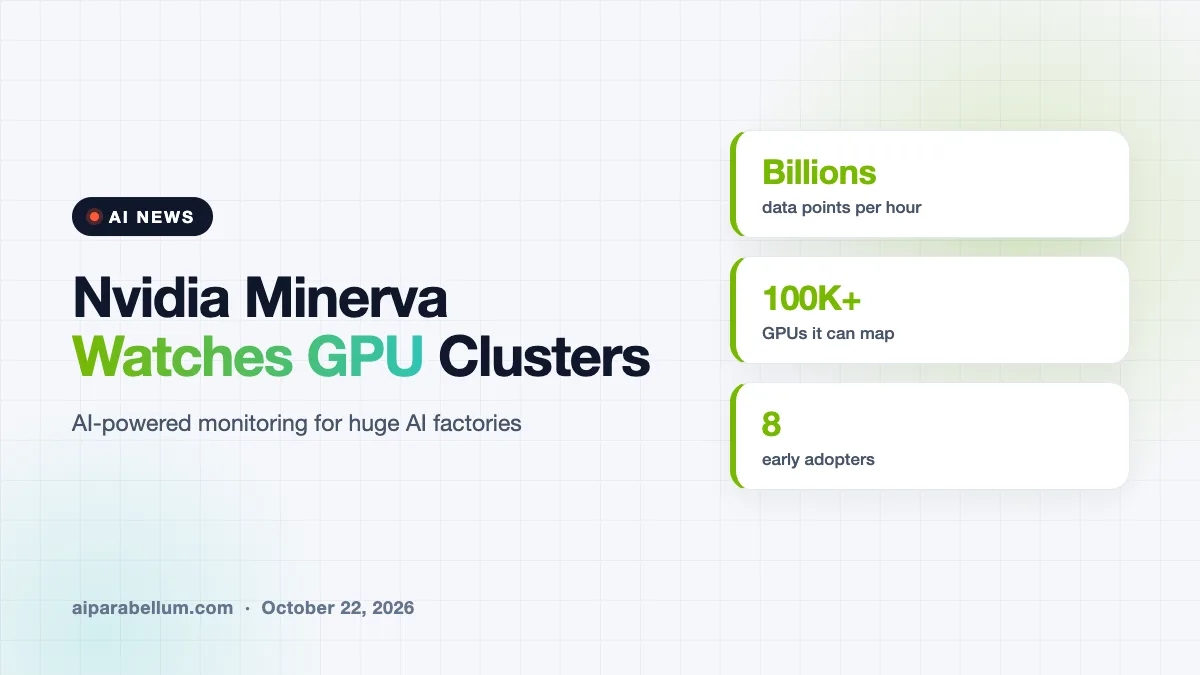
That map is what lets an operator trace a slow training job back to the exact part causing it. Nvidia says this works even in a facility with hundreds of thousands of GPUs. The platform analyzes billions of data points per hour using both supervised and unsupervised machine learning.
From Alert Storms to One Clear Incident
Instead of firing off an alert for every symptom, Minerva learns what normal looks like and flags anomalies it has never seen before. It can also predict failures that are starting to form. Related events get grouped into a single incident with a likely root cause, so teams are not buried in noise.
Here is a quick look at the main pieces Nvidia describes:
| Feature | What It Does | Why It Matters |
|---|---|---|
| Unified telemetry | Combines GPU, network, storage, scheduler and job data | One view instead of separate team dashboards |
| Knowledge graph | Maps hardware and running jobs together | Traces slow jobs to a specific component |
| Anomaly detection | Learns normal behavior and spots new problems | Catches issues before they cause outages |
| Incident grouping | Bundles related alerts with a likely root cause | Fewer alerts and faster fixes |
| AI assistant | Natural-language questions grounded in live data | Operators get suggested fixes by chatting |
A Built-In AI Assistant for Operators
Minerva ships with its own AI assistant and can also connect to outside agentic AI tools. Operators can ask about cluster health in plain language and get recommended fixes based on live telemetry. If you follow the wider push toward agent tracing tools, this is the same idea applied to physical infrastructure.
Teams get to choose how much control to hand over. A person can stay in the loop and apply fixes by hand, or Minerva can plug into automation through infrastructure APIs and other systems.
Nvidia frames the payoff around three goals:
- Longer stretches between interruptions, because problems are caught before jobs crash.
- Faster repairs, because the platform pinpoints the faulty part.
- Less noise, because only the handful of alerts that matter reach people.
All of this rolls up into what Nvidia calls AI factory yield, a measure of useful output based on GPU hours, goodput, cluster uptime and token production.
Who Is Using Nvidia Minerva
Cloud provider IREN is already using Minerva on its AI factories. Its chief technology officer, Denis Skrinnikoff, said the platform gives his team “one view across the network, the GPUs and the jobs running on them.”
Several other companies plan to deploy it, including Aolani, Bitdeer AI, IBM, Jio, Lambda, Quake AI and Tesla. On the hardware side, Dell Technologies, Lenovo and Supermicro will offer Minerva as part of their AI factory operations packages. It fits alongside Nvidia’s recent work on AI factory standards and its agent reference architecture.
What This Means for You
Most people will never log into Minerva, since it is built for the operators of massive GPU clusters. Still, the effects can trickle down to anyone who uses AI apps every day.
- If you rely on a cloud AI service, better uptime on the backend can mean fewer slowdowns and failed requests.
- If you run GPU infrastructure, ask your hardware vendor whether Minerva is part of its operations bundle.
- If you build AI products, watch how cloud providers talk about reliability, since tools like this may become a selling point.
Nvidia did not share pricing details in its announcement. For more updates like this, check our latest AI news.
Sources
Primary source: Nvidia’s Minerva announcement.
Conclusion
Nvidia Minerva is a bet that the next big challenge in AI is not just building bigger GPU clusters but keeping them running smoothly. By tying hardware and job data into one map and adding an AI assistant on top, Nvidia wants operators to fix problems before they slow anything down. Early users like IREN, plus planned rollouts at IBM, Tesla and Lambda, suggest the demand is real. How well it works at full scale will become clearer as those deployments go live.