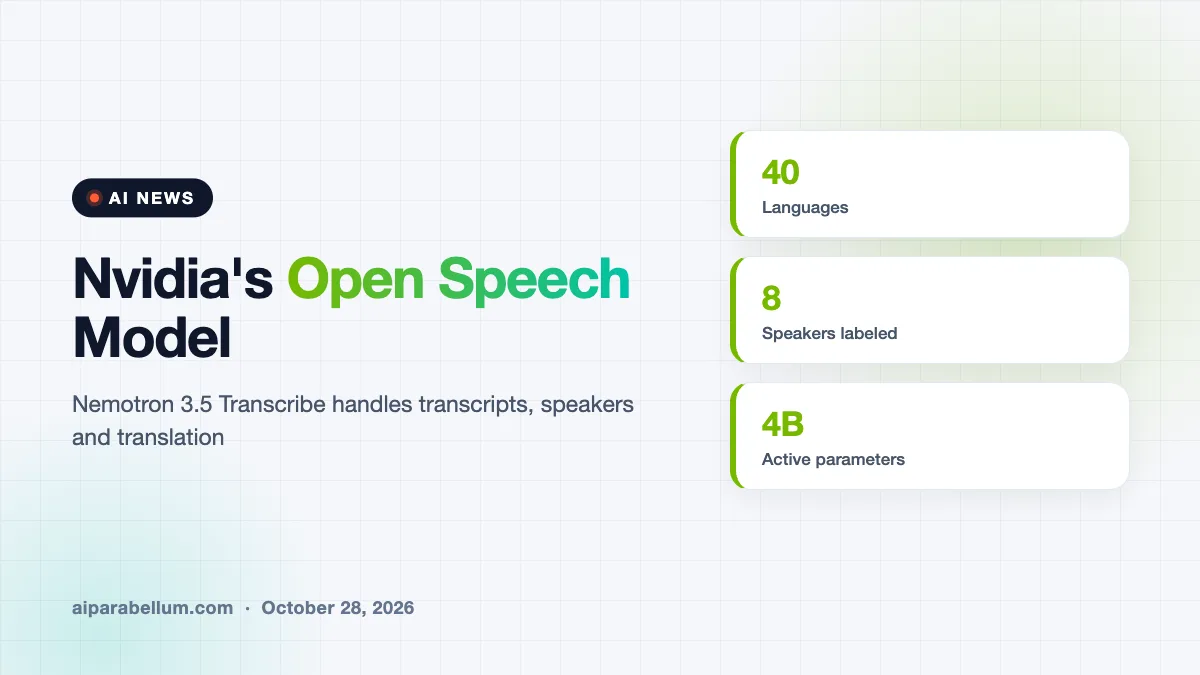
Nvidia has released Nemotron 3.5 Transcribe, an open-weight speech model that turns recordings into transcripts, speaker labels, translations and answers in a single pass. It ships with Granary v2, a bigger open dataset and pipeline for teaching the model your own vocabulary.
The model is free to download, and Nvidia says it tops several public speech leaderboards among open models. Here is what it does and who should care.
What Nemotron 3.5 Transcribe Does
Most speech tools chain several steps together: detect speech, write it down, figure out who spoke, then summarize. This model folds those jobs into one checkpoint that you steer with plain-English instructions.
You could ask it to transcribe a call and label each speaker, translate the audio into English, or tell you what decisions a meeting reached. The same recording can produce a different output depending on the prompt.
- Transcribes 40 languages and translates 31 of them to or from English.
- Labels speakers in 13 languages, with up to eight speakers per recording.
- Handles recordings up to an hour long and returns word-level timestamps.
- Accepts a list of jargon or names to spell correctly.
Where Nemotron 3.5 Transcribe Runs
Under the hood it is a mixture-of-experts model with 30 billion parameters, but only about 4 billion are active for each token. That keeps it small enough for a single Nvidia GPU, from a DGX Spark desktop or Jetson AGX Thor edge computer up to a Blackwell data-center card.
Nvidia says one RTX PRO 6000 Blackwell Server Edition GPU with NVFP4 precision can process 100 hours of audio in under three minutes. That speed was measured on 30-second clips at high concurrency, so your results will vary.
One limit matters: the model is built for recorded audio, not live streaming. If you need real-time captions, this is not the tool.
Open Speech Model Benchmarks
Nvidia reports first place among open-weight models on the Hugging Face Open ASR Leaderboard for English, at an average word error rate of 5.33%. It also reports the lowest diarization error rate, 18.26%, on a 21-language speaker-attribution leaderboard. These are the company’s own reported results, so treat them as a starting point and test on your audio.
| Measure | Reported result |
|---|---|
| English word error rate (open models) | 5.33%, first place |
| Speaker error rate, 21 languages | 18.26%, lowest of 14 systems |
| Languages transcribed | 40 |
| Active parameters | About 4 billion of 30 billion |
Granary v2 and Fine-Tuning for Your Field
Granary v2 is Nvidia’s open multilingual speech dataset, now covering 48 languages, up from 25 in the first version. Each recording comes with three transcript styles: one that keeps every “um,” one that turns spelled-out numbers into digits, and one that drops filler words.
Nvidia also published a medical case study. Out of the box, the model erred on 30.8% of words on an Indian medical speech benchmark. A better prompt cut that to 23.8%, and fine-tuning brought it to 11.8%.
Nvidia says the tuning took about 14 GPU-hours on one GB300.
What This Means for You
If you only want clean meeting notes, a hosted tool is still easier. Our guide to automatic meeting notes covers that route. Models like this one matter more if you build products or handle sensitive audio you cannot send to a third party.
- Developers can serve it with vLLM or try the Hugging Face demo, and hosted endpoints exist through Baseten, DeepInfra and Simplismart.
- Teams with medical, legal or support recordings can fine-tune on their own terms instead of fixing transcripts by hand.
- Everyone else should spot-check names, speaker changes and answers against the recording, as Nvidia itself advises.
It also adds to a busy month for open models. Nvidia recently launched the Super VL model, and IBM put out its own Granite Speech models. For a simpler starting point, see how to transcribe audio free, or browse more AI news.
Sources
Primary source: Nvidia’s Nemotron 3.5 Transcribe and Granary v2 announcement. Additional reporting from SiliconANGLE.
Conclusion
Nemotron 3.5 Transcribe packs transcription, translation, speaker labels and audio questions into one open model that runs on a single GPU. The benchmark numbers come from Nvidia and its cited leaderboards, so test it on your own recordings before you rely on it.