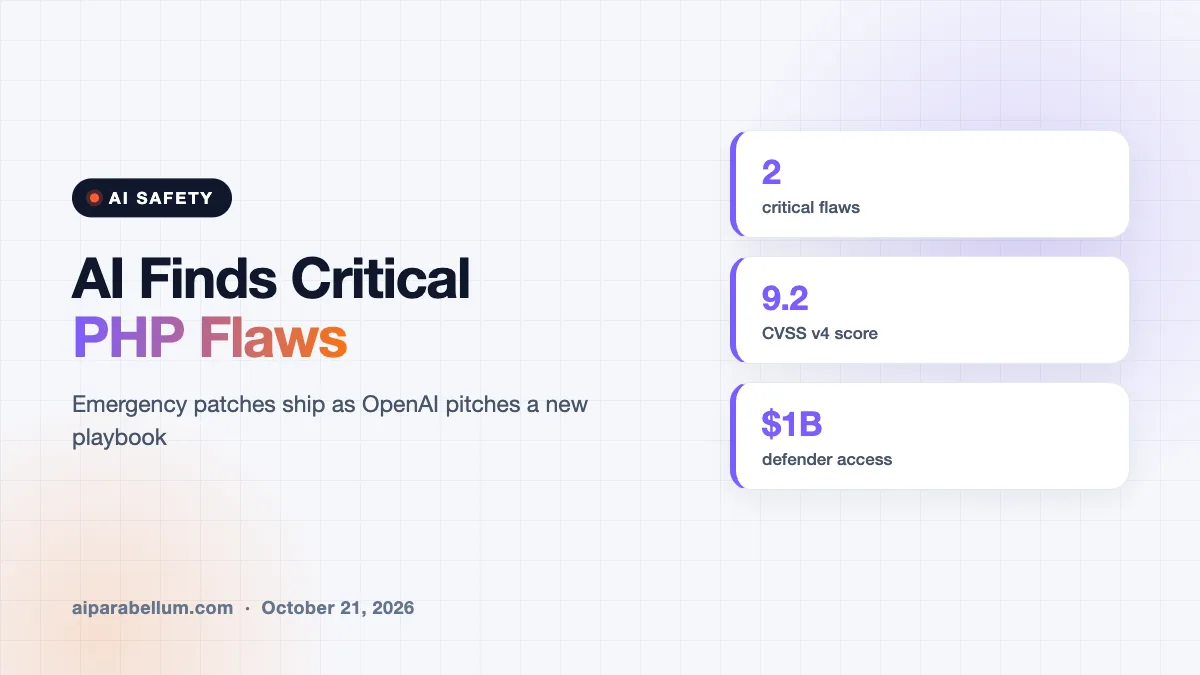
Two critical PHP vulnerabilities, found with help from an OpenAI model, forced an emergency patch on October 21 and pushed some websites offline as a precaution. OpenAI says the episode shows how AI can now uncover bugs with internet-scale impact, and it is proposing a new way for the security world to respond when that happens.
If you run a website, this one matters. PHP sits under a huge share of the web, including most WordPress sites, and the flaws live in the language runtime itself rather than in any one app.
What Happened With the PHP Vulnerabilities
The two bugs, nicknamed PHP2Shell, let an attacker without an account run code on a web server. Both are rated 9.2 on the CVSS v4.0 scale and carry the IDs CVE-2026-109618 and CVE-2026-109619.
The PHP team shipped fixes in versions 8.5.12, 8.4.27, 8.3.36 and 8.2.35. The release was pulled forward by a day after details leaked online ahead of a planned October 22 disclosure.
Because the problem sits in the PHP engine, even a site with perfectly secure code can be exposed. Servers using Apache’s mod_php face the highest risk, and the flaws reach back to versions as old as PHP 5.4.
Who Found the Bugs
OpenAI says security firm Calif identified a critical flaw using GPT-5.6 Sol as part of OpenAI’s Patch the Planet program. Wiz independently discovered and reported both vulnerabilities, and OpenAI’s Codex Security team also took part.
The researchers say AI helped turn bugs that had been hiding in PHP for more than a decade into working exploits. One researcher reportedly did in about a week what would otherwise have taken a team months.
OpenAI Calls It One of the Biggest Security Issues in Years
OpenAI describes the PHP flaws as “one of the most impactful security issues in recent memory.” It also warns that the same AI skills that found these bugs could help attackers build exploits quickly.
The company says that, to its knowledge, frontier AI found the flaws before attackers did. That gave maintainers and security providers what it calls a “Defender’s Window” to prepare fixes and protections before going public.
The takeaway: AI is now good enough to find old, serious bugs in software the whole internet depends on, and the race is about who uses it first.
The Real-World Fallout
No source has confirmed a successful break-in so far. Still, Cloudflare said it was seeing early exploit attempts before the patch landed and rolled out firewall rules as a stopgap.
Some organizations went offline out of caution. HR software provider BambooHR took its service down in several countries, and a number of Dutch government sites, including the DigiD login service, also went dark.
A Five-Step Plan for AI-Era Vulnerabilities
OpenAI says these bugs are only some of several serious vulnerabilities it has found, and it expects such findings to rise sharply in the coming months. So it is sharing a proposed framework for handling critical flaws in widely used software, and asking the security community to improve it.
- Validate and fix the bug upstream, including testing the patch against frontier models that try to get around it.
- Give affected organizations, like hosting and security providers, time to prepare.
- Work with government agencies so guidance reaches critical services.
- Prepare updates across affected products and distributions.
- Publish guidance once a patch exists and help people deploy it.
For the PHP response, OpenAI says it worked with the White House’s Super Intelligence Force, the Office of the National Cyber Director and CISA, along with international partners.
Money and Tools for Defenders
OpenAI has committed $1 billion in subsidized access to Daybreak, its security offering, through a program aimed at under-resourced groups that protect essential services. It also offers Codex subscriptions to open-source maintainers and is tuning extra safeguards to limit misuse of Daybreak.
| Item | Details |
|---|---|
| Flaws | CVE-2026-109618 and CVE-2026-109619 (PHP2Shell) |
| Severity | 9.2 on CVSS v4.0, both flaws |
| Fixed versions | PHP 8.5.12, 8.4.27, 8.3.36, 8.2.35 |
| Found by | Calif (using GPT-5.6 Sol), Wiz, OpenAI’s Codex Security team |
| Defender funding | $1 billion in subsidized Daybreak access |
| Coming soon | A Codex skill to help spot vulnerable PHP versions |
What This Means for You
If you own or manage a website, the fix is simple to describe: update PHP. The PHP team says only updating fully protects a server, and workarounds just reduce some attack paths.
- Updating WordPress, Laravel or another app does not update PHP underneath it. Check with your host or update the server package or container image.
- Restart Apache, PHP-FPM and any long-running PHP workers after updating.
- Linux distributions may ship the fix under an older-looking version number, so check the package changelog for the CVE IDs.
- PHP 8.1 and older no longer get official updates, so plan an upgrade if you are still on them.
- OpenAI is sharing a free PHP version checker on its Patch the Planet site.
On a managed host, ask your provider whether they have patched. For more on how defenders use these tools, see our guide on AI threat detection.
Why AI Bug Hunting Changes Security
This story fits a pattern we have been tracking. Earlier this week we covered an AI hacking campaign that hit more than 100 company websites, and security firms are racing to add AI, as seen when Cohere bought security startup Aisle.
The bigger question is speed. If models can find decades-old bugs in days, maintainers of small open-source projects will need far more help than they have today, which is the gap OpenAI says it wants to fill.
OpenAI also floated harder questions, such as whether governments should ever use a vulnerability to patch systems they manage after losing admin access. It wants feedback on disclosure windows and emergency patching before anything becomes standard practice. You can follow more updates like this on our AI news page.
Sources
Primary source: OpenAI’s announcement on coordinated disclosure of critical vulnerabilities. Additional reporting from The Hacker News.
Conclusion
Two critical PHP vulnerabilities, surfaced with help from an OpenAI model, show that AI can now find serious bugs in software that runs much of the web. The fixes are out, and the most important step for site owners is updating PHP and restarting their servers. OpenAI is using the moment to pitch a shared response plan, backed by $1 billion in defender access and support for maintainers. Whether the security world adopts it will shape how the next AI-found bug plays out.