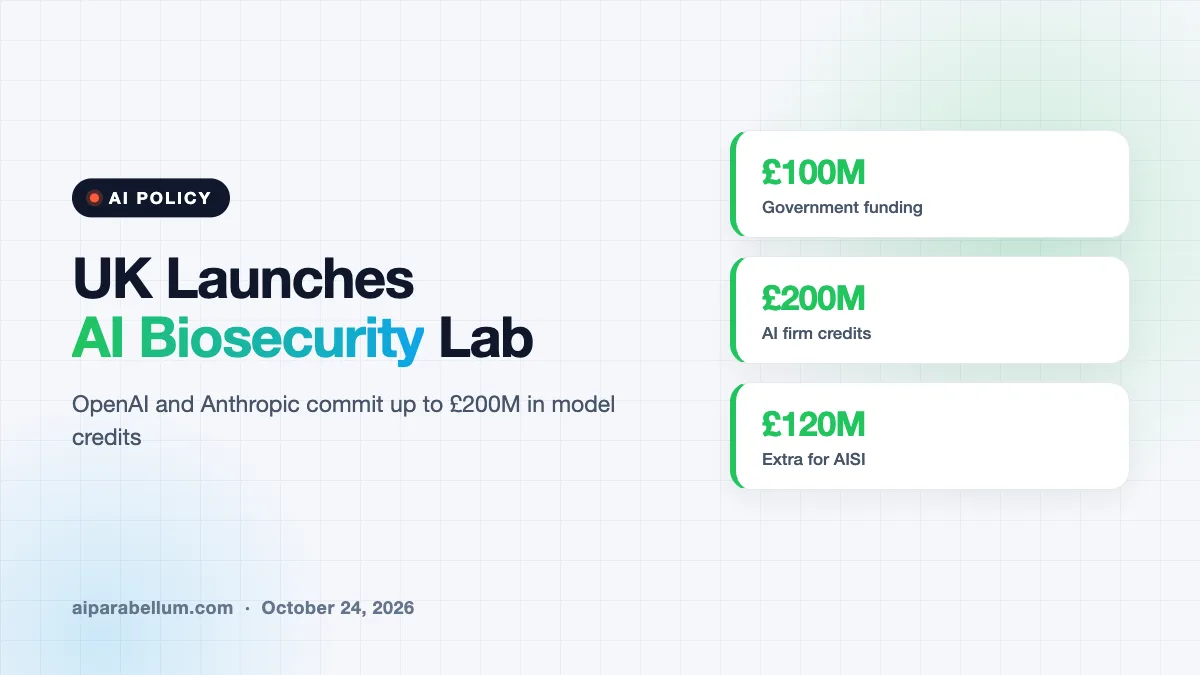
The UK government is setting up an AI Biosecurity Lab, a new non-profit that will use frontier AI to spot biological threats earlier and speed up work on vaccines and treatments. The lab gets £100 million in public money plus up to £200 million in model credits and support from OpenAI and Anthropic. It sits inside a wider package of roughly £600 million (about $800 million) aimed at AI-related health, cyber and security risks.
What the AI Biosecurity Lab Will Do
The government calls the lab the world’s first organization dedicated to AI biosecurity. Its job is to pair frontier AI talent with biology experts and turn that mix into practical tools. Officials say early work will focus on two goals.
- Detecting emerging biological threats, such as new pathogens, sooner than current systems can.
- Speeding up the discovery, development and testing of vaccines, treatments and other medical countermeasures.
The lab will run as an independent non-profit, modeled loosely on the UK’s existing AI Security Institute. The idea is to give it enough freedom to move at the pace of a startup while keeping close ties to government agencies. A scientific advisory committee drawn from academia, industry and charities will guide it, with details still to come.
Who it will work with
The lab is part of a broader National AI Biosecurity Initiative. That effort links it with the UK Health Security Agency, the Animal and Plant Health Agency and the Defence Science and Technology Laboratory. It will also work with the country’s medicines regulator to prepare for health emergencies and help shape rules for AI-designed drugs.
How OpenAI and Anthropic Are Contributing
The private side of the deal is mostly compute and model access, not cash. Each of the two big AI labs is putting in up to £100 million. Here is how the commitments break down, according to the government’s announcement.
| Partner | What it is providing |
|---|---|
| UK government | £100 million in funding for the lab |
| OpenAI | £100 million in compute and model credits, plus trusted access to its most capable relevant models through its Rosalind Biodefense program |
| Anthropic | Up to £100 million in model credits, trusted model access and dedicated technical support |
| Google DeepMind | Research collaborations and possible trusted access to Gemini and specialized science models |
| Basecamp Research | Access to its AI-biology models and technical expertise |
For Anthropic, this is another sign of a growing relationship with UK officials. The company has been vocal about biological misuse risks, and its Claude AI models will now be pointed at defensive biology work. It follows recent calls from both firms for binding UK rules on advanced AI.
The Bigger AI Security Package
The lab is the largest single piece of a wider spending plan that Chancellor John Healey is expected to set out in more detail in next week’s Budget. He framed it as a “distinctively British” approach that takes workers’ worries about AI seriously. Here are the other headline items reported so far.
- An extra £120 million for the AI Security Institute, which tests the most powerful AI models for risks.
- £70 million for a National Exposure and Real-Time Vulnerability (NERV) Centre that will use AI to find weak spots in critical infrastructure.
- £60 million for a National Cyber Shield that will use agentic AI to strengthen cyber defenses.
- £65 million to develop countermeasures against pathogens, as part of the biosecurity effort.
- About £10 million a year to study how AI will change industry and jobs, and how the country should prepare.
The timing is not random. Days earlier, AI-found flaws in the PHP programming language pushed some UK government sites offline as a precaution. That episode, which we covered in our report on critical PHP flaws, showed how fast AI can surface old bugs that attackers might use.
Why AI and Biosecurity Are Now Linked
AI cuts both ways in biology. The same models that can help scientists design drugs faster could also lower the barrier for someone trying to cause harm. The government’s own announcement says more capable systems create new biological risks even as they open up new science.
That tension has shaped how AI companies release their most capable models. Many now run special checks for biology and chemistry misuse before launch, and some limit sensitive features to vetted researchers. You can see that pattern in recent model safety reports and in independent testing work like outside AI evaluations.
What This Means for You
Most people will never touch the lab’s tools directly, but its work could affect public health and the AI products you use. Here is what to keep in mind.
- Faster outbreak response is the main promise. If the lab works as planned, new diseases could be spotted and studied sooner.
- Expect more “trusted access” programs. AI firms are increasingly giving powerful science features only to vetted partners, so some capabilities may never reach regular chatbots.
- Model credits are not cash. The real value depends on how much the lab actually uses the compute and access on offer.
- Cyber defense spending matters to businesses. If you run websites or IT systems, the push on AI-driven vulnerability hunting is a reminder to keep software patched. Our guide to AI threat detection covers the basics.
For more stories like this, browse our latest AI news coverage.
Sources
Primary source: GOV.UK announcement of the AI Biosecurity Lab. Additional reporting from BBC News and Sky News.
Conclusion
The AI Biosecurity Lab is the UK’s clearest bet yet that the best defense against AI-enabled biological risks is more AI, used carefully and in public hands. With £100 million from the government and up to £200 million in credits from OpenAI and Anthropic, it has real resources from day one. The bigger test is whether a new non-profit can move fast enough to matter. More details should arrive with next week’s Budget, and we will be watching how the lab’s first projects take shape.