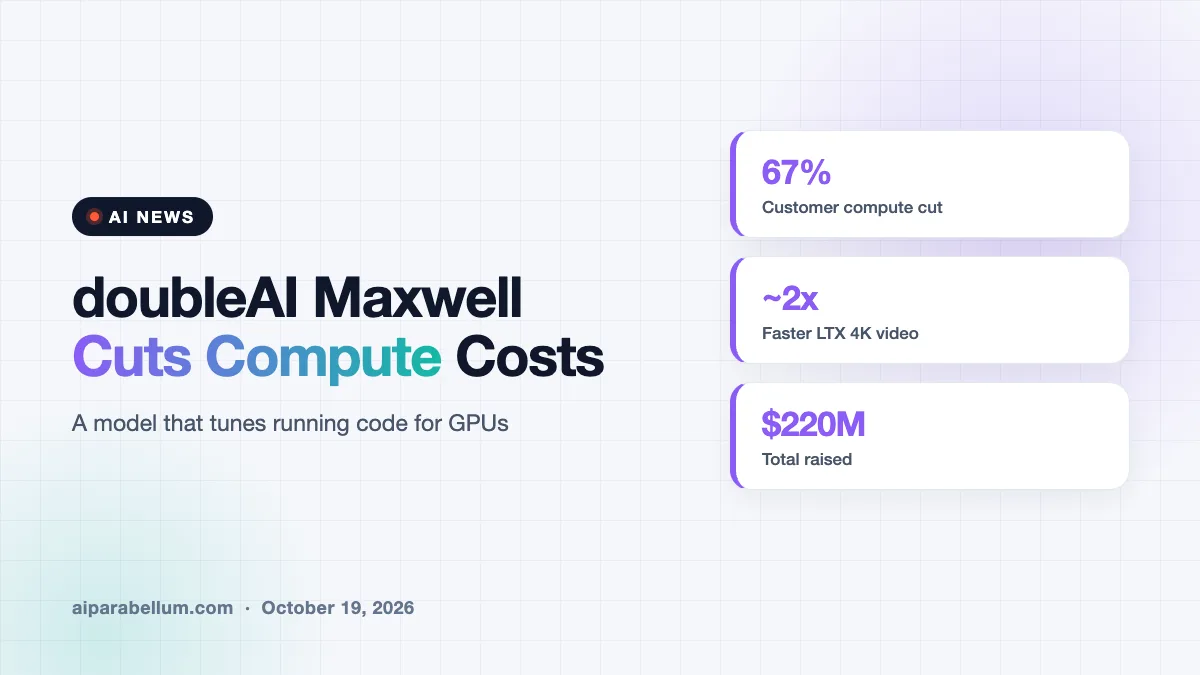
Nvidia-backed startup doubleAI has launched doubleAI Maxwell, an AI model that lives inside running software and makes it use hardware more efficiently. The company says Maxwell cut one early customer’s compute spending by 67%, according to a report published October 19.
What doubleAI Maxwell Actually Does
Maxwell is what the company calls a “code execution model,” or CEM. Most AI coding tools help people write software, but a CEM works on its own inside programs that are already running.
Its job is to find ways to make that code perform better on GPUs and CPUs. In plain terms, it tries to squeeze more work out of the same chips so companies need fewer of them.
The Hard Part: Proving the Code Still Works
Co-founder and CEO Amnon Shashua, who also runs Mobileye, said verifying the changed code was the biggest obstacle. doubleAI says it found a way to check the code formally and mathematically, so faster code doesn’t come at the cost of wrong results.
doubleAI has shared Maxwell research results since mid-2026, but this is its formal product unveiling. The company says a broader release is planned before the end of October.
Early Results From Maxwell Customers
The company has shared two early examples. Both are company or customer claims, not independent tests.
- One early customer saw its compute spending drop by 67%.
- LTX, which makes open-weight multimodal AI models, says Maxwell made 4K video generation with its LTX-2.5 model nearly twice as fast.
In a technical write-up, doubleAI says Maxwell made more than a dozen changes to the LTX pipeline, from how two GPUs split the work down to edits inside single GPU kernels. It says the audio output stayed identical and the video changed only slightly.
LTX’s CEO Zeev Farbman explained that his team tracks GPU time, which always has a market price. Faster inference means paying for less of it.
As AI chips get pricier, the cheapest GPU may be the one you no longer need because your code got smarter.
Why Compute Costs Are the Real Target
AI companies are spending heavily on chips, and rental prices keep climbing. The hourly price to rent Nvidia H100 capacity on a one-year contract is up 60% from a year earlier, according to the research firm SemiAnalysis.
Shashua’s argument is that demand for compute is growing faster than anyone can build GPUs and CPUs. Getting more out of existing hardware is, in his view, the quickest way to save money.
A Pay-for-Savings Business Model
doubleAI plans to bill customers based on how much they save. Shashua gave an example: if a customer’s compute bill fell from $10 million to $6 million, doubleAI would take a share of the $4 million saved, though he didn’t say what percentage.
He expects the biggest AI labs, such as OpenAI and Anthropic, to gain the most. He said even a 10% saving could be worth hundreds of millions of dollars to the largest players.
doubleAI at a Glance
| Detail | What we know |
|---|---|
| Headquarters | Tel Aviv |
| Company age | About two years |
| Employees | About 40 |
| Total funding | $220 million |
| Investors | Lightspeed, Bessemer, Nvidia and Dell |
| Own hardware | 1,000 Nvidia B300 chips, bought with about half its funding |
| Main product | Maxwell, a code execution model |
That chip purchase says a lot about the market. Shashua said the company can’t rely only on renting compute because prices keep going up.
What This Means for You
Most people won’t use Maxwell directly, but tools like it could shape what AI costs everyone. When AI labs spend less on compute, there’s more room to keep prices steady or offer more free usage.
- If you run AI workloads, track your GPU hours now so you can measure any future savings.
- Treat the 67% figure as a best case from one customer until wider results come out.
- Watch for the broader launch later this month and any independent benchmarks.
Chipmakers are tackling the same problem from the hardware side, as seen with Nvidia’s RTX Spark and its push for open AI factory standards. Developers can also browse our AI developer tools list or see how AI pricing models are changing. For more updates, visit our AI news page.
Sources
This article is based on doubleAI’s technical post on the LTX results, doubleAI, published October 19, 2026, and on an October 19 Quartz report summarizing an interview the company gave to The Wall Street Journal, which is the source of the cost-savings, funding and chip figures.
Conclusion
doubleAI Maxwell takes a different swing at the AI cost problem: instead of building more chips, it tries to make running code use them better. The early numbers are striking, but they come from the company and a single named customer. Its pay-for-savings model means doubleAI only wins if customers really save money. If wider testing backs up the claims, code execution models could become a standard tool for any company with a big AI compute bill.