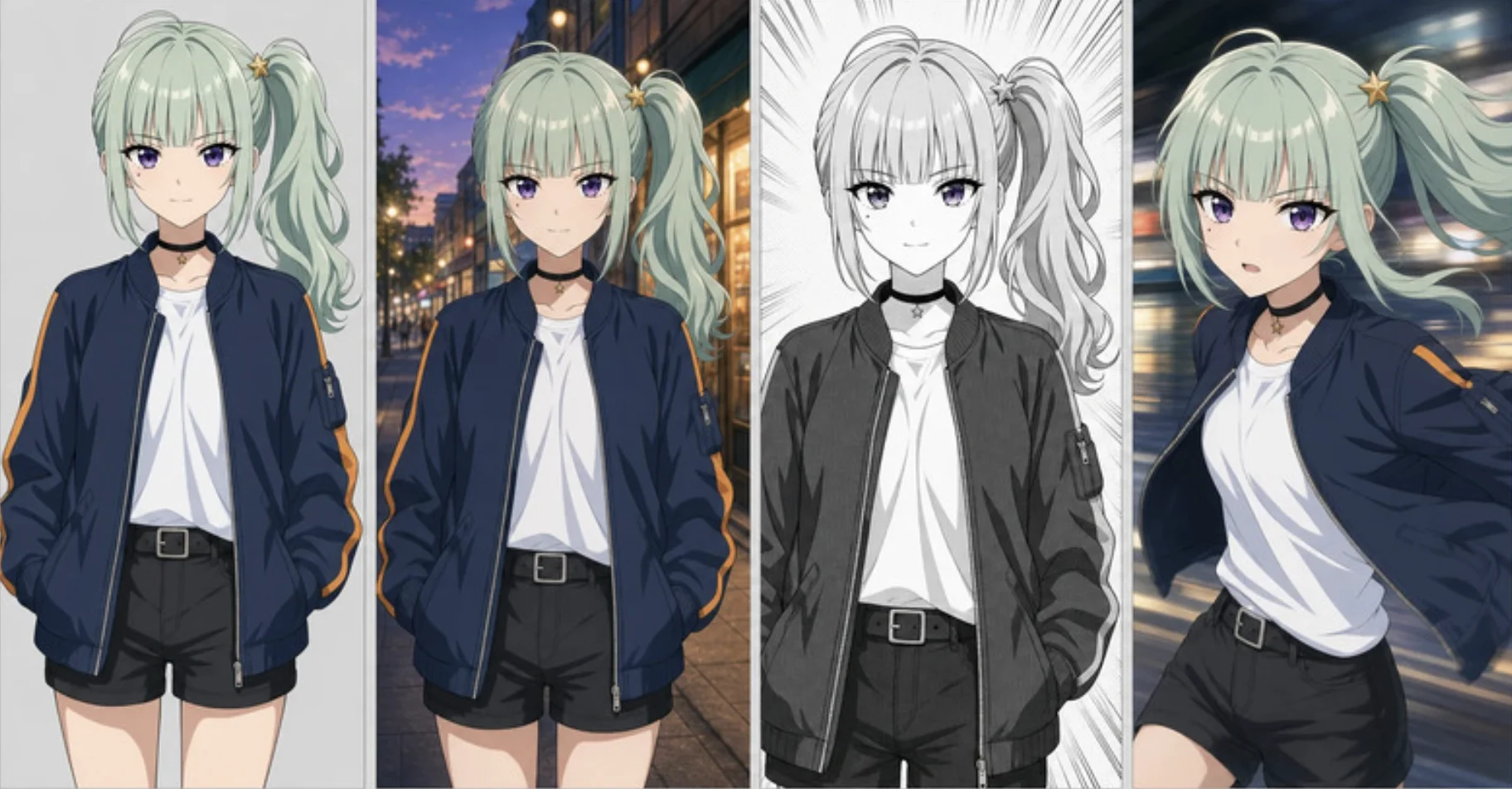
When AI image generation went mainstream, the thing everyone tested first was novelty. Type a sentence, get an image. Anime was one of the earliest and most enthusiastic use cases: the style is distinctive, the training data was abundant, and the results got convincing faster than almost any other genre.
But look closely at what people produced in that period and a pattern emerges — plenty of beautiful images, endless variety, and almost no recurring characters.
That’s not a small detail. Anime fandom has always been organized around *characters*, not images. Fan art, cosplay, fic, ships, VTuber personas and doujinshi all assume a persistent person who exists across many pictures, drawn by many hands, and stays recognizably themselves. Generic image generation gave people an endless supply of good-looking strangers, and a stranger is what each new image kept being.
The shift worth paying attention to is the one that happened next: the move from generating images to creating characters.
What people were actually trying to do
Ask around in original character communities and you find the same story with different details. Someone has had a character in their head for years. They know the hair, the eyes, the outfit, the personality, the backstory, the way she’d stand when she’s annoyed. What they don’t have is the ability to draw.
For most of the history of the hobby, that was the end of the road, or the start of a commission queue. The character stayed in a notes app.
So when generic AI image tools arrived, a lot of people didn’t use them the way the demos suggested. They weren’t trying to produce a nice picture; they were trying to *meet someone specific*. And on that particular task, prompt-only generation was frustrating in a distinctive way: it kept producing characters that were almost right, and never the same one twice.
That gap between “a nice anime image” and “my character” turned out to be where the real product problem was.
Consistency is the whole unlock
If you want to understand what changed technically, it comes down to how identity is stored.
In a pure text-to-image workflow, your character is a description. “Silver hair, red eyes, navy jacket” is a category containing millions of possible people, and every generation samples a new one. Nothing carries over between images because nothing was ever saved. The character existed for exactly one render.
The move that mattered was making identity into an asset rather than a sentence. Build the character once from a reference image, keep that reference, and generate everything else against it. Suddenly the text prompt isn’t responsible for who the person is, only for what they’re doing. That single change is what makes a second image of the same character possible, and everything else in the modern OC workflow is downstream of it.
It sounds like a technical footnote. In practice it’s the difference between a screenshot and a character.
The workflow that replaced the prompt
What has emerged over the past couple of years looks much less like “type a sentence” and much more like an actual character design pipeline: the one illustrators have used for decades, with the rendering step handled differently.
Design. One clean, neutral hero image of the character, iterated until it’s genuinely right. Plus a short written bible: hair, eyes, build, signature outfit, non-negotiable accessories.
Sheet. A turnaround (front, side, back) and a few expressions. This is where you discover the decisions you never made, like what the back of the coat looks like.
Poses. The same character in new body language, with the prompt describing action and framing rather than re-describing the face.
Outfits. Wardrobe changes that keep identity intact, which requires being explicit about which items are costume and which items are the character.
Scenes. Putting the character into environments without letting the environment swallow them.
Manga and video. The same identity carried into sequential panels and short animated clips. This is the stress test, because both formats show the character many times in a row.
Platforms built around this idea, such as KusArt, an AI anime character generator, organize the experience around the character rather than around the prompt box: you create an original character from a reference, and posing, dressing, staging, and animating them are all operations on that character. It’s a small conceptual shift with a large practical consequence, because it matches how people think about their OCs: as someone they have, not something they generate.
Who this is actually for
It’s worth being precise here, because the conversation around AI art tends to collapse into a single argument that doesn’t fit the people using these tools.
The audience that has taken to character-focused AI most enthusiastically isn’t professional illustrators looking to work faster. It’s the much larger group standing one step behind them: people with a fully-formed character and no drawing ability. Worldbuilders, tabletop players, fic writers, VTuber hopefuls, teenagers with a notebook full of names — people whose imagination was never the bottleneck.
For that group, this isn’t about output volume. It’s about a first meeting. The reaction that comes up again and again in OC communities when someone finally sees their character rendered properly isn’t “that was fast” — it’s something closer to recognition.
Working artists, meanwhile, have mostly found their own uses at the edges of the pipeline: reference sheets, pose exploration, color tests, quick visual notes for a character that will ultimately be drawn by hand. That’s a different job from making finished art, and the tools are most useful when they’re honest about which one they’re doing.
What still doesn’t work
Anyone writing about this owes readers the limitations, because they’re real.
Hands, small props, and fine detail remain unreliable at the edges, especially in busy compositions.
Long-form consistency degrades. One character across ten images is manageable. The same character across a forty-page manga, at varying panel sizes, is still genuinely hard, because small panels reduce identity to silhouette and hair shape, and that’s where drift becomes visible.
Motion is the weakest link. Image-to-video has improved sharply, but the longer the clip, the more the character wanders. Short shots built from a strong still are still the reliable move.
Style and identity get tangled. Asking for the same character in a very different art style often produces a character who is only approximately themselves.
None of these are solved. They’re the current frontier, and they’re where the next round of improvement will show up.
The direction of travel
The interesting trend line isn’t image quality. That curve flattened out sooner than most people expected, and the difference between an excellent render and a very good one stopped mattering to most users some time ago.
The curve that’s still climbing is *persistence*: how long an identity can survive across poses, outfits, styles, panels, and time. Every meaningful step in this space has been about carrying a character further without losing them.
That’s a good sign for where this ends up, because it points at something more interesting than an image machine. Anime has always been a medium of characters: people who show up again and again, in new situations, and stay themselves. Tools that only made pictures were never going to fit that. Tools that make characters might.
For a lot of people, the practical version of that is simple and slightly emotional: the character they’ve been carrying around for years is finally somewhere they can look at.