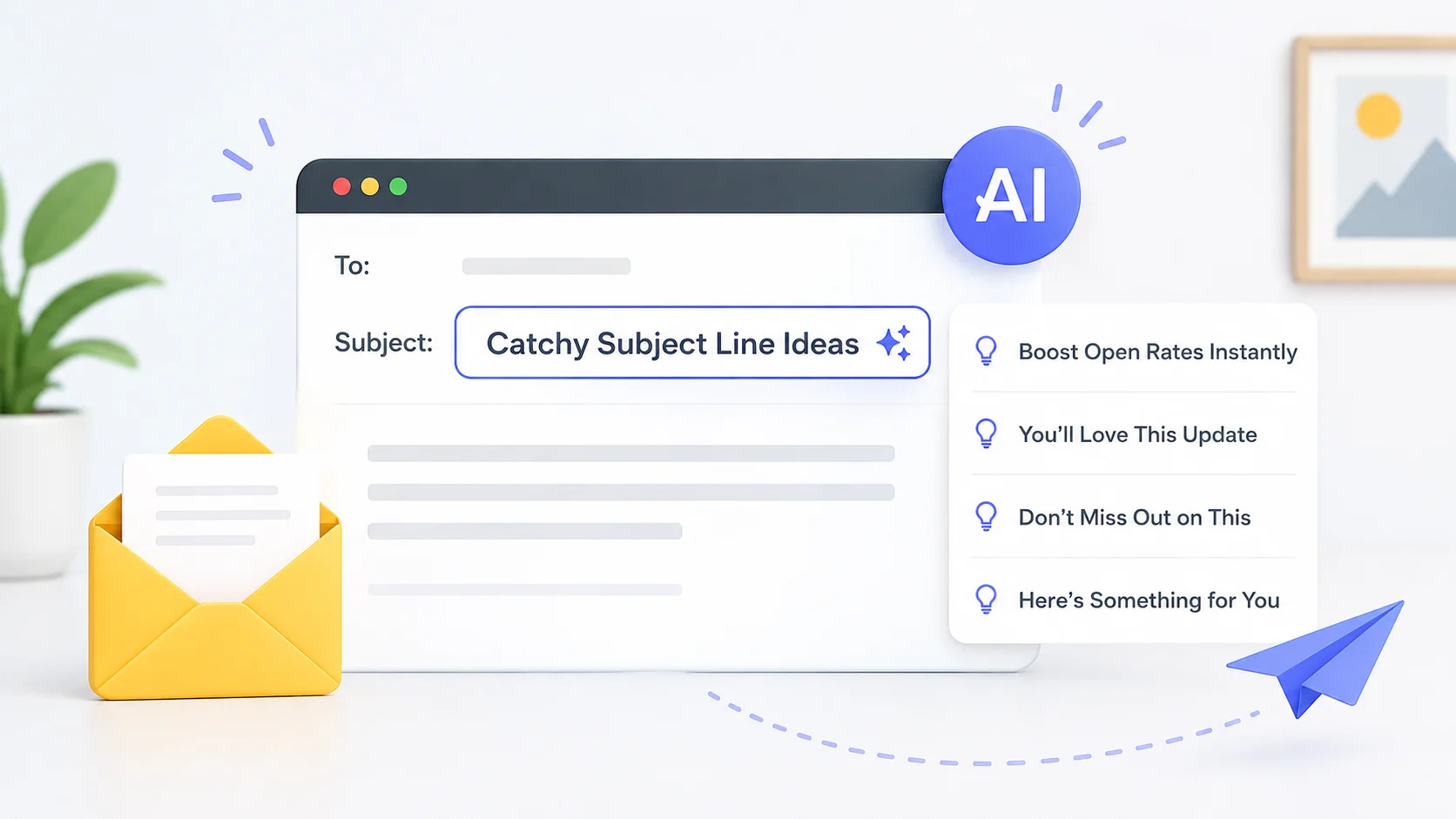
Your email could contain the most valuable offer of the year. It could solve a real problem, save someone money, or change how they work. None of that matters if nobody opens it.
The subject line is the gatekeeper. It decides whether your email gets read or buried under fifty others. And most people write subject lines as an afterthought, spending thirty seconds on the one element that determines whether anyone sees the hours of work that follow.
AI tools can generate dozens of high-performing subject line options in seconds. They analyze patterns from billions of emails, apply proven copywriting frameworks, and produce variations you can test immediately. Here is how to use AI to write email subject lines that actually get opened.
Why Email Subject Lines Matter More Than the Email Itself
The average person receives 121 emails per day. They spend about three seconds deciding whether to open or skip each one. Your subject line is the entire pitch in those three seconds.
Research from SuperOffice consistently shows that 47 percent of email recipients decide whether to open an email based solely on the subject line. Another 69 percent report emails as spam based on the subject line alone. These numbers make subject line writing one of the highest-leverage skills in email marketing.
Despite this, most marketers and business owners treat subject lines as filler text. They write whatever comes to mind first and hit send. AI changes this by making it easy to generate, compare, and optimize subject lines before a single email goes out.
The best email in the world is worthless with a bad subject line. It is like writing a bestselling novel and giving it a cover that says “Untitled Document.”
How AI Generates Better Subject Lines
AI tools analyze patterns across millions of successful email campaigns. They identify which word combinations, lengths, emotional triggers, and structures consistently drive higher open rates. This data-driven approach removes the guesswork from subject line writing.
Pattern Recognition at Scale
Human copywriters draw from their own experience, which might include a few hundred campaigns. AI draws from datasets containing billions of email interactions. It knows that subject lines with numbers outperform those without, that questions increase open rates in certain industries, and that urgency words work differently depending on the audience segment.
This pattern recognition extends to timing, audience demographics, and industry benchmarks. AI does not just write subject lines. It writes subject lines calibrated to your specific context.
Volume and Variation
Writing ten subject line variations manually takes time and mental energy. AI generates fifty variations in under a minute. This volume matters because email marketing success depends on testing, and you cannot test what you do not create.
More variations mean more A/B testing opportunities. More testing means faster learning about what resonates with your specific audience. AI compresses weeks of creative brainstorming into minutes.
AI Tools for Writing Email Subject Lines
Several AI tools excel at generating email subject lines, each with different strengths and approaches.
| Tool | Free Access | Best For | Key Feature |
|---|---|---|---|
| ChatGPT | Free tier available | Flexible subject line generation | Custom prompting for any tone or style |
| Claude | Free tier available | Nuanced, natural-sounding lines | Strong at avoiding spam triggers |
| Copy.ai | Free plan | Marketing-specific copy | Pre-built email subject line templates |
| Jasper | Free trial | Brand voice consistency | Learns your brand tone over time |
| Mailchimp AI | Included in plans | Integrated email workflows | Generates lines inside the email builder |
For most users, a general-purpose AI like ChatGPT provides the most flexibility. You can customize prompts for any industry, audience, or campaign type without being locked into templates.
How to Prompt AI for Email Subject Lines
The quality of your AI-generated subject lines depends entirely on the quality of your prompts. Generic prompts produce generic results. Specific, structured prompts produce subject lines you can actually use.
The Structured Prompt Approach
Give the AI detailed context about your email, audience, and goals. Here is a prompt template that consistently produces strong results.
Generate 15 email subject lines for the following campaign:
Product: [your product or service]
Audience: [describe your target reader]
Email content: [brief summary of what the email contains]
Goal: [what you want the reader to do]
Tone: [casual, professional, urgent, playful, etc.]
Constraints: Under 50 characters, no all-caps, no spam trigger words.
Include a mix of: questions, numbers, curiosity gaps, and benefit-driven lines.
This structured approach produces subject lines tailored to your specific situation rather than generic marketing phrases. Mastering how to write effective prompts is the single most important skill for getting usable output from any AI tool.
Prompting for Different Email Types
Different emails need different subject line approaches. Adjust your prompts based on the email category.
- Welcome emails: Ask AI for warm, friendly lines that set expectations and make new subscribers feel valued.
- Promotional emails: Request urgency-driven lines with specific benefits, discounts, or deadlines without sounding spammy.
- Newsletter emails: Prompt for curiosity-driven lines that tease the most interesting content inside without giving everything away.
- Cart abandonment emails: Ask for gentle reminder lines that acknowledge the abandoned items and offer a reason to return.
- Re-engagement emails: Request lines that acknowledge the silence and create genuine curiosity about what they have missed.
Proven Subject Line Formulas AI Can Apply
AI works best when you give it frameworks to follow. These proven formulas consistently produce high-performing subject lines across industries.
| Formula | Example | Why It Works |
|---|---|---|
| Number + Benefit | “5 ways to cut your ad spend in half” | Specific and actionable |
| Question | “Still sending emails at the wrong time?” | Creates a knowledge gap |
| Curiosity Gap | “The one metric most marketers ignore” | Triggers need to know |
| Urgency + Deadline | “Last chance: offer ends at midnight” | Creates fear of missing out |
| Personal + Specific | “Your March results are ready” | Feels individually relevant |
| How-to | “How to double your open rate this week” | Promises practical value |
| Social Proof | “Why 10,000 marketers switched this month” | Leverages crowd behavior |
Tell AI which formulas to use in your prompt and it will generate variations for each one. Then pick the strongest options from each category and test them against each other. The same social proof strategies that work in advertising translate directly to email subject lines.
A/B Testing Subject Lines With AI
Generating subject lines is only half the process. Testing them is what turns good guesses into proven winners.
How to Set Up Effective Tests
Most email platforms let you A/B test subject lines by sending two variations to a small percentage of your list and then sending the winner to the rest. Tools like Mailchimp make this process straightforward, and AI makes it more effective by giving you more variations to test.
Ask AI to generate pairs of subject lines that test specific variables. For example, one pair might test a question versus a statement. Another pair might test a short line versus a longer one. Structured testing reveals what your specific audience responds to, which is often different from general best practices.
Analyzing Test Results With AI
After running tests, feed the results back to AI. Share your winning and losing subject lines along with their open rates, and ask AI to identify patterns. Over time, this creates a feedback loop where your AI-generated subject lines get progressively better because they are informed by your actual audience data.
This iterative approach is where AI truly outperforms manual copywriting. A human writer might remember a few past successes. AI can analyze hundreds of data points to find subtle patterns in what works for your list. These same productivity strategies apply across every part of your marketing workflow.
Common Subject Line Mistakes AI Helps You Avoid
AI does not just generate good subject lines. It also helps you dodge the common errors that kill open rates.
- Spam trigger words. AI can be instructed to avoid words like “free,” “guarantee,” “act now,” and other phrases that send emails straight to spam folders. A good spam checker catches what slips through.
- Excessive length. Subject lines over 50 characters get cut off on mobile devices, which is where most emails are read now. AI generates concise options that display fully on every screen.
- Misleading promises. Clickbait subject lines might boost opens once, but they destroy trust and increase unsubscribes. AI generates honest, compelling lines when prompted correctly.
- Generic language. Phrases like “Check this out” or “Important update” say nothing specific. AI produces lines with concrete details that give readers a reason to click.
- Missing personalization. AI can generate subject line templates with personalization slots for names, locations, past purchases, or other dynamic fields that boost relevance.
The fastest way to land in the spam folder is to write subject lines that sound like spam. AI trained on successful campaigns naturally avoids the patterns that trigger filters.
Advanced AI Techniques for Subject Line Optimization
Once you have the basics down, these advanced strategies push your open rates even higher.
Audience Segmentation Prompts
Generate different subject lines for different audience segments. Ask AI to write variations for new subscribers versus long-time customers, or for high-engagement contacts versus those who rarely open. The same email content can have five different subject lines, each tailored to a specific segment’s behavior and preferences.
Emotional Trigger Mapping
Ask AI to generate subject lines targeting specific emotions: curiosity, fear of missing out, pride, relief, or excitement. Then test which emotional triggers perform best with your audience. This approach is especially effective for storytelling-driven marketing where emotional connection drives action.
Competitive Analysis
Subscribe to competitor email lists and save their subject lines. Feed a collection to AI and ask it to identify patterns, then generate subject lines that differentiate your emails from what your audience is already seeing. Standing out in an inbox full of similar-sounding emails is half the battle.
Subject Lines for Different Industries
AI adapts its output to match industry norms and audience expectations when given the right context.
| Industry | What Works | What to Avoid |
|---|---|---|
| E-commerce | Specific discounts, product names, scarcity | Generic “sale” announcements |
| SaaS | Feature benefits, use cases, data points | Technical jargon, feature lists |
| Media and Publishing | Curiosity gaps, trending topics, exclusivity | Clickbait that does not deliver |
| B2B Services | ROI figures, case studies, pain points | Overly casual tone, hype language |
| Nonprofit | Impact stories, urgency, community language | Guilt-driven manipulation |
Include your industry context in every AI prompt so the generated subject lines match your audience’s expectations and communication norms.
Building a Subject Line Workflow With AI
The most effective approach integrates AI into a repeatable system rather than using it ad hoc.
- Before every campaign, generate 20 to 30 subject line options using AI with your structured prompt template.
- Filter down to five to eight finalists based on relevance, clarity, and emotional impact.
- Run A/B tests with two or three of the strongest options on a small segment of your list.
- Send the winning subject line to the remaining subscribers.
- Log the results, including open rates, click rates, and unsubscribe rates, in a running document.
- Feed past results back to AI every quarter to refine your prompts and improve future output.
This workflow takes about ten minutes per campaign and consistently produces better results than spending an hour agonizing over a single subject line. The same automation mindset that improves other marketing tasks applies directly here.
The marketers with the best open rates are not better writers. They are better testers. AI gives you enough material to test seriously instead of guessing.
Measuring Subject Line Performance
Track these metrics to see whether your AI-generated subject lines are actually improving results.
- Open rate is the most direct measure of subject line effectiveness. Compare your rates before and after implementing AI-generated lines.
- Click-through rate shows whether the subject line attracted the right audience. A high open rate with a low click rate means your subject line promised something the email did not deliver.
- Unsubscribe rate reveals whether your subject lines are attracting or repelling subscribers. A spike after a campaign signals a disconnect between the subject line and the content.
- Spam complaint rate indicates whether your lines are triggering negative reactions. Keep this below 0.1 percent.
- Revenue per email ties subject line performance directly to business outcomes for promotional campaigns.
Review these numbers monthly and share them with AI to continuously improve your email workflows. The data tells you what works for your specific audience, which is always more reliable than generic advice.
Conclusion
Generating catchy email subject lines with AI transforms the most overlooked part of email marketing into a data-driven competitive advantage. AI produces dozens of tested, optimized subject line options in seconds, eliminating the guesswork that causes most emails to go unopened. The key is combining AI volume with structured prompts, proven formulas, and consistent A/B testing to discover what resonates with your specific audience. Every email you send is a chance to learn what works, and AI makes sure you never run out of ideas to test.