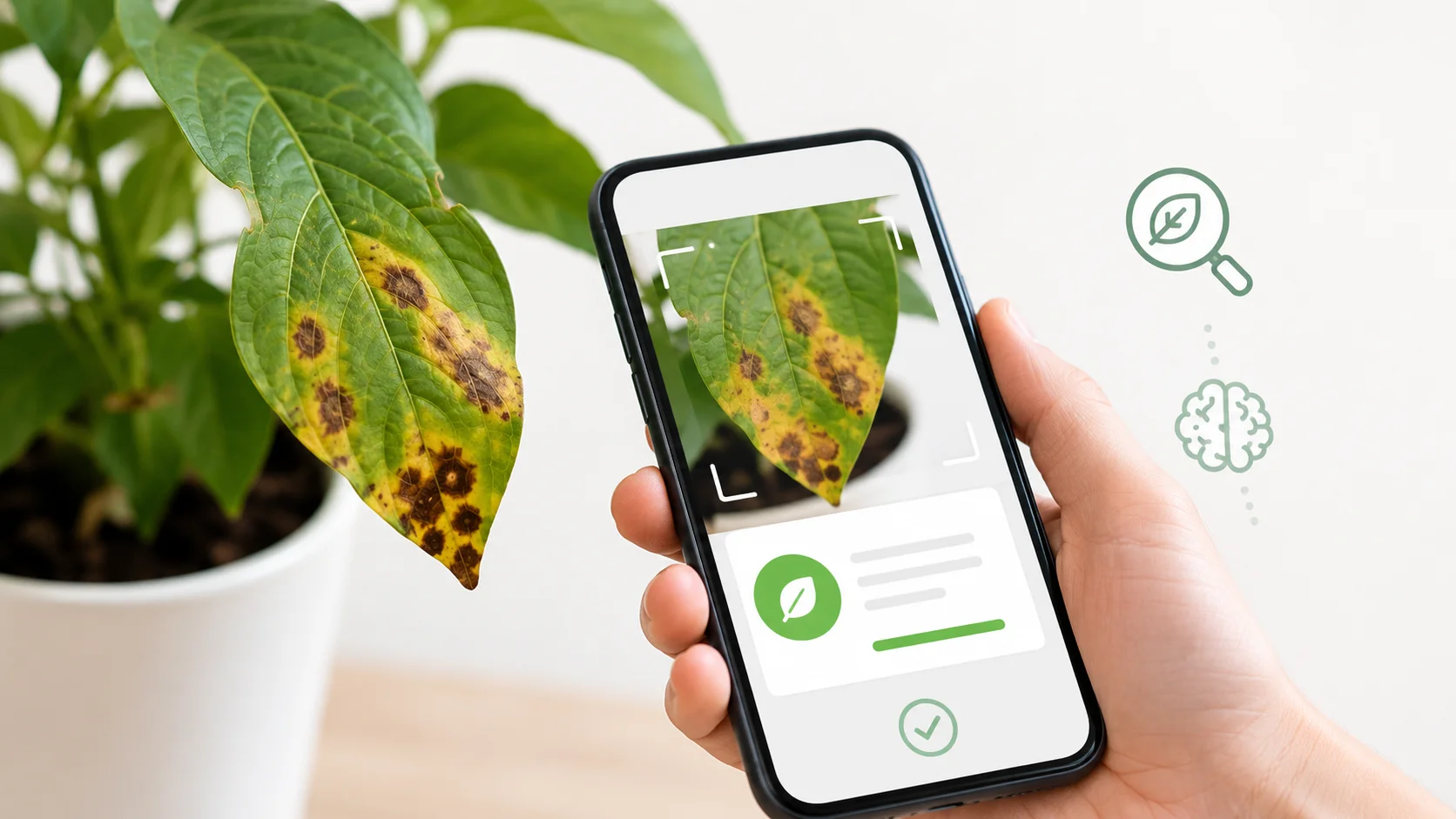
Your tomato leaves are turning yellow with brown spots. Your rose bushes have a white powdery coating. Something is clearly wrong, but you have no idea what it is or how to fix it.
This is where AI plant disease apps come in. You snap a photo of the affected plant, and within seconds the app tells you what is wrong and how to treat it. These tools have become remarkably accurate, and they are changing how home gardeners and farmers handle plant health problems.
How AI Plant Disease Detection Works
AI plant diagnosis apps use computer vision and deep learning models trained on millions of images of healthy and diseased plants. When you upload a photo, the AI compares it against its training data to identify patterns that match specific diseases, nutrient deficiencies, or pest damage.
The technology behind these apps is similar to what powers computer vision tools used in other industries. The model looks at leaf color, texture, spot patterns, wilting characteristics, and other visual markers to make its diagnosis.
Most apps use convolutional neural networks (CNNs) that have been specifically trained on plant pathology datasets. These datasets contain labeled images of thousands of plant species with hundreds of known diseases, making the AI increasingly accurate as more data gets added.
Top AI Apps for Diagnosing Plant Diseases
Several AI apps have established themselves as reliable tools for plant disease identification. Here is how the leading options compare.
| App | Plant Database | Disease Coverage | Price | Platform |
|---|---|---|---|---|
| PictureThis | 17,000+ species | Diseases, pests, nutrient issues | Free / $29.99 year | iOS, Android |
| PlantIn | 14,000+ species | Diseases, care advice | Free / $19.99 year | iOS, Android |
| Google Lens | Broad (general AI) | Basic identification | Free | iOS, Android |
| Plantix | Crops and vegetables | 30+ diseases per crop | Free | Android |
| Agrio | Crops and garden plants | Diseases, pests, weeds | Free / Premium | iOS, Android |
Each app has its strengths. PictureThis and PlantIn work well for home gardeners with ornamental plants. Plantix and Agrio are better suited for food crops and agricultural use. Google Lens is a decent free starting point but lacks the specialized plant pathology depth of dedicated apps.
Step-by-Step Guide to Using AI for Plant Diagnosis
Getting an accurate diagnosis from an AI app depends largely on how you use it. Follow these steps for the best results.
Step 1: Take a Clear Photo
The quality of your photo directly affects the accuracy of the diagnosis. Get close to the affected area and make sure the image is in focus. Natural daylight produces the best results because artificial lighting can alter how colors appear.
Take photos of both the affected area and a healthy part of the same plant for comparison. If the problem is on the leaves, photograph both the top and underside. Multiple angles give the AI more information to work with.
Step 2: Upload and Scan
Open your chosen app and use the camera or upload function to submit the photo. Most apps process the image in under five seconds. The AI will return one or more possible diagnoses, usually ranked by confidence level.
Step 3: Review the Results
Do not accept the first result blindly. Read through the description of the identified disease and compare the symptoms listed against what you see on your plant. A good AI app will show you reference images of the disease so you can visually confirm the match.
Step 4: Follow Treatment Recommendations
Most AI plant apps provide treatment suggestions alongside the diagnosis. These typically include organic remedies, chemical treatments, and preventive measures. Start with the least aggressive treatment and escalate only if the problem persists.
AI diagnosis is a starting point, not a final verdict. Always cross-reference the results with your own observations before applying any treatment to your plants.
Common Plant Diseases AI Apps Can Identify
AI plant apps are particularly strong at identifying diseases with distinctive visual symptoms. Here are the most commonly diagnosed conditions.
- Powdery mildew, which appears as white or gray powder on leaf surfaces and thrives in warm, humid conditions.
- Black spot, a fungal disease that creates dark circular spots on rose leaves and causes premature leaf drop.
- Blight, including early blight and late blight on tomatoes and potatoes, which causes brown patches and rapid plant decline.
- Rust, identified by orange or reddish-brown pustules on the undersides of leaves.
- Leaf curl, a viral or fungal condition that causes leaves to pucker, twist, and change color.
- Root rot, which AI can infer from above-ground symptoms like wilting, yellowing, and stunted growth even though the roots are not visible.
These diseases account for a large percentage of the plant health problems that home gardeners encounter. The visual patterns are distinct enough that AI achieves high accuracy rates, often above 90 percent for well-photographed samples.
How Accurate Are AI Plant Disease Apps
Accuracy varies by app, plant species, and image quality. Independent studies have shown that the leading AI plant apps correctly identify diseases between 85 and 95 percent of the time when given clear, well-lit images of common diseases.
Accuracy drops in certain situations. Rare diseases with limited training data, early-stage infections with subtle symptoms, and plants with multiple simultaneous issues all present challenges. Environmental factors like drought stress or chemical damage can also produce symptoms that mimic disease, confusing the AI.
| Scenario | Typical Accuracy | Why |
|---|---|---|
| Common diseases, clear photo | 90-95% | Abundant training data, distinct symptoms |
| Common diseases, poor photo | 60-75% | Blurry or poorly lit images reduce signal |
| Rare diseases | 50-70% | Limited training examples |
| Early-stage infection | 55-70% | Symptoms not yet fully visible |
| Multiple issues present | 40-60% | Overlapping symptoms confuse the model |
The takeaway is that AI apps work best as a first-pass diagnostic tool. For high-stakes situations like commercial crops or valuable specimen plants, it is worth confirming the diagnosis with a local extension service or plant pathologist.
AI Plant Diagnosis for Farmers vs Home Gardeners
The use cases for AI plant disease detection differ significantly between professional farmers and backyard gardeners.
Home Gardeners
For home gardeners, AI apps solve a knowledge gap. Most hobbyist gardeners cannot distinguish between a fungal infection and a nutrient deficiency just by looking at a leaf. AI gives them a starting point for treatment without needing to consult an expert for every yellowing leaf.
The free tiers of most apps are sufficient for casual use. If you have a small garden and encounter a problem a few times per season, you do not need a premium subscription. These productivity tools save time that would otherwise be spent searching forums and guessing at solutions.
Professional Farmers
For farmers, AI plant diagnosis is becoming a serious agricultural technology tool. Apps like Plantix and Agrio are designed for crop-level monitoring, offering disease tracking across fields and historical data that helps predict outbreaks before they spread.
Large-scale agricultural operations are integrating AI diagnosis with drone imagery and satellite data. Instead of walking fields manually, farmers fly drones that capture images of entire crops, and AI analyzes the footage for early signs of disease across thousands of acres. This kind of data analysis at scale was impossible without AI.
Limitations of AI Plant Disease Apps
Despite their usefulness, AI plant apps have clear limitations that users should understand.
- They cannot diagnose soil-borne diseases without visible above-ground symptoms.
- Environmental stress, such as overwatering or sunburn, can be misidentified as disease.
- The apps need internet connectivity for most diagnoses, which can be a problem in rural areas.
- They cannot assess the overall health context of a garden, like soil pH, drainage, or microclimate factors.
- Some apps push premium subscriptions aggressively, locking useful features behind paywalls.
AI apps are like a knowledgeable friend who can look at your plant and give you a solid guess. But they are not a replacement for a laboratory test when the stakes are high.
Tips for Getting Better Results From AI Plant Apps
A few simple practices dramatically improve the accuracy of AI plant diagnosis.
Always clean the lens of your phone camera before taking photos. A smudge or fingerprint can reduce image clarity enough to affect the diagnosis. Shoot in natural light, preferably on an overcast day when shadows are minimal.
Include a healthy leaf next to the affected one in your photo when possible. This gives the AI a baseline for comparison. Avoid placing the plant on a cluttered background. A plain surface behind the leaf helps the AI focus on the plant material rather than the environment.
If the app returns a low-confidence result, try again with a different photo or from a different angle. Sometimes a slightly different perspective captures the diagnostic features more clearly. Using photo editing tools to improve brightness or contrast before uploading can also help in challenging lighting conditions.
Beyond Diagnosis: AI for Plant Care
Most AI plant apps do more than just identify diseases. They offer comprehensive plant care features that make them useful tools throughout the growing season.
- Watering reminders based on plant species, pot size, and local weather conditions.
- Sunlight assessments that use your phone’s light sensor to measure whether a location gets enough sun for a specific plant.
- Species identification for unknown plants you encounter at nurseries, on hikes, or in other people’s gardens.
- Seasonal care guides that tell you what tasks to perform for each plant as the seasons change.
- Community features where users share photos and get advice from other gardeners and plant experts.
These additional features transform AI plant apps from single-use diagnostic tools into comprehensive gardening AI-powered assistants that help you manage your plants year-round.
The Future of AI in Plant Health
AI plant diagnosis is improving rapidly. The next wave of tools will move beyond reactive diagnosis to predictive plant health monitoring.
Imagine an app that analyzes a weekly photo of your garden and alerts you to early signs of stress before symptoms become visible to the naked eye. Or a system that monitors weather patterns and your garden’s plant inventory to warn you about disease conditions before they develop. These capabilities are already in development.
Agricultural AI research is also working on models that can recommend companion planting strategies and crop rotation schedules that naturally reduce disease pressure. The combination of educational content and real-time AI monitoring will make it easier than ever for anyone to maintain healthy plants.
Integration with smart garden sensors will add another layer of accuracy. When AI can combine visual diagnosis with soil moisture, temperature, humidity, and pH data from connected sensors, the accuracy and usefulness of these AI tools will reach a level that rivals professional plant pathology services.
Conclusion
AI apps have made plant disease diagnosis accessible to everyone, from first-time gardeners to experienced farmers managing large operations. The technology is remarkably accurate for common diseases when given clear photos, and it continues to improve with every update. While AI should not replace professional advice for serious or high-value situations, it is the fastest and most convenient first step when something goes wrong with your plants. Snap a photo, get a diagnosis, and start treating the problem before it spreads. That simple workflow is saving gardens and crops across the country every day.