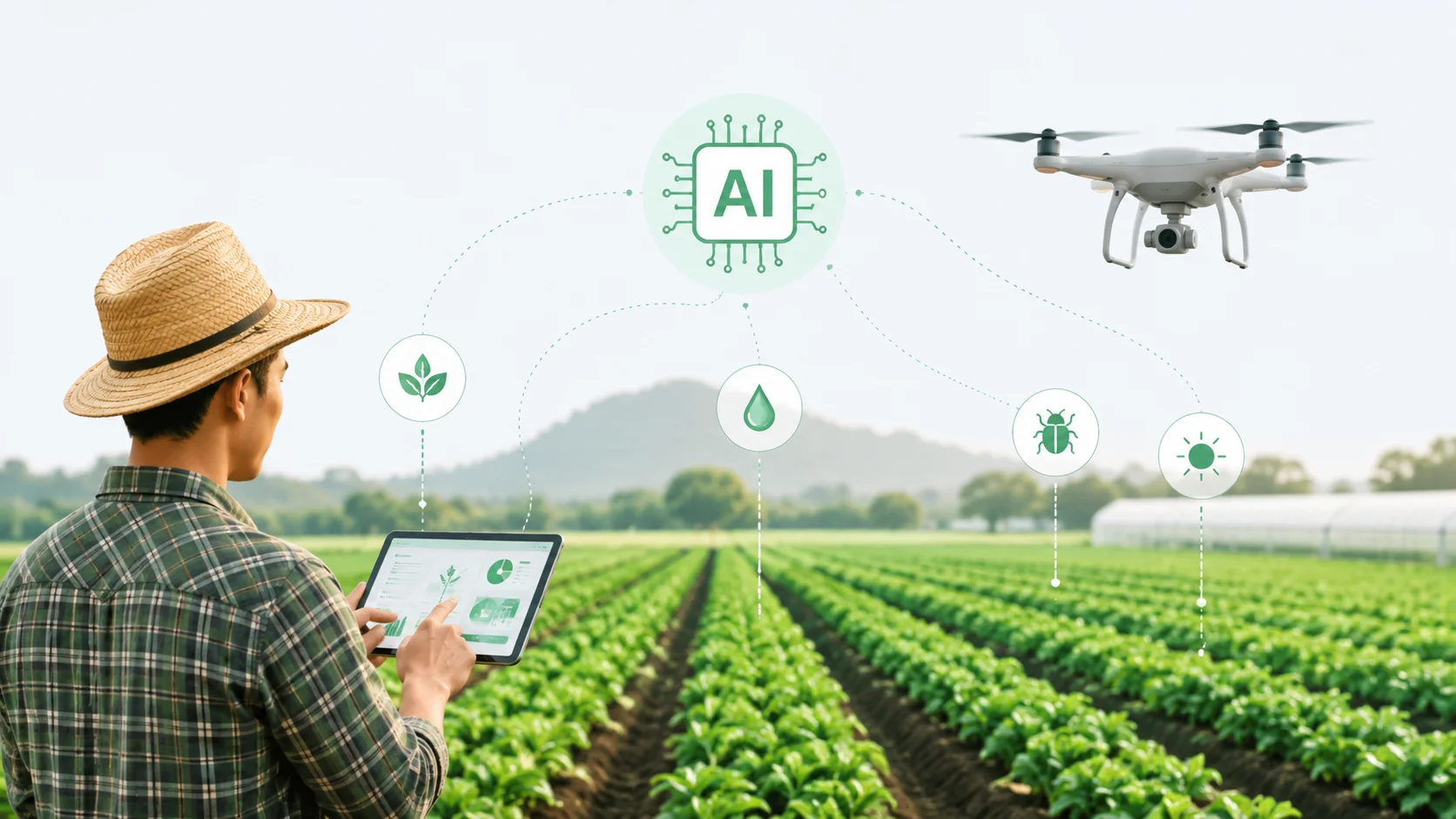
Farming has always been a gamble against weather, pests, and market prices. Generations of farmers relied on instinct, experience, and hope. That approach worked when the stakes were lower and the world needed less food.
Today, the global population demands more food from less land with fewer resources. Climate patterns are shifting, water is scarce in many regions, and labor shortages hit farms harder every year. The margin between a profitable harvest and a devastating loss keeps shrinking.
Artificial intelligence is changing how farms operate from the ground up. AI analyzes soil conditions, predicts weather impacts, monitors crop health from satellite imagery, and automates irrigation systems in real time. Here is how farmers and agricultural businesses are using AI to grow more food, waste fewer resources, and make smarter decisions at every stage of the growing cycle.
Why AI Matters for Modern Agriculture
Traditional farming decisions rely on averages. You plant based on last year’s weather, spray pesticides on a schedule, and irrigate entire fields uniformly. This blanket approach wastes water, chemicals, and money because every square meter of a field has different needs.
AI enables precision agriculture, where every decision is tailored to specific conditions at specific locations within a field. Sensors collect data on soil moisture, nutrient levels, and temperature. Drones capture high-resolution images of crop health. Machine learning algorithms process all of this data and deliver actionable recommendations in minutes.
According to the Food and Agriculture Organization of the United Nations, AI-driven agriculture could increase global crop yields by up to 70 percent by 2050 while reducing water usage and chemical inputs. That is not a marginal improvement. It is a transformation of the entire food production system.
Farming without data is guessing. AI turns every field into a laboratory where every decision is backed by evidence instead of intuition.
AI Applications in Smart Farming
AI touches almost every aspect of modern farming. The applications range from planting and growing to harvesting and selling. Each one solves a specific problem that costs farmers time, money, or yield.
| Application | What AI Does | Impact |
|---|---|---|
| Crop monitoring | Analyzes drone and satellite imagery for disease, stress, and growth patterns | Early detection saves 20-30% of crop loss |
| Precision irrigation | Uses soil sensors and weather data to water only where and when needed | Reduces water usage by 25-50% |
| Pest and disease prediction | Identifies threats before visible symptoms appear using image recognition | Cuts pesticide use by 30-40% |
| Yield prediction | Forecasts harvest volumes using historical and real-time data | Improves planning and market timing |
| Soil analysis | Maps nutrient levels across fields for targeted fertilization | Reduces fertilizer waste by 20-30% |
| Autonomous equipment | Self-driving tractors and robotic harvesters operate with minimal human input | Addresses labor shortages |
The most effective farms combine multiple AI applications into an integrated system. When your irrigation system talks to your soil sensors and your crop monitoring drones feed data into the same platform, the results multiply.
AI-Powered Crop Monitoring and Disease Detection
Crop diseases spread fast. A fungal infection that starts in one corner of a wheat field can destroy the entire crop within weeks if you do not catch it early. Traditional scouting means walking the fields and looking for problems with your eyes, which misses early-stage infections that are invisible to humans.
How Computer Vision Detects Crop Problems
Computer vision tools mounted on drones or satellites capture multispectral images that reveal plant stress before it becomes visible. Healthy plants reflect light differently than stressed ones. AI analyzes these subtle differences across millions of pixels and creates detailed maps showing exactly which parts of a field need attention.
These systems detect nitrogen deficiency, water stress, fungal infections, and insect damage with accuracy rates above 90 percent. They scan an entire 500-acre farm in under an hour, a task that would take a human scout days to complete on foot.
Real-Time Alerts and Recommendations
When AI detects a problem, it does not just flag it on a map. Advanced systems recommend specific interventions: which fungicide to apply, how much, and exactly where. This targeted approach treats only the affected area instead of spraying the entire field, saving money and reducing chemical runoff into waterways.
The same data analytics capabilities that power business intelligence apply directly to agricultural decision-making. The difference is that in farming, the data points are soil moisture readings, leaf color variations, and weather forecasts instead of sales figures and customer behavior.
A drone with AI sees what the human eye cannot. It catches the whisper of disease before it becomes a scream that costs thousands in lost yield.
Precision Irrigation With AI
Water is the most critical and most wasted resource in agriculture. Traditional irrigation systems run on timers or manual judgment, delivering the same amount of water everywhere regardless of actual need. In a field where soil composition varies from sandy to clay within a few hundred feet, uniform watering guarantees that some areas get too much and others not enough.
Sensor-Driven Water Management
AI irrigation systems combine data from soil moisture sensors, weather forecasts, satellite imagery, and crop growth models to calculate exactly how much water each zone of a field needs. They adjust in real time based on changing conditions. If rain is predicted for tomorrow, the system reduces today’s irrigation automatically.
These systems typically reduce water consumption by 25 to 50 percent while maintaining or improving crop yields. For farms in drought-prone regions, that reduction can mean the difference between a viable operation and bankruptcy.
Integration With Weather Prediction
AI weather models go far beyond the forecasts you see on the news. Agricultural AI systems process hyperlocal weather data, accounting for microclimates within individual farms. They predict frost events, heatwaves, and precipitation with higher accuracy than general forecasts because they train on data specific to the farm’s geography and elevation.
This integration allows farmers to make proactive decisions rather than reactive ones. Knowing that a cold snap is coming three days in advance gives time to adjust irrigation, apply protective treatments, or delay planting schedules.
AI Tools and Platforms for Farmers
Several AI platforms are already available to farmers at various price points and complexity levels. You do not need a computer science degree to use them.
| Platform | Free Option | Best For | Key Feature |
|---|---|---|---|
| John Deere Operations Center | Free basic tier | Equipment integration and field mapping | Connects directly to compatible machinery |
| Climate FieldView | Free basic plan | Data-driven planting and harvest decisions | Field-level yield analysis and prescriptions |
| Plantix | Free mobile app | Crop disease identification | Snap a photo and get instant diagnosis |
| FarmLogs | Free tier available | Farm management and record keeping | Rainfall tracking and profit/loss per field |
| Taranis | Demo available | Aerial crop intelligence | Leaf-level imagery from drones and planes |
| ChatGPT | Free tier | General farming questions and planning | Custom advice through conversational prompts |
For small farms just getting started with AI, a free app like Plantix combined with ChatGPT for research and planning provides immediate value. Larger operations benefit from integrated platforms that connect sensors, equipment, and analytics into a single dashboard.
Knowing how to write effective prompts makes general-purpose AI tools significantly more useful for agricultural applications. Asking “What should I plant?” gives a generic answer. Asking “Given sandy loam soil in central California with 12 inches of annual rainfall and a growing season from March to October, what cover crop rotation maximizes nitrogen fixation?” gives actionable advice.
AI for Livestock Management
AI in agriculture extends beyond crops. Livestock operations use AI to monitor animal health, optimize feeding, and improve breeding outcomes.
- Wearable sensors on cattle track movement patterns, feeding behavior, and body temperature. AI detects early signs of illness hours before visible symptoms appear, allowing treatment before the condition spreads to the herd.
- Automated feeding systems adjust rations based on each animal’s weight gain, milk production, and nutritional needs. This precision feeding reduces feed waste by 10 to 15 percent while improving animal health.
- AI-powered cameras monitor poultry houses for abnormal behavior patterns that indicate disease outbreaks, ventilation problems, or overcrowding stress.
- Breeding optimization algorithms analyze genetic data to recommend mating pairs that maximize desirable traits while maintaining genetic diversity.
These technologies address a critical challenge in livestock farming: the impossibility of individually monitoring thousands of animals. AI watches every animal continuously and alerts the farmer only when something needs human attention.
AI and Supply Chain Optimization in Agriculture
Growing the crop is only half the challenge. Getting it to market at the right time, in the right condition, and at the right price determines whether the farm makes money.
Harvest Timing and Market Predictions
AI predicts optimal harvest windows by analyzing crop maturity data, weather forecasts, and market price trends simultaneously. Harvesting a week early or late can cost thousands in quality downgrades or missed price peaks. AI removes the guesswork by crunching more variables than any human can process.
The same approach works for predictive ordering and inventory management throughout the food supply chain, from farm to restaurant to grocery store.
Reducing Post-Harvest Losses
Globally, about one-third of food produced is lost or wasted between harvest and consumption. AI-powered cold chain monitoring tracks temperature, humidity, and handling conditions from the moment produce leaves the field. According to McKinsey, AI-optimized supply chains can reduce food waste by up to 50 percent in developing markets where infrastructure is limited.
Smart sorting systems use computer vision to grade produce by size, color, and defect presence at speeds impossible for human workers. This automated grading improves consistency, reduces labor costs, and ensures that premium-quality products reach premium-price markets.
The world does not have a food production problem. It has a food waste problem. AI attacks waste at every point in the chain where food is lost between the field and the plate.
Getting Started With AI on Your Farm
You do not need to overhaul your entire operation to start benefiting from AI. A phased approach reduces risk and lets you learn as you go.
- Start with a free crop monitoring app on your phone. Take photos of plant issues and let AI diagnose them. This costs nothing and builds familiarity with the technology.
- Install a few soil moisture sensors in your most variable field. Even basic sensor data reveals patterns that change how you irrigate.
- Use AI productivity tools for farm record keeping, market research, and financial planning. These save hours of administrative work every week.
- Consider a drone survey of your property once per season. The aerial imagery reveals field variability, drainage problems, and growth patterns invisible from ground level.
- Connect with your local agricultural extension office. Many universities now offer free AI training programs for farmers through USDA-funded initiatives.
The key is starting small, measuring results, and expanding what works. A single soil sensor that saves 20 percent on water in one field pays for itself in a season and proves the concept for scaling across the operation. Automation tools that handle repetitive tasks free up your time to focus on the decisions that actually require human judgment.
Challenges and Limitations of AI in Agriculture
AI is not a magic solution for every farming problem. Understanding its limitations helps you invest wisely and set realistic expectations.
| Challenge | Reality | Mitigation |
|---|---|---|
| Connectivity | Many rural areas lack reliable internet | Edge computing and offline-capable devices |
| Cost | Advanced systems require upfront investment | Start with free tools, scale gradually |
| Data quality | AI is only as good as the data it receives | Proper sensor placement and calibration |
| Learning curve | New technology requires time to learn | Training programs and community support |
| Local conditions | AI models trained elsewhere may not fit your region | Choose platforms with local data sets |
The connectivity issue is real but improving rapidly. Satellite internet services are expanding rural coverage, and many AI farming tools now work offline, syncing data when a connection becomes available. The AI tools available for businesses today are more accessible and affordable than ever, and agricultural platforms follow the same trend.
Conclusion
Using AI for smart farming and agriculture transforms how food is grown, monitored, and delivered. From precision irrigation that cuts water waste in half to computer vision that catches crop disease before it spreads, AI gives farmers the data-driven edge they need to produce more with less. The technology is accessible at every scale, from a free phone app that diagnoses plant diseases to integrated platforms that manage entire operations autonomously. Farms that adopt AI today are not just improving their margins. They are building the resilience needed to feed a growing world under increasingly difficult conditions.