The last30days skill is one of the most-starred Claude Code tools on GitHub right now. You type /last30days and a topic, and it searches Reddit, Hacker News, YouTube, GitHub and more for what people said in the last 30 days, then writes a brief with links and quotes. We wanted to know if it beats Claude Code’s own web search, so we asked both the same question on the same day.
Below you will find how to install the last30days skill, what it quietly does to your computer, and what our side-by-side test showed. The short version: it hears the community far better than plain Claude, but it is not a complete news brief, and it costs twice as much.
Quick verdict
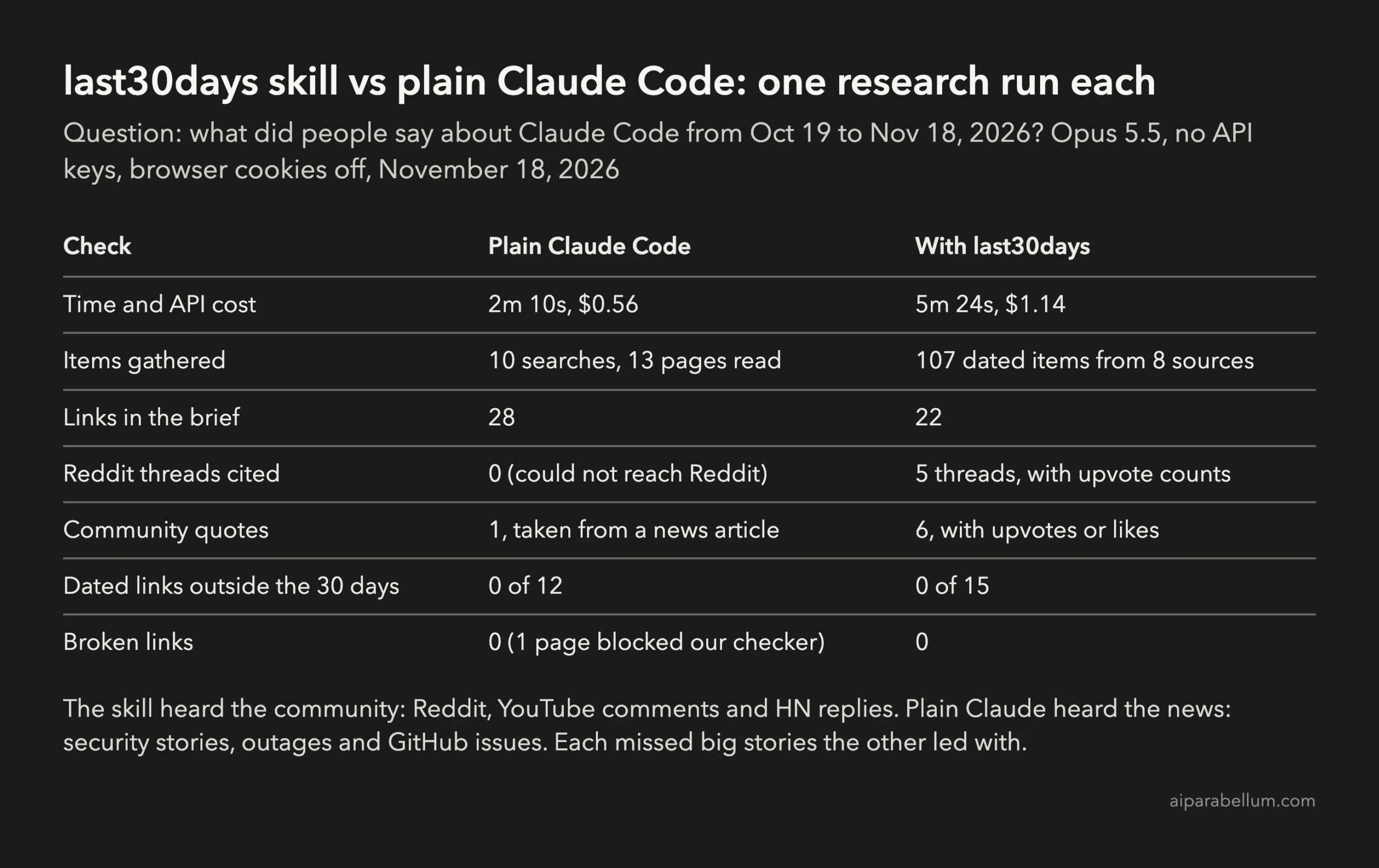
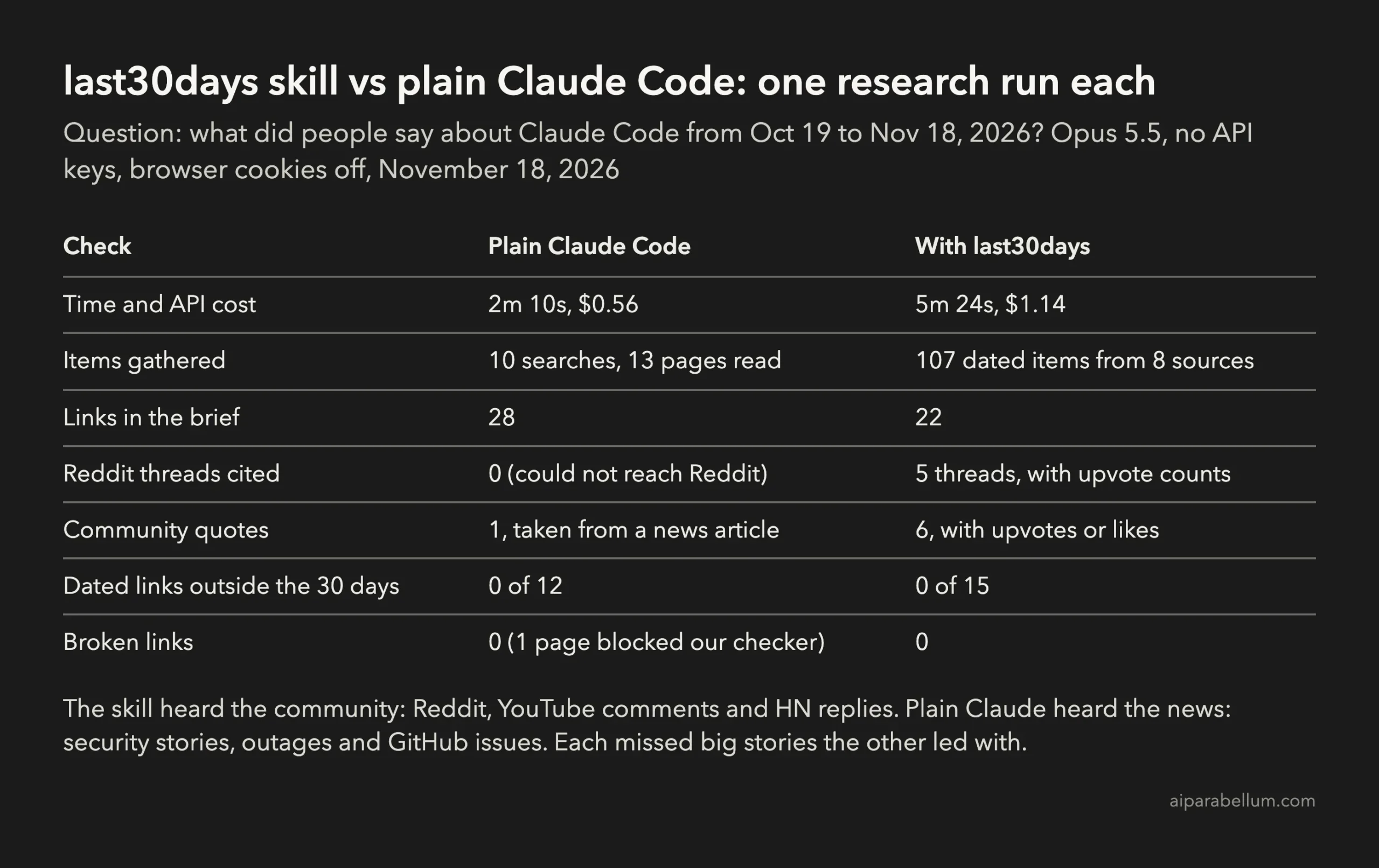
The skill pulled 107 dated items from 8 sources with no API keys. Its brief cited 5 Reddit threads with upvote counts and quoted 6 real comments and videos. Plain Claude Code could not reach Reddit at all and quoted one developer, through a news article.
Plain Claude was not worse, just different. It led with the month’s big news: a security incident, an outage, game-project refusals and complaints about limits. The skill left all four out of its brief, even though two of them were in its own raw data.
The skill run took 5 minutes 24 seconds and $1.14, against 2 minutes 10 seconds and $0.56. Both briefs had zero links outside the 30-day window and zero broken links. Install it if you want to know what developers, buyers or fans are actually saying, and read the setup notes below first.
What the last30days skill is
The skill lives in the last30days-skill GitHub repository, which is MIT licensed. We tested version 4.3.2, released on November 17, 2026. It is more than a prompt: the skill ships a Python research engine of 127 library files and 17 reference guides that tell Claude how to plan, search and write.
Claude does the thinking and the engine does the fetching. Claude writes a search plan, the engine queries every source in parallel and scores each item by engagement, relevance and freshness, and Claude turns the ranked evidence into a brief.
| Source | What you need |
|---|---|
| Reddit, Hacker News, Polymarket, GitHub | Nothing, works right away |
| arXiv, Techmeme, Digg, Yahoo Finance | Small free helper programs that first-run setup installs |
| YouTube | The free yt-dlp tool |
| dev.to | Nothing; Claude adds it to the search plan for developer topics |
| X | An X API token, an xAI key, or permission to read your browser’s x.com cookies |
| TikTok, Instagram, Threads, LinkedIn | A paid ScrapeCreators key (10,000 free calls first) |
We tested only the free, keyless sources. That still covered 8 of them.
How to install the last30days skill in Claude Code
You need Python 3.12 or newer. The recommended install is the plugin marketplace, inside Claude Code:
/plugin marketplace add mvanhorn/last30days-skill
/plugin install last30days
That keeps it updated automatically. For our test we used a project-level install instead, so the skill only existed in one throwaway folder. You can do the same by copying the skill folder into your project:
git clone --depth 1 https://github.com/mvanhorn/last30days-skill.git
mkdir -p .claude/skills
cp -R last30days-skill/skills/last30days .claude/skills/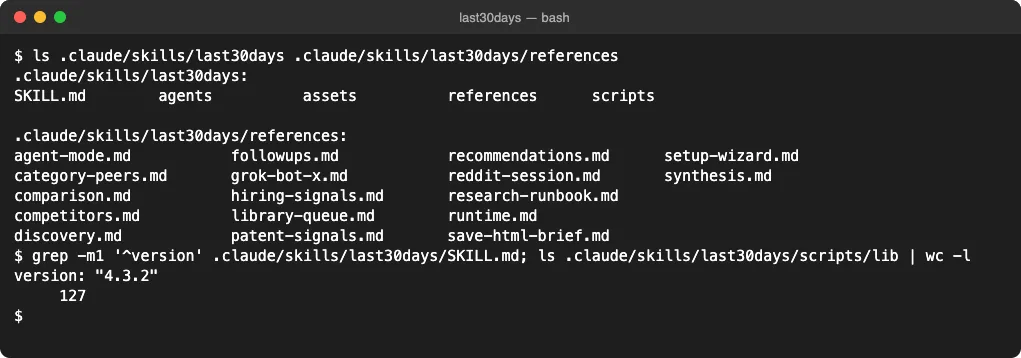
The Claude Code skills docs explain the difference between project and personal skill folders. Then just type a topic:
/last30days Claude CodeRead this before your first run
The first run starts a setup wizard. It is quick, but it does more than most skills, so here is what to expect.
It asks to read your browser cookies
To search X without an API key, setup asks for permission to read your browser’s x.com cookies, and it checks Chrome and other browsers. The skill asks first and remembers a no. If you don’t want any cookie reads, answer “Skip X” or set FROM_BROWSER=off in ~/.config/last30days/.env. We turned cookies off for the whole test.
It installs four helper programs
Setup installs command-line helpers for Digg, arXiv, Techmeme and Yahoo Finance into ~/.local/bin, plus yt-dlp through Homebrew or pip if it is missing. On our Mac, which has the Go language installed, setup built all four helpers from source.
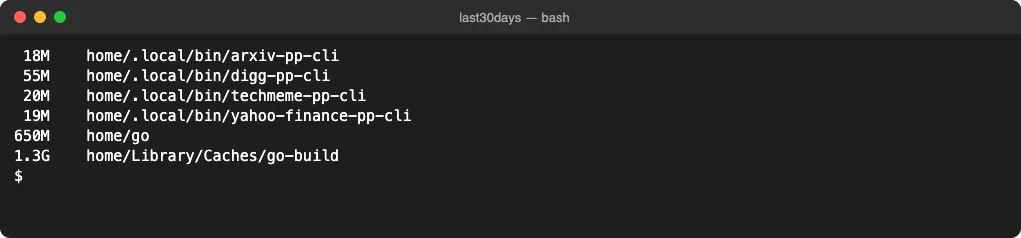
The helpers themselves are 112 MB. The Go build and download caches added about 2 GB more. If you don’t use Go for anything else, go clean -cache -modcache frees that space after setup.
It borrows your GitHub login
If the GitHub CLI is signed in on your computer, the engine runs gh auth token and uses that login for its GitHub searches. It only reads public data, but it is your login and your rate limit. Set GITHUB_TOKEN to a read-only token if you want to control this. In our test, an empty gh config folder was not enough to hide the login, so treat the skill as able to use it.
It writes files in your home folder
Research briefs are saved to ~/Documents/Last30Days by default, and run data goes to ~/.config/last30days. The helpers keep small caches in ~/.cache and ~/.local/share. Set LAST30DAYS_MEMORY_DIR to choose where briefs go.
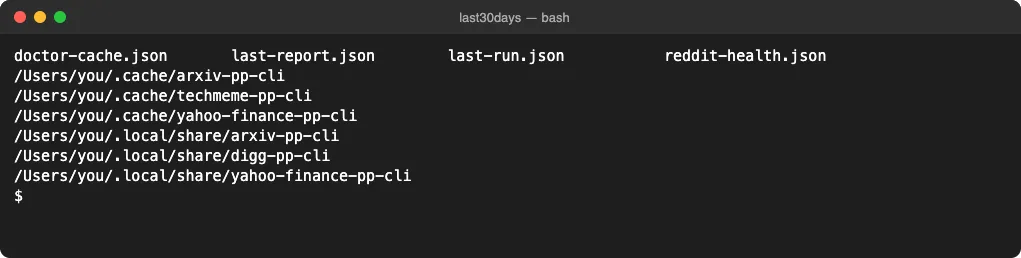
The skill’s preflight command shows most of this before you research, without reading cookies or writing files:
python3 .claude/skills/last30days/scripts/last30days.py --preflight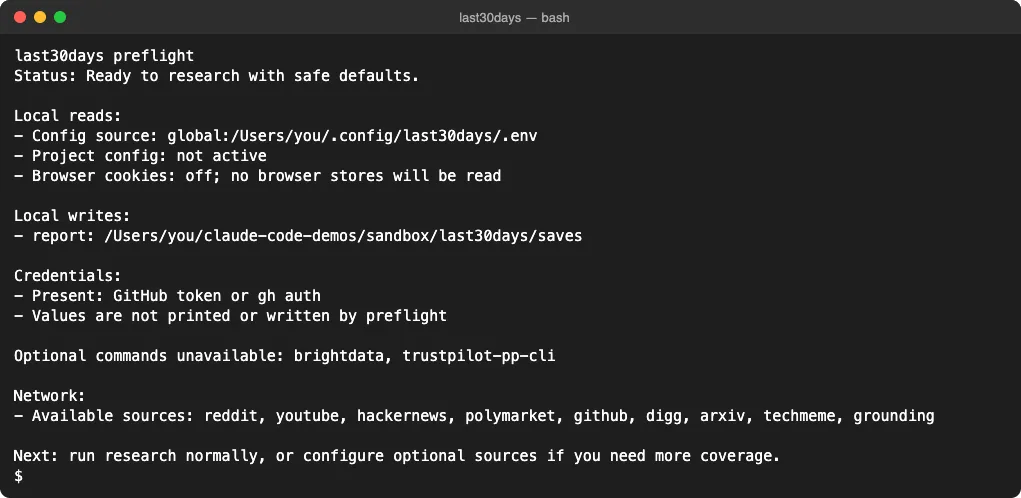
How we tested it
We made two empty folders. One had the last30days skill; the other had nothing extra. Both used Claude Code with Opus 5.5 on November 18, 2026, with no API keys and browser cookies off.
The skill folder got /last30days Claude Code. The plain folder got the same request in words: research what people said about Claude Code from October 19 to November 18 across Reddit, Hacker News, X, YouTube, GitHub and the web, with a link for every claim.
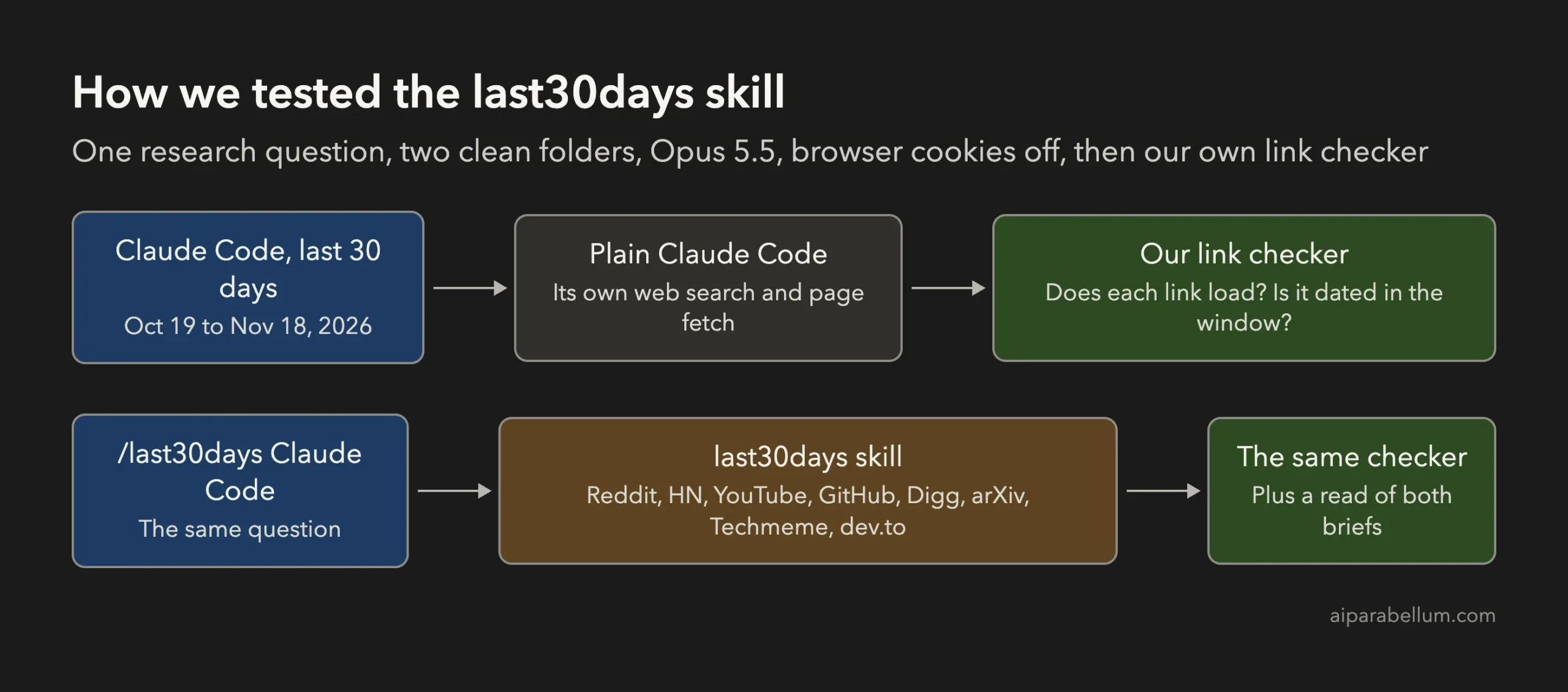
Afterward we checked every link in both briefs. Our checker loaded each page and read the posting date from Hacker News, YouTube and X post IDs. Reddit blocked our checker, so we took those thread dates from the skill’s own raw results file.
What the last30days skill found
In one engine run, the skill came back with 26 Reddit threads, 28 Hacker News stories, 11 YouTube videos, 20 Digg clusters, 10 Techmeme headlines, 7 arXiv papers, 4 dev.to articles and GitHub stats. It saved everything to a 146 KB raw file.
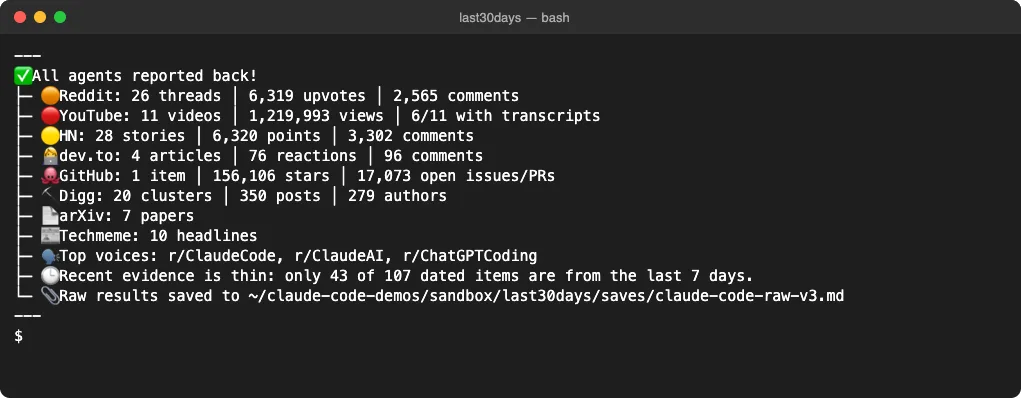
The brief read like a smart friend who lives on Reddit. It covered enterprise pushback over cost, the pull of cheaper open-weight models, a settings bug that leaked secrets, a talk by the Claude Code team, and advice for new users. Most themes came with a quote and its upvote or like count.
The best example was a thread about teaching a reluctant developer Claude Code in three days. The top reply, with 815 upvotes, was simple: “Tell him to treat it like a junior dev.” Plain Claude never saw that thread.
There was one real slip. The brief called a Goldman Sachs thread “the biggest Hacker News thread of the month.” The skill’s own data showed it at 905 points, while a thread about Claude Code sending users’ email addresses had 1,616. The engine ranks items by a blended score, and the write-up treated that rank as size.
What plain Claude Code found
Plain Claude ran 10 web searches and read 13 pages, including five Hacker News threads, a GitHub issue and the official changelog. Its brief was organized like a news roundup, with a clear note at the end about what it could not cover.
It led with stories the skill’s brief missed: a tampered Claude Code extension on another company’s marketplace, refusals to recreate existing games, a November 13 sign-in outage, and GitHub issues about weekly limits draining fast. Its Hacker News point counts matched the live numbers.
Its weak spot was the community itself. Reddit was unreachable, and its five X links were all official Anthropic posts. As its own brief put it, “Reddit sentiment is only included second-hand.”
Side by side: what each brief led with
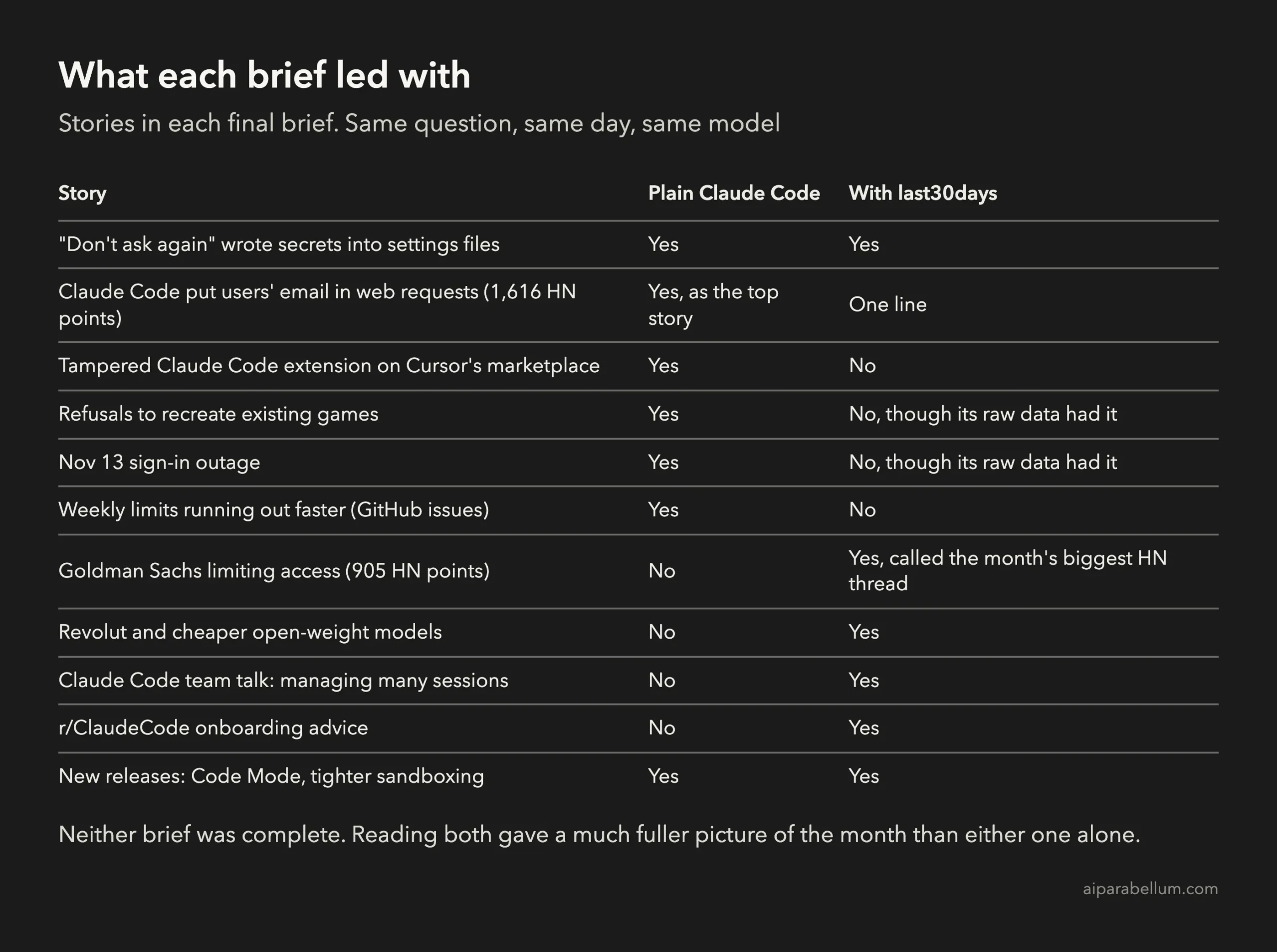
The interesting part is why. The skill’s raw file did include the game refusals and the outage, ranked in its top 30. Its brief picked six themes with the strongest community engagement, so news-style stories with fewer comments fell out.
The numbers behind the last30days skill test
| Check | Plain Claude Code | With last30days |
|---|---|---|
| Time and API cost | 2m 10s, $0.56 | 5m 24s, $1.14 |
| Turns and output tokens | 25 turns, 6,277 | 17 turns, 8,644 |
| Links in the brief | 28 | 22 |
| Links by type | 9 web, 5 HN, 5 X, 5 GitHub, 2 YouTube, 2 Anthropic | 6 Reddit, 6 web, 5 HN, 4 YouTube, 1 GitHub |
| Dated links outside the window | 0 of 12 | 0 of 15 |
| Broken links | 0 (1 page blocked our checker) | 0 |
| Brief length | 858 words | 1,071 words |
Freshness was a tie. Both tools stayed inside the 30 days on every link we could date, which is the part people usually worry about with AI research.
Who should install it
Install the last30days skill if your question is “what are people saying?” It is great before you write about a tool, launch a product, compare two options or meet someone, because it brings back real threads and comments with numbers attached. For research beyond social sources, our roundup of Claude Code research skills covers deep-research tools.
For the news itself, pair it with a normal web search or ask Claude to check the major outlets too. The skill’s brief is ranked by engagement, so quieter but important stories can drop out. If you need full-page scraping, our guide to web search plugins and our Scrapling MCP test cover tools built for that.
Be careful on a work machine. The cookie question, the borrowed GitHub login and the helper installs are all reasonable, but you should decide on each one rather than click through. If you want Claude to double-check its own output too, our Claude Code verification setup works well with research briefs. The Skills Directory lists hundreds more skills to try.
What we did not test
Each tool ran once through claude -p on one topic, so treat time and cost as a rough guide. We did not test X, TikTok, Instagram or any paid source, the Reddit login option, the watchlist and daily briefing scripts, or comparison mode such as “Claude Code vs Codex.”
We also did not check every claim inside the briefs, only the links, dates and the engagement numbers we could confirm. Both briefs reported what people said, which is not the same as what is true, and the skill itself frames its output that way.
Final verdict
The last30days skill gives Claude Code something it can’t do on its own: read Reddit, YouTube comments and Hacker News replies at scale and report what real people said, with numbers, in a few minutes. In our test it was fresh, well-linked and full of voices that plain Claude never reached, at about twice the cost and time. It is not a full news brief, and its setup asks for more access than a typical skill, so turn cookies off unless you need X and point its saves where you want them. Used that way, the last30days skill is one of the most useful research add-ons you can give Claude Code. Find more hands-on tests in our Claude Code tutorials.