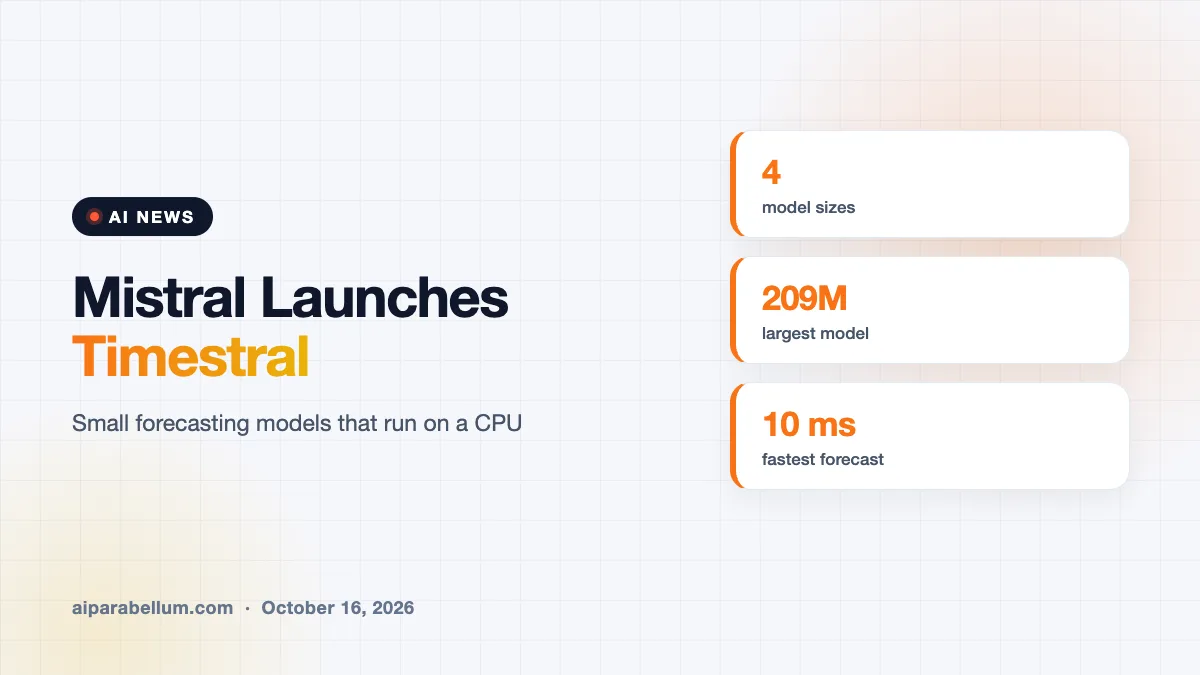
Mistral AI has released Timestral, its first family of time-series forecasting models, and the French lab says they beat larger rivals while running on an ordinary CPU. Mistral Timestral is built to predict numbers that change over time, like sensor readings, sales volumes, or server load. The largest version has just 209 million parameters, a tiny size next to today’s chatbots, yet Mistral says it ranks first on the field’s three main public benchmarks.
What Mistral Timestral Is Built For
Time-series data is everywhere in business. Factories track vibration and temperature, finance teams watch cash flows, and IT teams monitor traffic on their servers.
Forecasts on that data drive big decisions, from ordering spare parts to planning power use. Older tools like ARIMA usually learn from one data series at a time, so they start from scratch on every new problem.
Timestral works more like a language model. It was pre-trained on a huge mix of data, so it can forecast series it has never seen before, a skill known as zero-shot forecasting.
Features That Set It Apart
- Multivariate forecasts, so related signals like a pump’s pressure and temperature are predicted together
- Probabilistic output that shows a range of likely outcomes, not just one number
- Support for known-future inputs, such as holidays, weather forecasts, or planned shutdowns
- Categorical inputs like day of the week or whether a machine is running or idle
Four Timestral Model Sizes, No GPU Needed
Mistral is offering four sizes that share the same design and training recipe. The smaller ones are faster and cheaper, while the bigger ones are more accurate.
| Model size | Best use | Speed on an 8-thread CPU |
|---|---|---|
| 5M parameters | Very fast, low-cost forecasts | About 10 milliseconds |
| 28M parameters | Balance of speed and accuracy | About 5 times faster than 209M |
| 123M parameters | Near-top accuracy | About three quarters of 209M’s time |
| 209M parameters | Highest accuracy | About 140 milliseconds |
Those timings are for forecasting one day ahead from three weeks of 15-minute readings. Mistral says the 123M model lands within 0.2% of the top model’s score.
How It Stacks Up
Mistral says its 209M model ranks first on GIFT-Eval, TIME, and fev-bench among pre-trained, zero-shot models. It claims the model beats TimesFM-3 and Falcon-2.0 with fewer parameters, and that even the 28M version beats Chronos-2, a rival that is about four times larger.
These are Mistral’s own results, though it says it has submitted them to the public GIFT-Eval and TIME leaderboards. A full technical report is still to come.
How Timestral Fits Into AI Agents
Mistral pitches Timestral as a partner for its language models. In its example, the model watches a plant’s sensor streams and flags a strange reading on a pump.
An AI agent then compares that signal with past failures, digs through maintenance logs and manuals, and drafts a likely diagnosis. The plant manager gets a plan backed by data instead of a bare alarm.
Companies that need more can fine-tune Timestral on their own data through Mistral Forge. The full pipeline can even run on a customer’s own hardware, including air-gapped systems with no internet connection.
What This Means for You
If your team forecasts anything, from inventory to energy bills, Timestral is a sign that strong forecasting no longer needs expensive hardware. A model that runs in milliseconds on a CPU can slot into tools you already use.
- Try the code on Mistral’s GitHub repository with a sample of your own data.
- Compare it against your current method, since benchmark wins do not always carry over to real data.
- Start with a smaller model if speed or cost matters more than the last bit of accuracy.
- Feed in known future events, like promotions or holidays, to sharpen forecasts.
For background, see our guide to AI demand forecasting and our roundup of data analytics tools. Forecasting AI is on a roll, as shown by Microsoft’s six-week weather model, and you can find more stories on our AI news page.
Sources
This article is based on the official launch announcement from Mistral AI.
Conclusion
Timestral is Mistral’s first move into time-series forecasting, and it arrives as a family of four small models from 5 million to 209 million parameters. Mistral says the largest one tops three major benchmarks while running on a regular CPU in a fraction of a second. Features like probabilistic and multivariate forecasts make it a good fit for factories, finance, and IT teams. The results are company-reported for now, with a technical report still on the way. If your business lives on forecasts, it is worth a test run against the tools you use today.