Monday.com has launched Harmony, a new voice AI platform that phones sales leads, qualifies them and hands the promising ones to human reps. The company announced it on October 19, 2026, and it is aimed at mid-market and large businesses in the US, UK, Australia and Singapore. If your sales team struggles to call every lead before it goes cold, this is the problem Harmony is built to solve.
What Harmony Voice AI Actually Does
Harmony works like an always-on calling team. Its AI agents dial leads, ask qualifying questions, handle common pushback and take notes, then transfer a warm prospect to a live salesperson with a short briefing.
Beyond the agents, Harmony bundles the plumbing that a call center needs. Here is what the launch includes:
- Outbound dialing and inbound call routing, with telephony built on Twilio
- Lead qualification, objection handling and live handoffs to human reps
- Consent and recording controls for compliance
- Call notes written back to CRM tools such as Salesforce and HubSpot
- Agents that tell callers they are talking to an AI by default
That last point matters. A lot of people now worry about robocalls and AI voice scams, so a clear disclosure is a smart default for any business using this kind of tool.
Why Harmony Uses Small Models Instead of One Big LLM
The most interesting part of Harmony is how it is built. Instead of sending every word through one large language model, it uses a set of small models trained on real customer calls. Each one handles a single job, such as qualifying a lead, spotting a voicemail or responding to an objection.
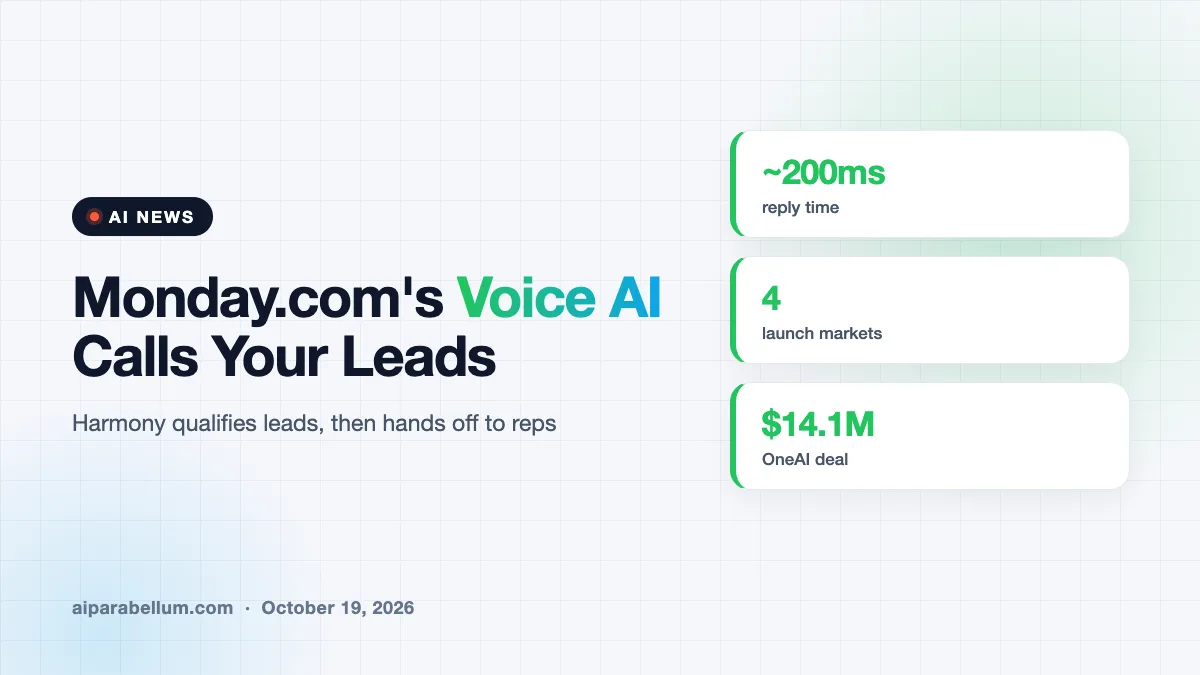
Speed is the main reason. Monday.com says its agents reply in about 200 milliseconds because the compact models run largely on Harmony’s own servers. Long pauses make a phone call feel robotic, and a prospect who hears dead air is likely to hang up.
A sales call is a series of small, predictable steps. Harmony’s bet is that a fast specialist for each step beats a slow generalist for the whole call.
Vitali Margolin, who leads Harmony, put it simply in an interview: “You can’t use large language models that are very slow in a real-time conversation.” He also stressed that the tool is not meant to close big deals or replace sales staff.
Where the Technology Came From
Harmony grew out of OneAI, a voice AI company Monday.com bought in May 2026 for $14.1 million in cash, according to a company filing. Rather than folding OneAI into its existing CRM, Monday.com spun the technology out as a standalone product that can connect to its wider platform later.
Harmony by the Numbers
Several figures came with the launch. Keep in mind that most of them are company claims, not results from independent testing.
| Detail | What Monday.com Says |
|---|---|
| Launch date | October 19, 2026 |
| Markets | US, UK, Australia and Singapore |
| Response time | About 200 milliseconds |
| Contact rate | Up to 70% (method not shared) |
| Pricing | Not published; billed per minute |
| Built on | OneAI, acquired for $14.1 million |
One early customer, UK car finance broker Bright Car Finance, says Harmony helped it close 9% more deals in less than a year. Before, the broker turned only about 5% of approved applications into finance agreements because leads went cold before reps could call back.
The Bigger Picture for Monday.com and Voice AI
Harmony is part of a wider push by Monday.com to rebuild itself around AI. In July, the company said it would cut about 620 jobs, roughly a fifth of its staff. In June, it set up a $200 million fund to back workplace AI startups.
The voice agent market is getting crowded fast. Startups such as Bland and Vapi have each raised $50 million this year, and many CRM vendors are adding their own calling agents. This shift is part of a larger debate about AI sales reps and how much of the sales funnel software should handle.
Margolin says the next steps include SMS support and a single view of AI and human conversations. The long-term goal is for the AI to learn from a company’s best human reps automatically.
What This Means for You
If you run or work on a sales team, Harmony is one more sign that AI calling is becoming a normal part of the toolkit. Here is how to think about it:
- Start with your follow-up gap. These tools shine when leads pile up faster than reps can call them back, not on complex, high-value deals.
- Ask for real numbers. Contact rates and response times sound great, but request a pilot and track transfers, errors and closed deals yourself.
- Check compliance setup. Disclosure and consent controls only help if they are configured correctly for your region.
- Compare options. If you already use HubSpot CRM AI or the Monday AI tools, see how a voice agent would plug into your current workflow before buying.
On the receiving end, expect more calls from AI agents. A good one will tell you up front that it is an AI, and you can always ask for a human. You can browse more options in our AI agent directory or catch up on the latest AI industry news.
Sources
This report draws on launch coverage from The Next Web and an interview with Harmony’s leader published by CX Today.
Conclusion
Harmony shows how Monday.com plans to turn its OneAI purchase into a real product: fast, task-focused voice agents that call leads and pass the good ones to people. The design choice of many small models over one big LLM is a sensible answer to the lag problem that makes many AI phone calls feel awkward. Still, the headline numbers come from the company, and no prices are public yet. For sales teams, the smart move is to test it against your own leads before trusting the claims. For everyone else, it is a clear signal that the next sales call you get may well start with an AI introducing itself.