
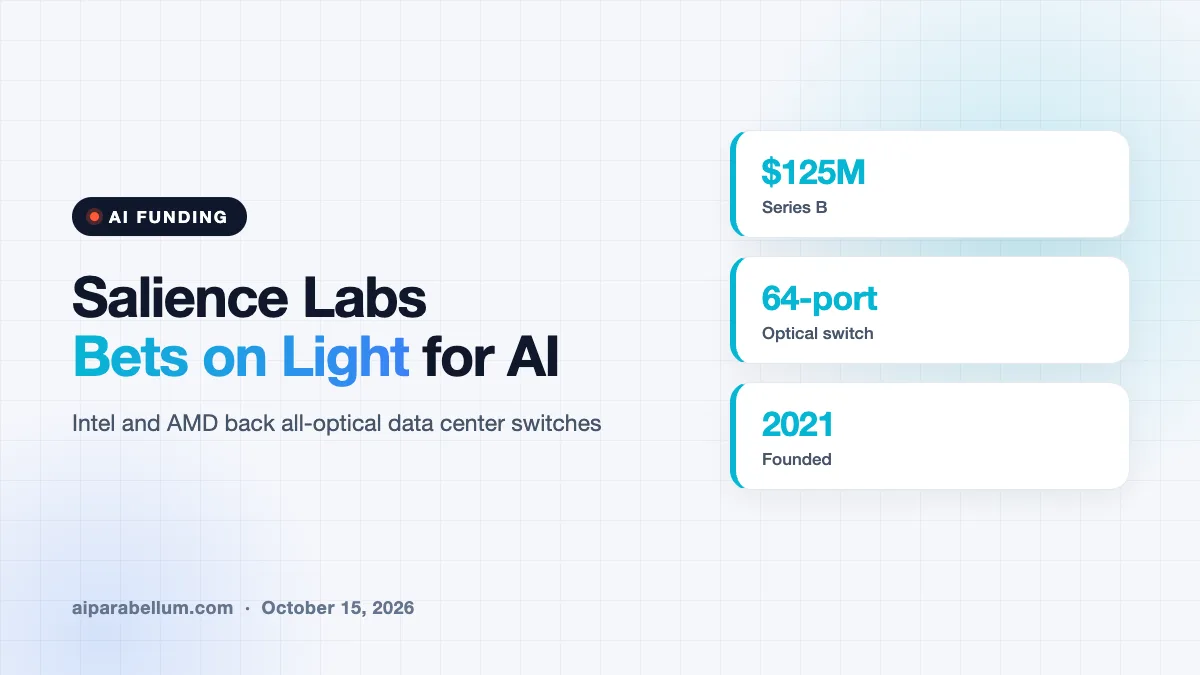
Salience Labs, a startup from Oxfordshire in the UK, has raised $125 million to build optical switches for AI data centers. These switches move data between graphics chips as pure light instead of turning it into electrical signals along the way. The company says that cuts delays and power use, two of the biggest headaches in today’s giant AI clusters.
Inside the $125M Series B Round
Bullhound Capital led the Series B round. The chip world showed up in force too, with the investment arms of both Intel and AMD joining the deal.
Other new backers include SBI Group, trading firm Hudson River Trading and the British Business Bank, which is backed by the UK government. Several earlier investors also put in more money, and a Bullhound principal is joining the company’s board.
| Detail | What we know |
|---|---|
| Amount raised | $125 million (Series B) |
| Lead investor | Bullhound Capital |
| Chipmaker backers | Intel Capital and AMD Ventures |
| Other new investors | SBI Group, Hudson River Trading, British Business Bank |
| Returning investors | Applied Ventures, Oxford Science Enterprises, Cambridge Innovation Capital, Silicon Catalyst Ventures |
| Founded | 2021, in Milton, Oxfordshire |
| Latest product | 64-port all-optical switch, shown in September 2026 |
How Optical Switches Work in AI Data Centers
Inside most data centers today, data travels over fiber as light. But when it reaches a regular network switch, it gets converted into an electrical signal, routed, and then turned back into light. That back-and-forth happens over and over, and each step adds delay and burns power.
Salience takes a different path. Its switch sets up a direct route for the light itself, so the signal never leaves the optical world. The whole design sits on a single silicon photonics chip, which the company says is built for high-volume manufacturing.
Why AI Workloads Need This
Modern AI models are trained and run on clusters of tens of thousands of graphics chips. Those chips can only work as fast as the network feeding them data. CEO Vaysh Kewada argues that network bandwidth has fallen behind raw computing power, which leaves expensive chips waiting around.
Chipmakers are trying to solve the same problem from the chip side, as seen in recent designs like the Maia 300 chip and Nvidia’s push for open data center designs. Salience is betting the network deserves just as much attention.
What the Optical Switch Startup Plans Next
In September, Salience showed off a 64-port all-optical switch at the ECOC 2026 conference. The company calls it an industry first for silicon photonics switching. An earlier 32-port version launched in the spring.
The new money will go toward a few clear goals:
- Scaling up high-volume manufacturing, with help from partners Keysight Technologies and Tower Semiconductor
- Building denser 128-port and 256-port switches for larger networks
- Opening a second West Coast office in Silicon Valley and entering new markets
- Growing its engineering team
What Is Still Unknown
There are some gaps worth noting. Salience has not named a customer or a deployment date, and the bigger 128-port and 256-port switches have no release timeline yet.
The startup also faces competition. UK rival Oriole Networks is already deploying its own optical switching gear in a UK government research lab, and Lumilens raised more than $700 million in August for similar technology. The overall market is growing quickly, with research firm Cignal AI expecting optical circuit switching to top $8 billion by the end of the decade.
AI’s next bottleneck is not just how fast the chips think. It is how fast they can talk to each other, and that is where light-based networking comes in.
What This Means for You
You will never buy an optical switch. But the speed and price of the AI tools you use depend heavily on how efficiently data centers run.
- Faster networks could mean quicker answers from chatbots and AI assistants as companies add more chips.
- Lower power use can help keep AI subscription prices from climbing as demand grows.
- Big funding rounds for “picks and shovels” companies, like the one for Modal’s AI cloud, show investors expect AI demand to keep rising.
If you follow the AI industry closely, keep an eye on whether Salience lands a major cloud customer in the next year. That will be the real test of its technology. You can track more stories like this on our AI news page.
Sources
This article draws on funding coverage from SiliconANGLE, Tech.eu and The Next Web.
Conclusion
Salience Labs’ $125 million round shows how much attention is shifting to the plumbing behind AI. With Intel and AMD both backing it, the startup has strong allies as it tries to replace electrical switching with light. Still, it has yet to name a customer, and well-funded rivals are moving fast. If its bigger switches arrive on time and work at scale, light-based networking could become a quiet but important part of how AI gets faster and cheaper.
