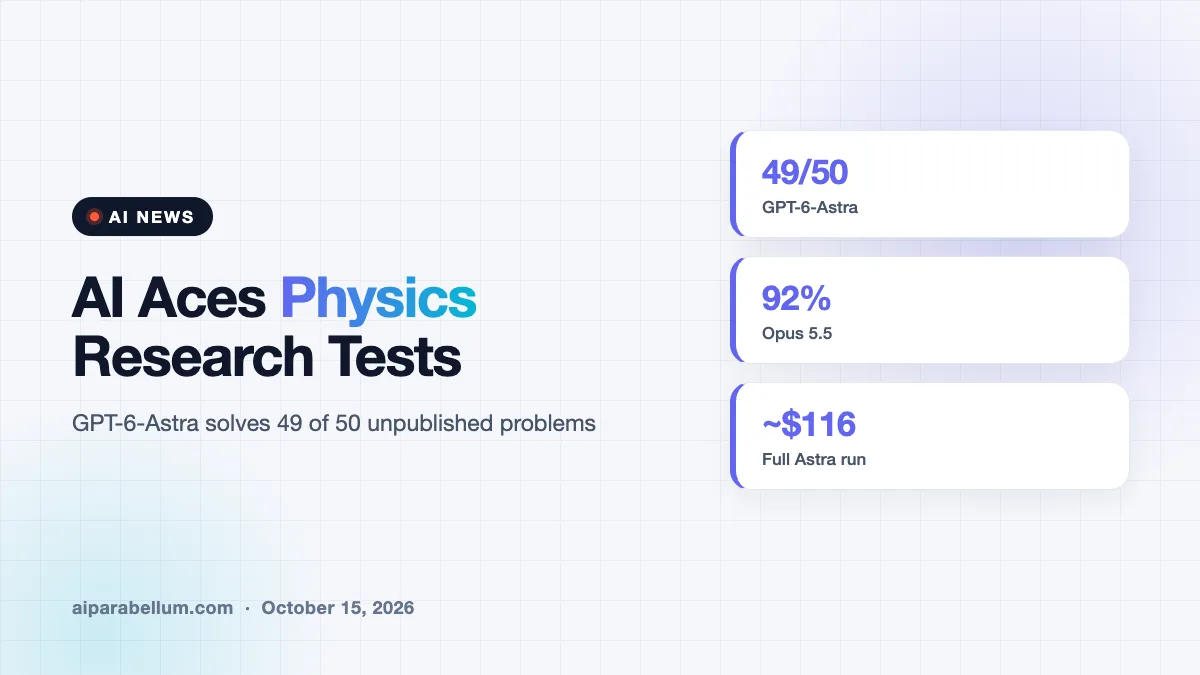
A new AI physics benchmark called TheoPhysEval suggests top AI agents can now handle research-level calculations as well as leading experts. OpenAI’s GPT-6-Astra got 49 of 50 unpublished theoretical physics problems right, at an average cost of less than $3 each. Anthropic’s Opus 5.5 came in a close second.
What the TheoPhysEval Physics Benchmark Tests
The benchmark was built by 35 researchers from places like the International Centre for Theoretical Sciences, Harvard, KU Leuven, and Google DeepMind. It holds 50 problems that have never been published, each with an answer that can be checked. A top expert in the matching subfield would need about a day or less to solve a typical one without AI.
These are not grand mysteries of the universe. The authors call them “turn-the-crank” problems, where you apply known methods to a slightly changed question. Contributors often tweaked numbers from their own recent papers, so the models could not simply look up the answer.
Eleven Fields, Two Test Runs
The problems span eleven areas of theoretical physics, including fluid flow, biology, particle physics, and cosmology. Each AI agent ran the test twice. One run allowed web search, and the other cut the agent off from the internet completely.
How the AI Models Scored
The team tested commercially available AI agents with no human hints. GPT-6-Astra ran inside OpenAI’s Codex coding tool, while Opus 5.5 ran inside Claude Code.
| Model | Headline score |
|---|---|
| GPT-6-Astra (OpenAI) | 98% (49 of 50) |
| Opus 5.5 (Anthropic) | 92% |
| Gemini 3.8 Flash (Google) | 68% |
| DeepSeek-V4.1-Flash | 54% |
| GLM 5.3 | 42% |
Astra’s full run cost just under $116. The weaker models sometimes made errors an expert would catch right away. On one black hole problem, two of them copied formulas built for five dimensions when the question asked for four.
The Internet Barely Mattered
Without web search, both Astra and Opus still scored 92%. Many problems relied on formulas from research papers the models were not given. The authors read this as a sign that leading models have soaked up much of the theoretical physics literature.
Some Misses Were the Experts’ Mistakes
The one problem Astra missed stumped every model, and the authors admit it might seem unfair. On several other problems, follow-up checks found small errors in the experts’ own answer keys. Once those were fixed, Astra’s answers were correct every time.
Why Strong Math Has Not Meant Physics Breakthroughs
The authors say some current models may already beat the best human researchers at concrete calculations, which they call a major milestone. Yet theoretical physics has not seen a big AI-driven discovery the way mathematics has. Their explanation comes down to something hard to measure: taste.
- A calculation comes at the end of research. Someone first has to build a theory and ask the right questions.
- Good researchers switch to a simpler, related problem when one gets too hard. Agents are not good at that yet.
- When asked to invent new problems, the agents got lost in details a human would find boring.
The researchers stress these points are observations, not a forecast. They still think AI agents could do top-level research on their own fairly soon.
What This Means for You
You do not need to be a physicist for this to matter. Benchmarks like this show where AI is truly useful today and where it still needs a human in charge.
- For students, routine calculations are no longer a good test of learning. The authors say some of these problems no longer make sense as first research projects.
- For anyone using AI on technical work, the best results come from tools like Codex and Claude Code, where the model can run code and check its own steps.
- Do not assume the answer key is always right. In this test, the AI caught real expert errors, so a second look from AI can be worth it.
- Cost may shape who wins. Cheap problems today could become expensive at the frontier, which could favor well-funded labs.
If you want to try AI on your own studies, our list of AI research tools is a good place to start. You can also compare the ChatGPT assistant with the Claude AI app for everyday tasks.
Sources
This article is based on a detailed write-up of the TheoPhysEval paper by The Decoder, which covers the benchmark design, model scores, and the authors’ conclusions.
Conclusion
TheoPhysEval shows that the best AI agents can now match top experts on everyday research math in theoretical physics, and do it for a few dollars a problem. GPT-6-Astra led the pack, with Anthropic’s Opus 5.5 not far behind. But the researchers argue that solving problems is not the same as choosing good ones. Until AI develops that sense of taste, human physicists still steer the science. For more on the AI model race, visit our AI news page.