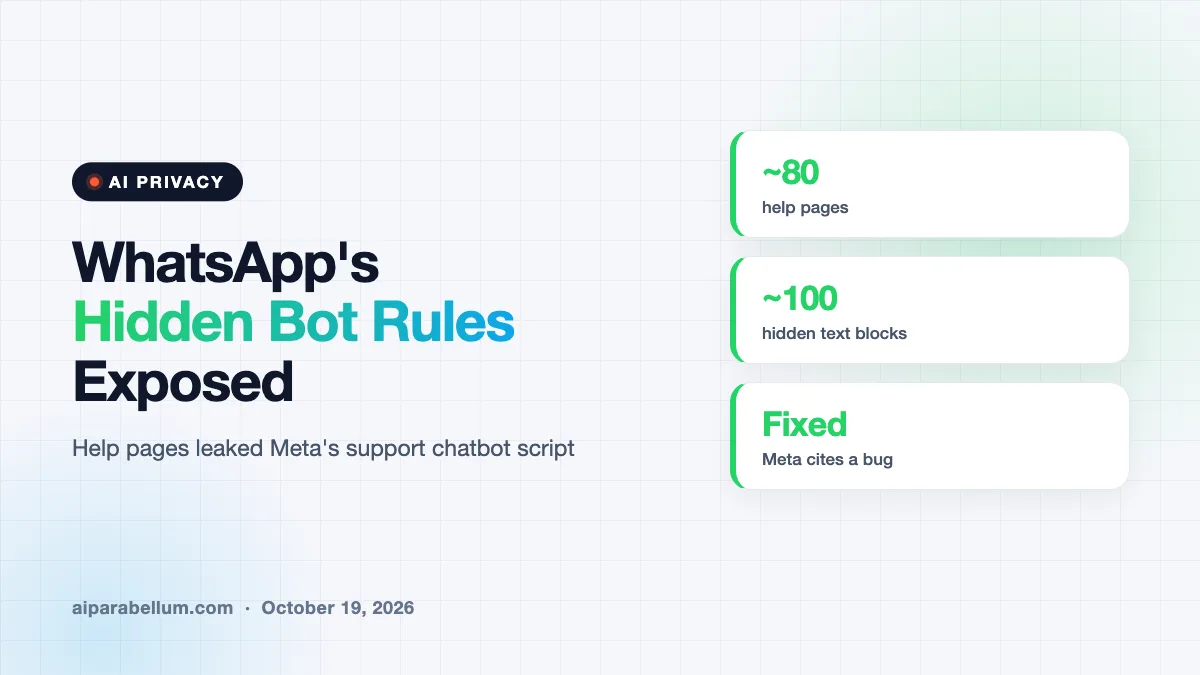
Hidden WhatsApp chatbot instructions were sitting in the code of dozens of the app’s public help pages, and they gave an unusual look at how Meta tells its AI support bot to talk to you. The privacy company Redact found the text on around 80 help and FAQ pages. Some sections carried headings like “WHAT NOT TO SAY,” and others told the bot to steer clear of legal topics and data regulators.
What the Hidden WhatsApp Chatbot Instructions Said
Redact counted about 100 blocks of hidden text across the pages. The text was not shown to people reading the help articles, but it appeared in the underlying page code inside blocks labeled “HelpContentGalaxyLLMInclude.” Those blocks were written for a large language model, specifically one of Meta’s own.
Much of it was ordinary. Many instructions simply pointed the bot toward other official support channels, which is what you would expect from a help desk script.
The lines that raised eyebrows
A few instructions stood out because of what they asked the bot to avoid. On the page about deleting your account, the hidden text told the bot not to recommend contacting any data protection authority or regulator. That is a notable gap, since regulators are exactly where many people go when they have a privacy complaint.
Other rules covered moments when a user brings up a lawsuit, a lawyer or a court. In those cases, the bot was told not to quote or interpret WhatsApp’s terms of service or privacy policy, and not to comment on the company’s liability. It was also told not to reference privacy laws such as GDPR or CCPA, even when a user raised them directly.
- Do not suggest contacting regulators about account deletion.
- Do not cite or interpret the terms of service or privacy policy.
- Do not discuss privacy laws, even when the user asks about them.
- Treat a user’s mention of being deaf or hard of hearing as background, not as the request itself.
- Do not mention community features that are not yet widely available.
How Meta Responded to the WhatsApp Chatbot Leak
After reporters at WIRED asked Meta about the findings, the text was removed from all of the pages. A WhatsApp spokesperson said the instructions were displayed because of a bug that has since been fixed. The company described them as directions for its support chatbot, meant to keep answers accurate and relevant for people who choose to message WhatsApp Support with AI.
Meta also said it wants its support bots focused on helping with the app, not on giving legal advice. It added that it already gives users clear information about their data rights. Still, it is not known how long the text was visible or whether outside chatbots could have read it.
| Detail | What we know |
|---|---|
| Pages affected | Around 80 help and FAQ pages |
| Hidden text blocks | About 100 |
| Who found it | Privacy company Redact |
| Meta’s explanation | A bug, now fixed |
| Still visible? | Removed from live pages; archived copies still show it |
| How long it was exposed | Unknown |
Why This Matters for AI Chatbot Transparency
Every AI support bot runs on a hidden script, usually called a system prompt. Companies rarely show these scripts, so this leak offers a rare peek at the kind of guardrails a big platform writes. Redact’s founder, Dan Saltman, summed up the issue as “the gap between what people are told vs LLMs.”
Telling a bot to avoid giving legal advice is common and reasonable. Telling it not to mention regulators or privacy laws, even when a user asks, is a different matter. It means the bot may quietly leave out options you are entitled to know about.
This also comes during a busy stretch for Meta on data questions. The company recently faced pushback over its new business terms and later dropped the AI training clause after the backlash.
A support bot is only as neutral as the script behind it. When that script tells the bot to skip your legal options, you need to know where else to look.
What This Means for You
You do not need to stop using WhatsApp or its support bot. But it helps to treat any company chatbot as a helper for that company’s product, not as an advisor on your rights.
- Use the bot for quick how-to questions, like changing settings or finding a feature.
- For privacy or legal questions, read the official privacy policy yourself.
- If you have a data complaint, remember you can contact your state attorney general, the FTC or, in Europe, your national data protection authority.
- Save screenshots of support chats when an issue involves your account or personal data.
Chatbots are taking over more of the front line, as our look at AI customer support explains. If privacy matters to you, our guide on differential privacy covers how AI systems can protect personal data. You can follow more updates on our AI news hub.
Sources
This report is based on reporting from WIRED, which reviewed Redact’s findings and the exposed text and obtained Meta’s response.
Conclusion
WhatsApp’s help pages briefly showed the public what its AI support bot is told behind the scenes. Most of the rules were routine, but a few told the bot to avoid mentioning regulators and privacy laws, even when users asked. Meta says a bug caused the exposure and that it has been fixed. The bigger lesson is simple: company chatbots follow company scripts, so for anything involving your rights, check official policies and outside resources yourself.