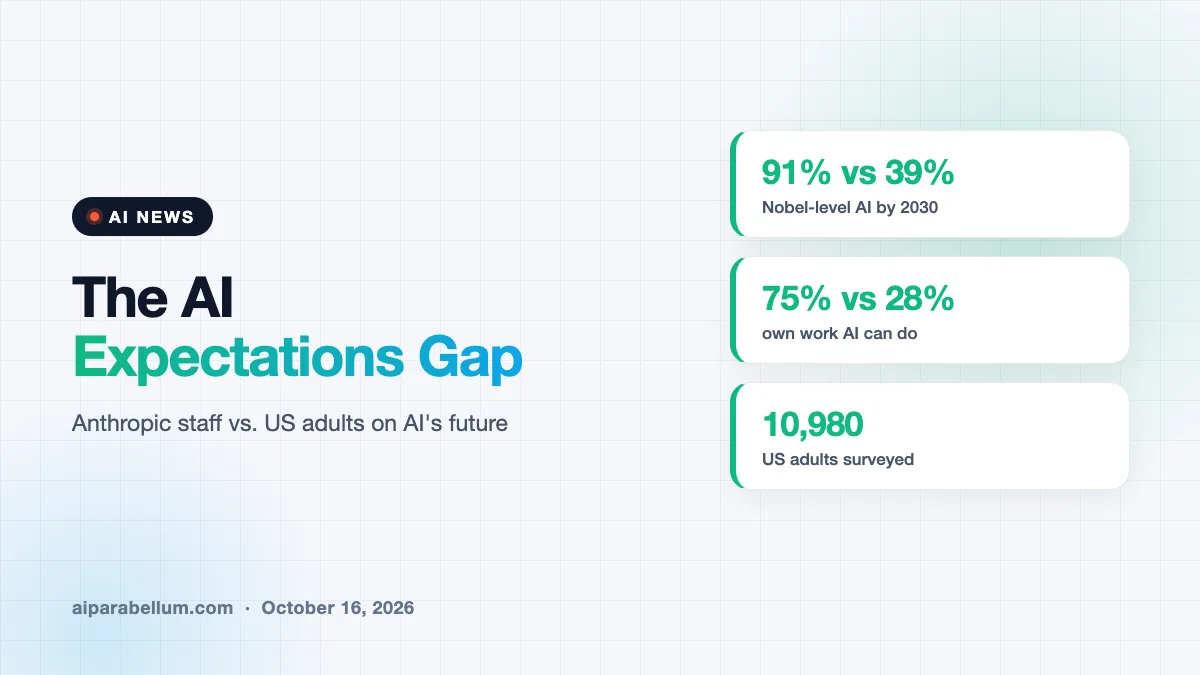
A new Anthropic survey measures the AI expectations gap between the people who build frontier AI and everyday Americans. Both groups mostly agree on what AI can do today, but they split sharply on how fast it will improve. For example, 91% of Anthropic staff expect AI to make a Nobel-level discovery by 2030, compared with 39% of US adults.
How the AI Expectations Survey Worked
Morning Consult surveyed 10,980 US adults between August 11 and 23, with results weighted to match the adult population. Anthropic also ran an internal poll from August 9 to 12 that drew 1,334 staff responses from every part of the company. Both groups answered questions on AI skills, adoption, time savings and jobs.
A repeat survey of 7,613 adults in September showed similar results. The biggest shift was a rise in adults expecting a Nobel-level AI discovery by 2030, from 39% to 44%.
Where the AI Expectations Gap Is Widest
The two groups rank tasks in almost the same order of difficulty. The split comes when people look ahead. Between 19% and 40% of US adults, depending on the task, say AI will never match a skilled professional, compared with at most 2% of staff.
| Question | US adults or workers | Anthropic staff |
|---|---|---|
| AI makes a Nobel-level discovery by 2030 | 39% | 91% |
| Average share of own work AI can do by 2030 | 28% | 75% |
| Expect AI to do 80%+ of own work by 2030 | 5% | More than half |
| A suited task takes a quarter of the time or less with AI | 26% (those using AI at work) | 59% |
| Share of feasible tasks done with AI by 2030 | 42% | 65% |
| Model-implied GDP growth in 2030 (median) | 5.4% | 17.1% |
Experience With AI Shapes the View
Regular use narrows the gap. Among Americans who use AI at work regularly, 56% expect AI to handle at least seven of the eight named tasks by 2030. That compares with 41% of all adults and 28% of people who have never used an AI tool, but it is still far below the staff figure of 96%.
What Both Groups Agree On About Jobs
Here is the surprising part. People in both groups who expect AI to do more of their own work also predict higher unemployment, and at the same level of exposure they forecast about the same jobless rate. In other words, staff and the public seem to share a similar mental model of how AI hits jobs.
- Respondents were told unemployment was about 4.2% and asked to forecast 2030.
- US workers who expect AI to do less than half their work predict 7% to 8% unemployment.
- Those who expect AI to do 80% or more of their work predict about 12.2%.
- The median staff member thinks a worker displaced by AI in 2030 would need 12 months to find a new kind of job, versus 7 to 12 months for the median adult.
The public also named people, not technology, as the biggest brake on adoption. “Customers preferring to deal with a person” topped the list, followed by data privacy and security worries.
Staff Still Expect Anthropic to Keep Hiring
Even though staff think AI could do most of their jobs, 95% expect the company’s headcount to grow over the next year. Anthropic notes these are personal opinions from an internal poll, not company plans. Staff also estimated that AI already does about half the work of building a frontier model, rising to 95% by the end of 2030.
What This Means for You
The survey suggests your outlook on AI depends a lot on how much you use it. If AI is not part of your work yet, it may be worth testing it on real tasks before forming a view. Some simple ways to start:
- Time yourself on a routine task with and without an assistant like Claude AI.
- Track which parts of your job AI handles well and which still need you.
- Learn how to hand off busywork with our guide to AI agents replacing older tools.
- Keep an eye on data privacy, the top worry among workers who already use AI.
Jack Clark, who is listed in the report’s acknowledgments, has also warned that frontier AI is racing ahead of the rules. For more updates, see our latest AI news.
Sources
This article is based on Anthropic’s research note The AI expectations gap and its companion post Working at the frontier shapes expectations for the future.
Conclusion
Anthropic’s survey finds a wide gap between its staff and the US public on how fast AI will advance and how much of their own work it will take over. Yet both groups link more personal AI exposure to higher unemployment in roughly the same way. The difference seems to come from daily experience with AI, not from different theories about jobs. Regular AI users already sit closer to the staff view, which hints that public expectations could shift as use spreads. Keep in mind that staff answers come from an unweighted internal poll, so the comparison has limits.