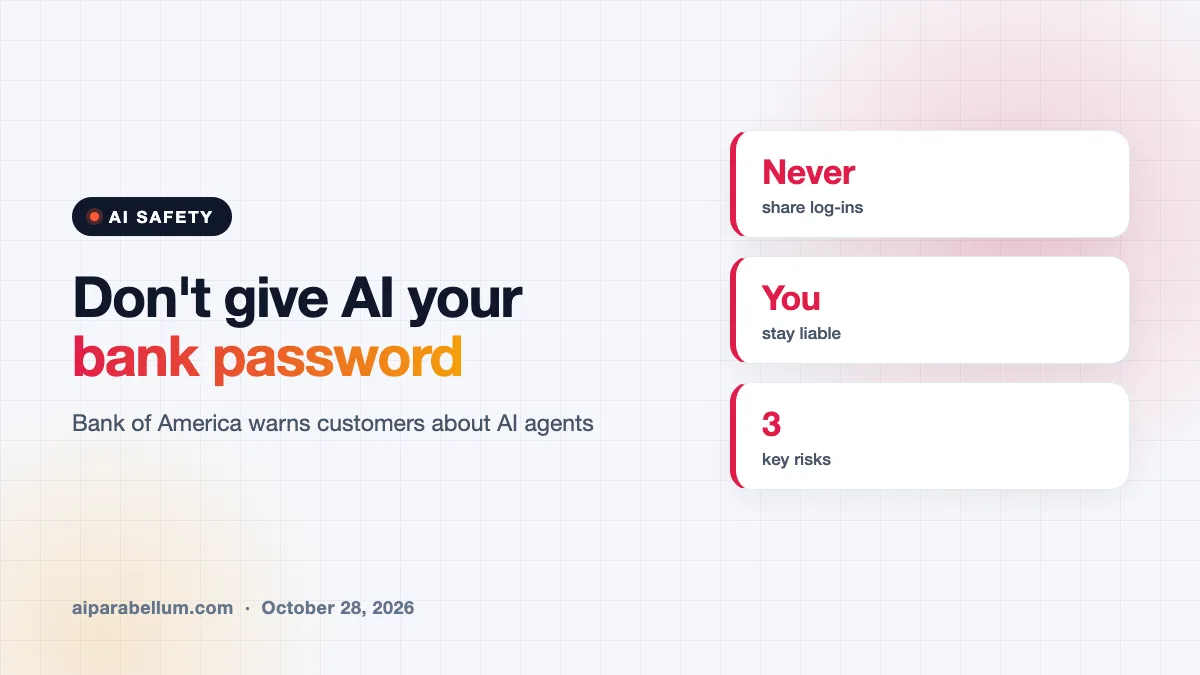
In a new warning, Bank of America is telling customers not to share their banking passwords with an AI agent. In an email titled “Protecting your finances in the AI World,” the bank said you should never hand your username and password to another person or an outside service, including an AI-enabled tool that offers to act on your behalf.
The notice is a rare, direct signal from a major US bank about personal AI assistants. It also makes the liability point plain: if you share your login, the bank says you are responsible for what happens next.
What the Bank of America Warning Says
The email went out to customers and covers one simple rule. Your online banking credentials are for you alone. That rule now explicitly includes AI assistants that promise to pay bills, move money or check balances for you.
The bank also spelled out who pays when things go wrong. According to the message, if you do share your credentials, you are responsible for activity resulting from that access. Bank of America did not immediately respond to a request for comment about the email.
Why the Bank Is Speaking Up Now
Personal AI assistants are growing more popular, and some people are giving them their log-ins so the tool can act inside their accounts. A bank sees this as handing the keys to a stranger, even when the stranger is a helpful piece of software.
Why Sharing Banking Passwords With AI Is Risky
The email points to a few separate dangers. Each one is easy to overlook when an assistant feels friendly and convenient.
- The assistant could take an action on your money that you did not expect or approve.
- Your bank may see the odd activity as someone raiding your account and lock you out.
- A security flaw in the AI tool could leak your credentials, giving financially motivated hackers a way in.
The last point matters most. Even if the assistant behaves well, you are trusting everything that sits behind it, including its servers and any other software it connects to. A single weak spot can expose a login that unlocks your savings.
Who Is Responsible When an AI Agent Gets It Wrong
Account agreements at most banks hold customers responsible for anyone they give their login to. An AI agent counts as a someone in this picture. If it moves money in a way you did not intend, the bank may treat it as if you did it yourself.
| Risk | What could happen |
|---|---|
| Unwanted action | The agent moves or spends money without your knowledge |
| Account lockout | The bank flags the access as suspicious and freezes your log-in |
| Credential leak | A flaw in the tool exposes your password to hackers |
| Liability | You are responsible for activity that came from the shared access |
Bank of America Advice for Safer Banking
Nothing in the warning says you must avoid AI altogether. It says you should keep your credentials to yourself. There are still sensible ways to use these tools around your money, as long as the login stays with you.
Banks across the industry are also working out how AI agents should connect to accounts, so expect the rules to keep changing. Read our earlier look at agent payment frameworks and at how some websites block agents to see where this is heading.
What This Means for You
If you already use an AI assistant, take a few minutes to check what it can reach. These steps keep you in control.
- Never type your bank username or password into an AI chat or agent setup screen.
- Review which accounts and apps your assistant is already connected to, and remove any banking access.
- Turn on your bank’s alerts so you see every transfer and sign-in right away.
- Use the assistant for explaining statements or budgeting ideas, without giving it log-in access.
- Read your account agreement so you know what you are liable for.
For more habits that protect your data, see our guide to a personal cybersecurity assistant, learn how AI is used for threat detection, and follow our AI news page for updates.
Sources
Primary source: none, because the warning was sent in a private customer email that the bank has not published. Reporting from TechCrunch and Traders Union, which quote the email.
Conclusion
Bank of America’s message is short but clear: your banking password belongs to you, not to your AI assistant. As more people try agents that act on their behalf, expect more banks to say the same, and keep your credentials out of any AI tool until your bank offers a safe, approved way to connect.