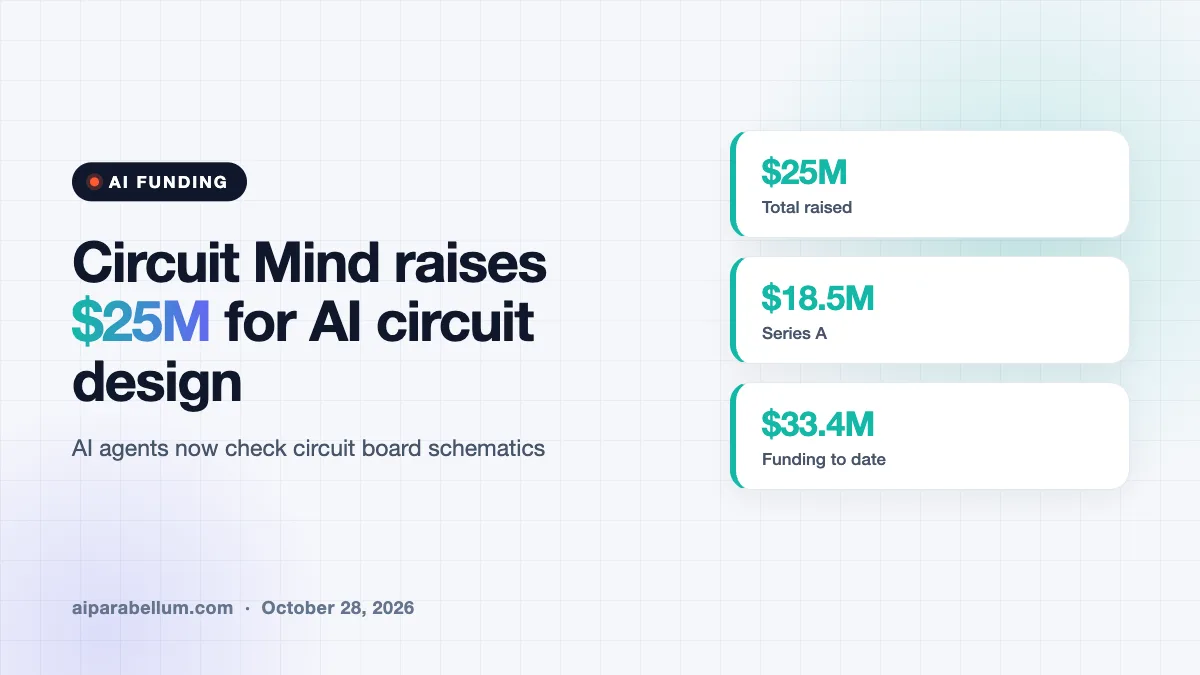
London startup Circuit Mind has raised $25 million to grow its AI circuit board design platform, and it launched a new tool that sends AI agents hunting for mistakes in electronic schematics. The money arrives as more companies try to bring the speed of AI coding tools to hardware engineering.
Designing a new piece of hardware can take engineers more than a year, according to the company. Much of that time goes to reading datasheets that run for thousands of pages, and mistakes often stay hidden until someone builds and tests a physical prototype.
What Circuit Mind Announced
The company said it closed $25 million across two rounds. Norwest Venture Partners led an $18.5 million Series A, with new investor Lightscape Partners and existing backers Third Prime, Differential Ventures and Blackhorn Ventures joining in. The rest comes from a previously unannounced seed round led by Third Prime.
Norwest general partner Dave Zilberman will join the board. Including this round, investors have now put $33.4 million into the business, which was founded in London in 2018 by Tomide Adesanmi and Basilio Gentile.
| Detail | What we know |
|---|---|
| Total raised in this announcement | $25 million |
| Series A | $18.5 million, led by Norwest Venture Partners |
| Seed round | Remainder, led by Third Prime |
| Total funding to date | $33.4 million |
| New product | Agentic Verification Engine (AVE) |
| Availability | AVE is available now on the company website |
How the AI Circuit Board Design Platform Works
Circuit Mind argues that general-purpose chatbots cannot handle this work alone, because they were never trained on professionally designed circuits. So its platform puts AI agents on top of a patented, physics-based engine that checks each design decision against electrical limits.
The agents draw on the company’s own machine-readable models of electronic parts. Each customer can also feed in its own engineering rules, down to a list of approved manufacturers.
From Block Diagram to Schematic
The original product turns a hardware block diagram into a schematic, a bill of materials and supporting analysis in minutes. Engineers get several options to compare, each tuned for a priority such as cost or power use. Finished designs can be exported into the design software their teams already use.
The New Verification Tool
The Agentic Verification Engine focuses on design review. A group of AI agents reads component datasheets and any review checklists a customer loads, then traces every connection and bus in the circuit looking for mismatches with pin tables or operating voltages. According to the company, nothing reaches a human engineer until the system has critiqued its own findings.
Early Results Customers Report
Most of the results Circuit Mind cites involve the original design application rather than the new review tool. These are company-supplied figures, so treat them as promising rather than independently proven.
- Engineers at Los Alamos National Laboratory finished a medium-difficulty board in just over four hours, compared with an estimated 60 to 80 hours by hand, based on a report the lab cleared for public release.
- Schneider Electric’s early evaluations point to a cut of more than 90% in the effort spent exploring electronic architectures, said its chief technology officer for energy management, Daniel Gheno.
- Circuit Mind says users have lowered bill of materials costs by 25%.
- Emerson Electric’s Charlie Eastberg said both tools have sped up his team’s move from system architecture to schematic.
Why AI Circuit Board Design Matters
Software teams have shipped faster in recent years thanks to coding assistants. Adesanmi said electronics design “hasn’t changed in 40 years” and pitched the company as hardware’s answer to tools like Cursor and Claude Code. If you want to see how that software side works, our guides on Cursor guide and Claude are a good start.
Hardware has an extra challenge, because a bug in a circuit can mean a costly new prototype instead of a quick patch. That is why Circuit Mind leans on physics-based checks rather than trusting a language model’s guess. The trend also fits a wider wave of money flowing to AI agent startups.
What Happens Next
Circuit Mind plans to use the funding to extend the platform into later stages of the design lifecycle, including testing and firmware. It will also grow its sales, engineering and customer success teams and set up a U.S. headquarters to serve North American customers.
What This Means for You
You may never design a circuit board, but the products you buy are shaped by how fast hardware teams can work. Here is what to take away.
- If you work in hardware, test AI review tools on a low-risk board first and compare their findings with a human review.
- If you lead a team, ask vendors for results from real projects rather than demos.
- If you follow AI trends, watch for agent tools moving from software into physical engineering.
- If you invest or advise startups, note that specialized AI with built-in rule checking is attracting funding.
For more stories like this, browse our AI news section.
Sources
Primary reporting from SiliconANGLE. All figures and customer results are company claims as reported there.
Conclusion
Circuit Mind’s $25 million round shows investors are betting that AI agents can speed up one of the slowest parts of building electronics. The early customer numbers look strong, but they come from the company and its customers, so real-world results will matter most as the new verification tool reaches more engineers.