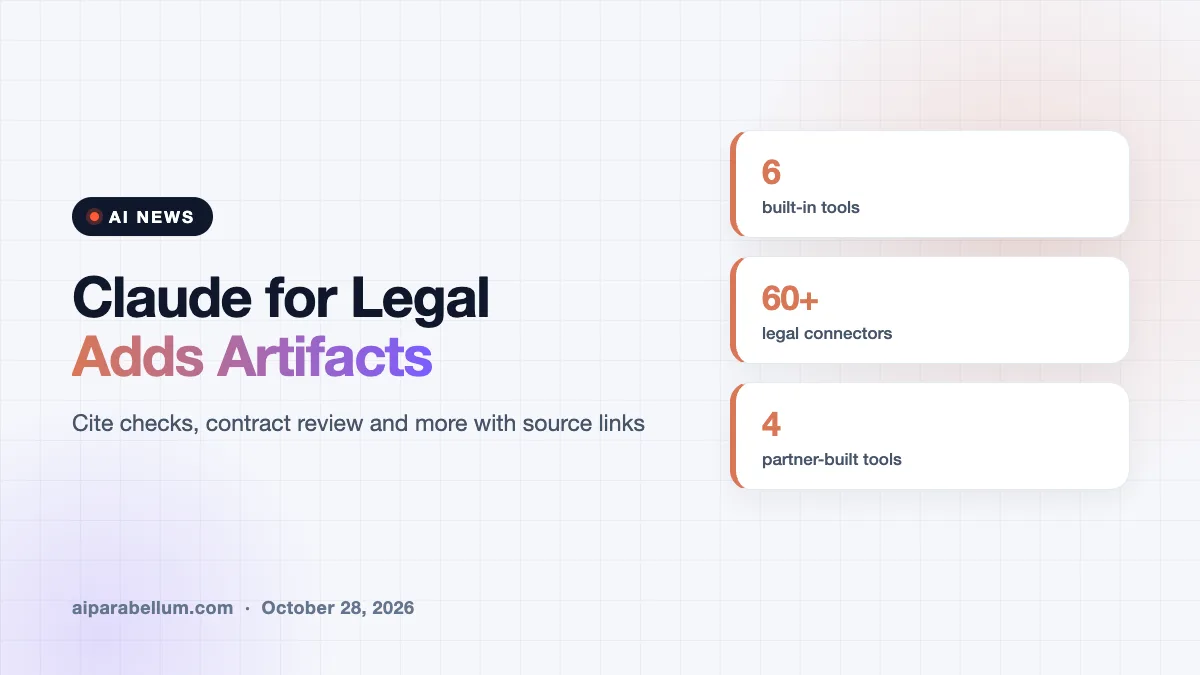
Anthropic has added ready-made artifacts to Claude for Legal, giving lawyers interactive trackers and dashboards for tasks like cite checking, contract review and regulatory monitoring. The company announced the update on October 28, 2026, saying legal teams had asked for simpler setup and easier ways to work with colleagues since the product launched in May.
What Claude for Legal Artifacts Actually Are
Artifacts are interactive tools that sit next to the chat window in Claude. Think of a table, a board or a timeline that you can edit, share and reuse instead of a long block of text. Anthropic built a legal gallery of them, and each one opens with an example so you can see how it works before adding your own files.
The workflow is simple. You bring your documents and sources, Claude completes the first pass, and a lawyer applies judgment to the results. Every answer or output links back to its source, so a person can check the work quickly.
Six Built-In Legal Tools
Anthropic’s own set covers the requests it says legal teams raised most often. Here is what each one does.
| Artifact | What it does |
|---|---|
| Cite check | Compares a document with its sources and flags mismatched quotes, wrong page numbers and weak support |
| Jurisdiction survey matrix | Compares one legal topic, like data breach notice rules, across states or countries in a single table |
| Matter board | Turns engagement letters, emails or spreadsheets into a board of open matters with owners and deadlines |
| Playbook deviation board | Flags contract clauses that differ from your standard terms and routes them to the approver |
| Regulatory horizon scan | Maps upcoming rules on a timeline and ranks them by impact for your business |
| Tabular review | Builds a table from many contracts, with links to the exact language behind each term |
Tools Built With Law Firms and Legal Tech Companies
Anthropic also opened the gallery to outside builders. Four partner-made artifacts are available at launch, and more are coming from Legora and Orrick.
- AI Governance Benchmark, built by Goodwin, checks a company’s AI governance approach for gaps.
- Harvey Intake, built by Harvey, gives business teams one place to send legal requests, answering routine ones and routing the rest to a lawyer.
- Subpoena Response Tool, built by PwC, turns precedents and standard objections into audit-ready first drafts.
- Obligations Checker, built by Foley & Lardner, reviews agreements for each party’s obligations before and after closing.
The move follows Anthropic’s January launch of a legal plugin and its May release of 12 practice-group plugins. The company says it now offers more than 60 legal connectors, including Bloomberg Law, Filevine, Ivo, Legora and Patlytics, so teams can pull in playbooks and research sources without uploading files by hand.
Sharing, Guardrails and Community Programs
Legal work often involves sensitive client information, so sharing controls matter. Anthropic says its sharing settings protect privacy and support ethical walls between teams, while still letting legal staff collaborate with colleagues across the business, clients and partners.
The company is also funding public interest groups building artifacts for access-to-justice work, along with legal education programs that teach students to build with Claude. A new Legal Ambassadors Program lets legal professionals learn from each other, though a trade publication reports it currently has a wait list.
What This Means for You
If you work in a law firm or an in-house legal team, the update lowers the effort needed to try AI on routine work. You no longer need to build a workflow from scratch, because you can start from an example and adapt it. If you are outside the legal field, it is a useful preview of how Claude is packaging expertise into reusable tools for other professions too.
- Start with one narrow task, such as a cite check on a draft brief, and compare the output with your own review.
- Treat every flagged item as a lead to verify, since a lawyer still makes the final call.
- Check your connector and sharing settings before loading client documents.
- Review how your Claude account is set up before rolling anything out to a team.
Some observers see the launch as more packaging than breakthrough. One legal-tech publication noted that a skilled legal engineer could already have built similar tools with Anthropic’s existing offerings, and that the real change is convenience. Anthropic is also now competing for the same customers as the legal AI companies that build on Claude, a tension worth watching as the enterprise push continues.
For more on how legal teams use AI day to day, see our guide to drafting contracts with AI tools, and browse the latest AI news for related stories.
Sources
Primary source: Anthropic’s announcement of artifacts for legal work. Additional reporting from Artificial Lawyer and Legaltech News.
Conclusion
Claude for Legal artifacts make it easier for lawyers to turn Claude into practical tools for cite checking, contract review and tracking regulations, with source links built in and a human making the final decision. The real test will be whether firms and legal departments adopt the shared gallery and whether partner-built tools keep arriving.