A network of more than 400 linked apps and websites that look like pet photo editors, language tutors and workout coaches has been secretly offering explicit deepfake tools, according to a new investigation. These deepfake apps show a harmless screen to app store reviewers, then switch to a hidden adult interface for some users. Apple and Google have pulled many of them, but researchers say similar apps were still appearing as the reporting wrapped up.
How the Hidden Deepfake Apps Work
Each app asks a remote server what to show when it opens. The server looks at details such as the user’s location, language and a device identifier, then decides whether to display the innocent version or load a hidden web interface.
That second layer lets people upload photos of real individuals and place them into sexual scenes, which is how these tools harm victims. Researcher Paul Bouchaud of the nonprofit AI Forensics, who reverse engineered the code, says one trigger appears to be installing the app after tapping an ad on Meta’s platforms.
Apple says the apps passed review when they were approved. In its account, developers later swapped the web content the apps load and promoted them through adult ads on a third-party platform.
The Scale of the Network
The website code exposed a list of domains and apps run by the same operators. Infoblox researcher Maël Le Touz identified almost 500 linked domains that run the same code and point to each other.
| Detail | What researchers found |
|---|---|
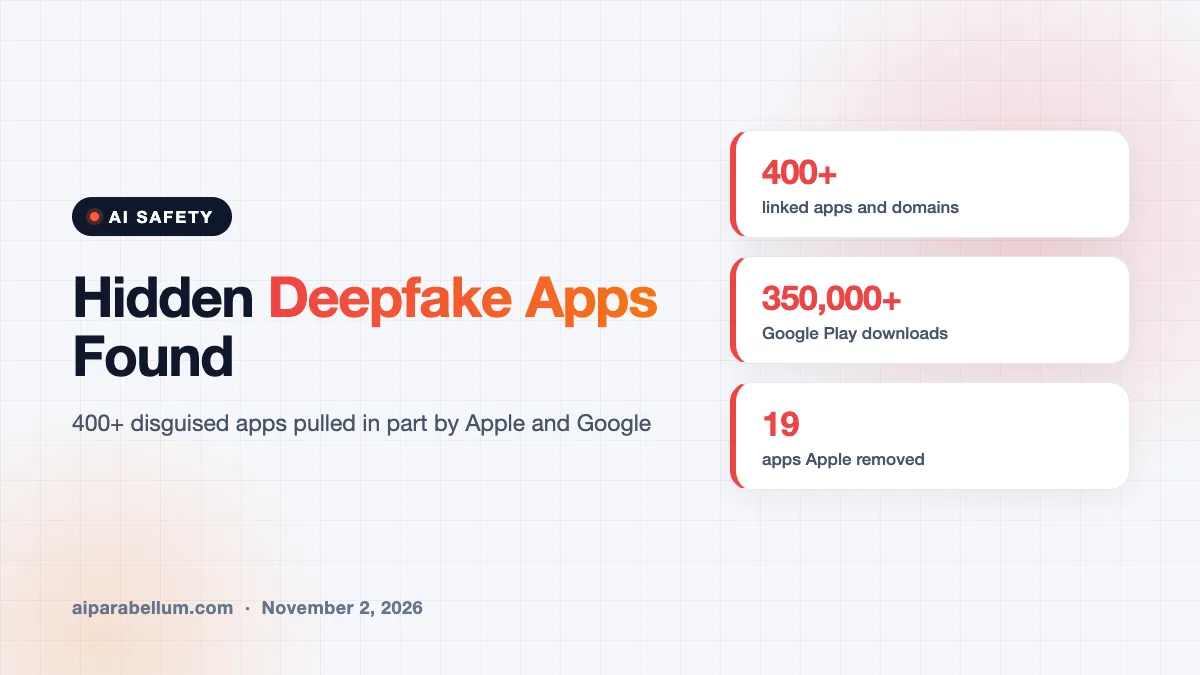
| Linked domains and apps | More than 400 (almost 500 domains per Infoblox) |
| Peak registration pace | Around 30 app websites per week |
| Live on Google Play in September | 27 apps, over 350,000 combined downloads |
| Most popular app | DiffAI, more than 100,000 downloads |
| Apple removals | 19 apps after being contacted |
| Meta actions | 11,600 ad accounts and 209 apps blocked from advertising |
The apps began appearing late in 2025, with a spike this spring. Many carried age ratings that said they were suitable for all ages, and one user review of DiffAI warned that it had no age verification.
Who Is Behind It
Researchers point to Chinese-speaking developers and a Hong Kong company called KeLing Technology Limited. Its name shows up in contact details, an admin login page and a related AI model site. The company did not answer requests for comment, and some of those public links were scrubbed after reporters made contact.
Meta says it banned the company from advertising in 2025 after it ignored a cease and desist letter. The company also says the criminals behind such apps use fake names and benign-looking ads. Google had removed most of the apps before being contacted and did not comment.
What Platforms Are Doing About Deepfake Apps
Apple says it has suspended tens of thousands of apps for bait-and-switch tactics over the past year, and it recently tightened its rules for nudify tools. You can read how that policy change works in our earlier coverage of App Store rules.
Meta says it removed about two-thirds of more than 3,000 ads that were shared with it. Katie Paul of the Tech Transparency Project argues that platforms still owe answers about where the money goes and how the operators keep slipping past moderation.
What This Means for You
An app that looks innocent in the store can change after you install it, so the store listing alone is not proof of safety. A few habits help:
- Be wary of apps promoted through odd social media ads, especially ones with unrelated names and no real following.
- Check whether the publisher has a real website, a clear privacy policy and believable reviews.
- Never upload photos of other people, especially minors, to apps you do not trust.
- Report suspicious apps and ads to the store or platform so they can be reviewed.
- Learn the warning signs of manipulated media with our guide on spotting deepfake videos.
Parents should also know that age ratings on these apps were unreliable. For wider context on AI fakes used for fraud, see the INTERPOL deepfake warning, and for more on how generators work, our explainer on AI image generators.
Sources
Primary reporting: WIRED’s investigation into the deepfake app network.
Conclusion
The case shows how easily bad actors can hide harmful AI tools behind ordinary-looking apps and ads. Stores and ad platforms are removing apps and accounts, yet the network was still producing new ones when the investigation ended. Until enforcement catches up, careful installs and quick reporting are the best protection you have.