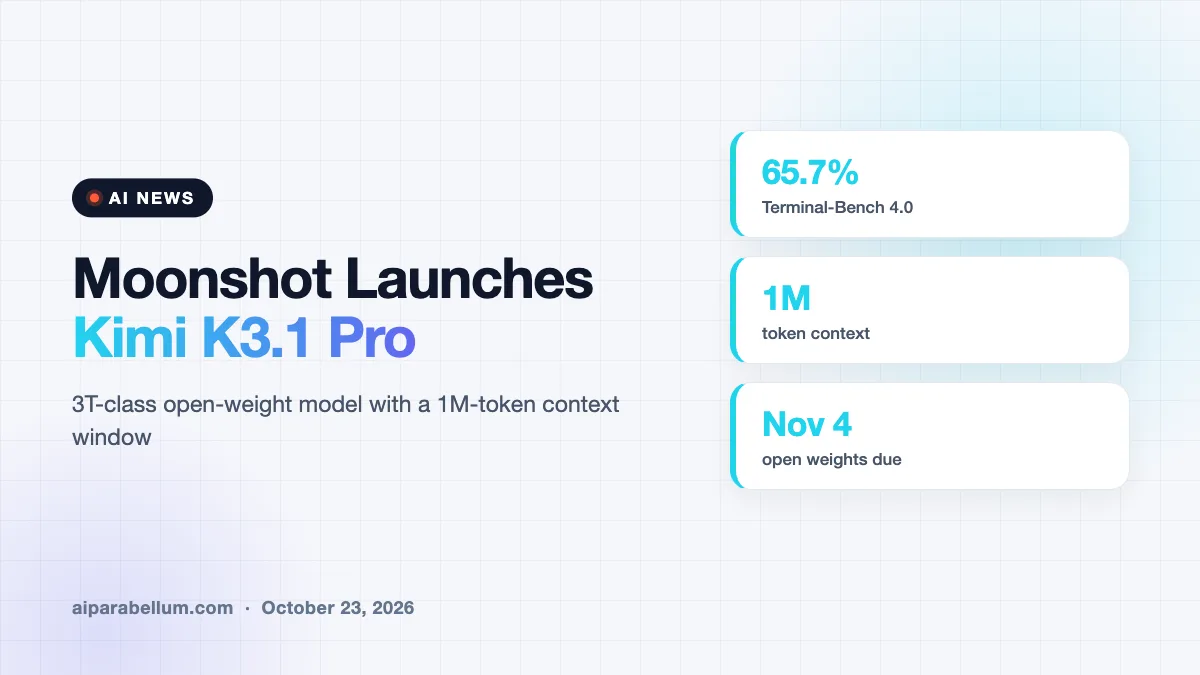
Moonshot AI has launched Kimi K3.1 Pro, a 3-trillion-parameter-class model with a 1-million-token context window that the company says nearly matches the best closed models at coding. It is live today in Kimi’s apps and API, and Moonshot plans to release the full open weights by November 4.
What Kimi K3.1 Pro Is
K3.1 Pro is the first model in Moonshot’s new K3.1 series. It is not a brand-new base model, but a post-trained version of Kimi K3 that got much more reinforcement learning compute.
Moonshot says it rebuilt almost every layer of its training stack to make that extra RL pay off. That includes the RL framework, long-context inference, sandbox setup and rollout scheduling, so that gains showed up across hundreds of task types instead of just a few.
A companion model, K3.1 Pro Highspeed, ships alongside it. Moonshot says it runs two to three times faster with the same capabilities, which matters if you use it inside an interactive coding tool.
How Kimi K3.1 Pro Scores on Benchmarks
The headline claim is about agentic coding. On Terminal-Bench 4.0, which tests coding agents on realistic terminal tasks, Moonshot reports a score that lands just behind the top closed model and ahead of the latest GPT release.
Keep in mind that every number below comes from Moonshot’s own announcement. Several of the tests are internal benchmarks the company designed, so independent results will tell a fuller story in the coming weeks.
| Benchmark | Kimi K3.1 Pro | Comparison |
|---|---|---|
| Terminal-Bench 4.0 | 65.7% | Claude Opus 5.5: 66.4%, GPT-6 Astra: 58.2% |
| BenchCAD (with tools) | 92.7% | Claude Opus 5.5: 96.2%, GPT-6 Astra: 95.9% |
| Kimi Code Bench 3.0 Long-horizon (internal) | 61.2% | Kimi K3: 55.95% |
| OfficeQA Pro v2 | 64.4 | Moonshot calls this state of the art |
| Claim-level hallucination rate (internal stress test) | 8.3% | Kimi K3: 23.4% |
The hallucination drop is one of the bigger changes. Moonshot notes the test was built on purpose to trip models up, so the rates are not meant to reflect everyday error rates.
Beyond Coding: 3D and Finance
Moonshot is also pushing K3.1 Pro as a 3D and finance tool. It says the model can turn a text brief, sketch or reference image into usable 3D models and can write scripts for Blender and CAD software on its own.
A new 3D Make feature on kimi.ai lets you preview and edit models online, then download them ready for 3D printing. On the finance side, Moonshot reports gains over K3 of 7.2 points on its financial modeling test and 11.6 points on financial research.
Where You Can Use It
The model is rolling out across the whole Kimi product family on day one. Here is where it shows up:
- Kimi.ai and the Kimi mobile apps on iOS and Android
- Kimi Work desktop app, version 3.1.0 or later, on Windows and Apple silicon Macs
- Kimi Code, where you pick it with the /model command
- The Kimi API as kimi-k3.1-pro and kimi-k3.1-pro-highspeed, with zero data retention available
- Kimi Enterprise, where admins must switch it on because access is off by default
Developers should note a few API quirks. K3.1 Pro always runs in thinking mode, supports low, high and max reasoning effort (max is the default), and fixes sampling settings like temperature, so you should leave them out of requests.
A Careful Approach to Cyber Risk
Moonshot spent a surprising share of its announcement on security. The company says it found hacking-related data mixed into its general training corpus and RL tasks, and that leaving it in would have pushed offensive cyber skills up sharply.
So it filtered that data out. On its in-house exploit benchmark, a version trained without the filtering solved 90.5% of tasks, while the final K3.1 Pro solved 81.0%.
Moonshot says its rule is to avoid releasing open weights that extend the frontier of cyber capability. It argues that open access still helps defenders audit the code they maintain, including older systems that rarely get security reviews. That fits a wider industry debate we have tracked in stories like abliterated model risks.
What This Means for You
If you build with AI coding tools, Kimi K3.1 Pro is worth a test run. A model this close to the top closed systems, with weights you can eventually host yourself, could change how much you pay for agent-heavy work.
- Developers can try it now in Kimi Code or the API and compare it against tools like Claude AI on your own repos.
- Teams that need to keep data in-house should watch for the November 4 weight release.
- Anyone comparing open models can line it up with recent launches such as Meta’s Muse Spark and Nemotron 3.5 Super.
- Treat the internal benchmark wins with caution until outside testers publish results.
The release also shows how quickly the open-weight race is moving. For more launches like this one, keep an eye on our latest AI news page.
Sources
Primary source: Moonshot AI’s Kimi K3.1 Pro announcement. Additional details from the Kimi API quickstart guide and reporting from Unite.AI.
Conclusion
Kimi K3.1 Pro is Moonshot AI’s strongest bid yet to show that an open-weight model can keep pace with the best closed systems. Its reported coding scores sit within a point of the leader, its hallucination rate fell sharply, and it is available today across Kimi’s apps and API. The full weights arriving by November 4 will be the real test, since that is when outside developers can verify the claims for themselves. Until then, it is a strong option to try, with the usual caution around self-reported benchmarks.