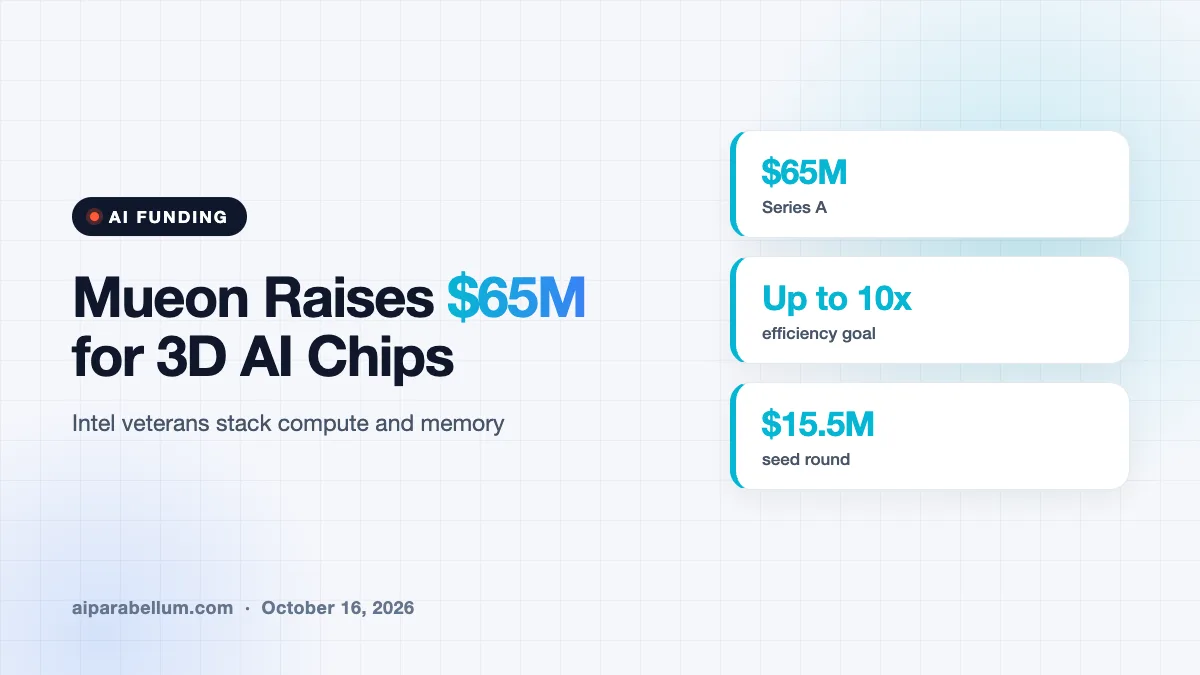
Mueon, a data center hardware startup founded by two Intel veterans, has closed a $65 million Series A to bring its 3D computing modules closer to market. The Mueon Series A was led by semiconductor fund Maverick Silicon, with Intel’s venture arm joining in. The company says its stacked design could make AI hardware up to 10 times more power- and cost-efficient within the same rack.
Who Backed the Mueon Series A
The Portland, Oregon, company drew a long list of chip and deep-tech investors. Alongside lead investor Maverick Silicon, the round included:
- Intel Capital
- Geodesic Capital
- Oregon Venture Fund
- M-Ventures
- Wellington Management
- IQT
- Defined
Maverick Silicon’s Manish Muthal is joining Mueon’s board, where he will sit with Intel Capital Managing Director Srini Ananth. Intel also led Mueon’s $15.5 million seed round last year, and the company says it has now raised more than $80 million in total.
How Mueon’s 3D Cubelets Work
Mueon was founded in 2025 by Wilfred Gomes and Jack Hwang. Gomes, the CEO, worked on chip stacking at Intel, while CTO Hwang helped develop the methods Intel uses to etch transistors into silicon wafers.
In a normal server, the main parts sit side by side on a flat motherboard. Mueon’s design, called Cubelets, stacks compute and memory on top of each other in modular 3D blocks, as part of what it calls an Exponential Computing Platform.
Why Stacking Saves Power
Putting parts closer together shortens the distance data has to travel. Less travel means less power used and faster calculations, and it could reduce the need for sprawling racks of servers.
Each Cubelet bundles more than chips. It also packs in the interconnect, power delivery, and cooling gear those chips need, and early descriptions say the modules can host graphics processors and Arm CPUs.
| Detail | Mueon |
|---|---|
| Headquarters | Portland, Oregon |
| Founded | 2025 |
| Founders | Wilfred Gomes (CEO), Jack Hwang (CTO) |
| Series A | $65 million, led by Maverick Silicon |
| Seed round | $15.5 million, led by Intel |
| Core product | Cubelets, stacked 3D compute and memory modules |
| Efficiency target | Up to 10x better power and cost efficiency per rack |
The Heat Problem
Stacking chips brings a big challenge: heat. Processors and memory chips often have different temperature limits, so a hot processor can cook the memory sitting on top of it.
Heat from the top layer also has to pass through other parts before it escapes. Mueon says it has found a way to manage this, which is key to making 3D systems practical at scale.
What Mueon Plans to Do With the Money
Mueon will use the new funding to grow its engineering and operations teams and deepen its customer work. It also plans to move Cubelets out of platform development and into broader system validation and production readiness.
Software is a big part of the plan too. The company is building a layer that lets customers run popular AI frameworks and familiar deployment workflows on its modular hardware, which matters because new chips often struggle without easy software support.
Gomes says the money gives Mueon the scale to bring its compute and memory integration to market. The startup joins a busy field of companies chasing better AI hardware, from Microsoft’s Maia 300 chip to Salience Labs and its optical switch funding.
What This Means for You
You will not buy a Cubelet, but data center efficiency affects the AI tools you pay for. Here is why it matters:
- Cheaper, cooler hardware could lower the cost of running AI models, which can show up in subscription prices.
- Lower power use helps ease the strain AI data centers put on energy grids.
- More hardware competition gives cloud providers options beyond today’s dominant chip suppliers.
Demand for AI computing keeps climbing, as shown by AI cloud funding and Nvidia’s push for open AI factory designs. Follow more stories like this on our AI news page.
Sources
This article is based on reporting from SiliconANGLE and the company’s official announcement on PR Newswire.
Conclusion
Mueon’s $65 million Series A gives the Intel-founded startup the runway to turn its 3D Cubelet design into real products. By stacking compute and memory into modular blocks, it hopes to deliver up to 10 times better power and cost efficiency per rack. The big hurdles are heat management and software support, both of which the company says it is tackling. If it delivers, Mueon could become one of the more interesting new names in AI data center hardware.