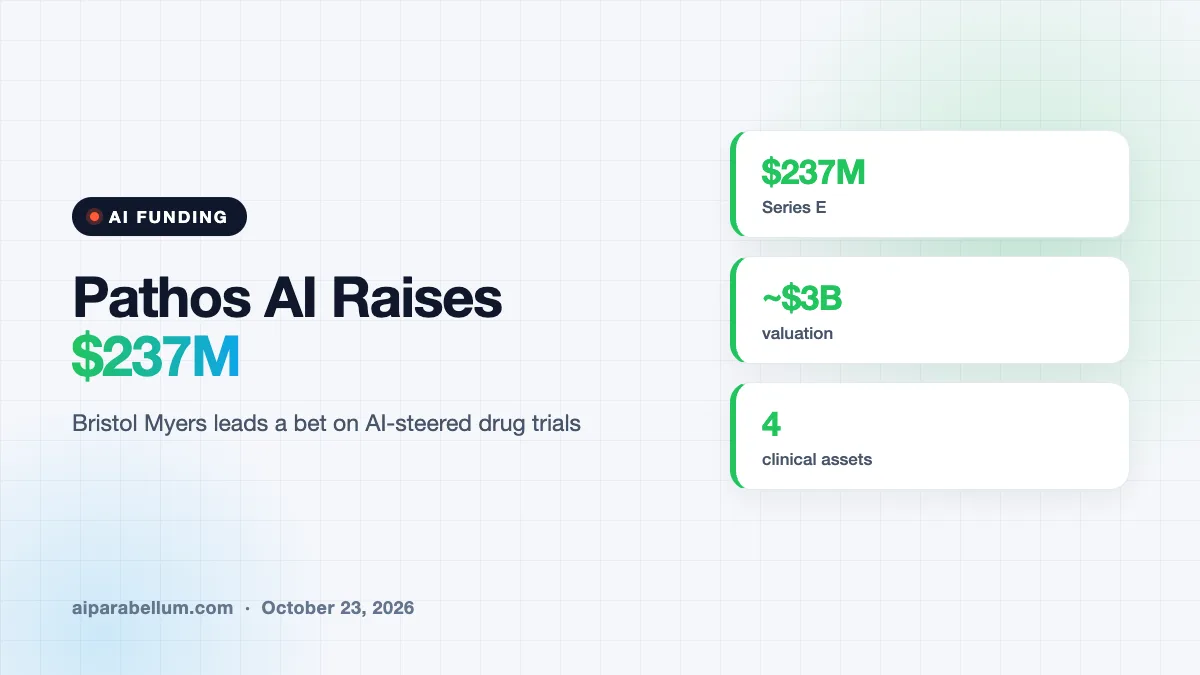
Pathos AI funding just hit a new level: the New York drug developer closed a $237 million Series E round at a post-money valuation of about $3 billion. Bristol Myers Squibb led the round, and the two companies also signed a research deal with Tempus AI aimed at Alzheimer’s disease and other brain conditions.
Pathos is not a typical biotech. It calls itself an AI and technology company that runs its own pipeline of drugs, and it uses software agents to decide which drugs to pursue and how to steer their trials.
Pathos AI Funding at a Glance
The company announced both deals on October 23, 2026. Here are the key numbers from the two announcements.
| Item | Detail |
|---|---|
| Round | Series E, $237 million |
| Valuation | About $3 billion post-money |
| Lead investor | Bristol Myers Squibb, plus existing investors |
| Clinical assets | Four active programs |
| Data deal | Five-year, $55 million license from Tempus |
| New focus area | Alzheimer’s and other neurological conditions |
How the Pathos AI Platform Works
The engine behind the company is a platform called Foundry. Pathos says it runs thousands of specialized AI agents that pull together everything known about a drug program in real time, from clinical results and genomics to specimen data and what competitors are doing.
The goal is to pick the best next move for each program. According to the company, that means spotting the patient groups most likely to respond, changing trial plans mid-course and dropping risky paths early, before they burn years and money.
The pitch is simple: most drugs fail in trials, so an AI that improves the odds even a little could be worth billions.
CEO Iker Huerga framed it as a system built to “improve the probability of success in drug development.” That is a company claim, and the real test will be whether its drugs actually win approval.
Where the $237 Million Will Go
Pathos says the money will scale Foundry and push its cancer programs forward. Its current clinical pipeline includes:
- JSKN016, a first-in-class TROP2/HER3 bispecific antibody-drug conjugate, which the company wants to move toward registrational studies
- Pocenbrodib, being tested in metastatic castration-resistant prostate cancer and relapsed or refractory multiple myeloma
- AZD4241, an ER PROTAC for ER-positive breast cancer, partnered with AstraZeneca
- DO-2, a next-generation MET kinase inhibitor for MET-altered lung cancer
The company says Foundry helped it add these assets quickly through a series of deals over the past several months. That speed is a big part of why investors are paying up.
A New Push Into Alzheimer’s Research
The second announcement may matter even more over time. Tempus will build a de-identified, long-term dataset from hundreds of thousands of patients with neurological conditions, tracking how their health changes over the years.
Pathos will license that data for $55 million over five years and point Foundry at it to test ideas about disease biology and design tighter trials. Bristol Myers gets three-year exclusive rights to use the platform in neuroscience, plus multi-year access to Foundry across its wider research portfolio.
Why Big Pharma Wants In
Alzheimer’s has been one of the hardest areas in medicine, with many costly trial failures. Bristol Myers says it hopes AI insights will help it understand disease progression and find the patients most likely to benefit from new treatments.
This deal fits a wider trend of drugmakers teaming up with AI firms, much like the AstraZeneca and insitro partnership and the Iambic public listing we covered earlier.
What This Means for You
You will not be using Foundry yourself, but this kind of deal shapes how future medicines reach patients. Here is what to keep in mind:
- AI agents are moving from chat apps into high-stakes work like clinical trial design, as seen in recent healthcare AI agents funding.
- Large patient datasets are becoming as valuable as the AI models that read them.
- Claims about faster, smarter trials still need proof, so watch for real trial results, not just valuations.
- If you work in research, our guide to AI research tools shows how similar ideas apply at a smaller scale.
For more stories like this one, browse our latest AI news coverage.
Sources
Primary source: Pathos AI’s Series E announcement. Additional details from the Bristol Myers and Tempus collaboration release and reporting from Axios.
Conclusion
Pathos AI’s $237 million round, led by Bristol Myers Squibb, values the company at about $3 billion and funds both its cancer pipeline and a new AI push into Alzheimer’s research with Tempus data. The bet is that thousands of AI agents can make drug trials smarter and cut costly failures. It is one of the clearest signs yet that big pharma sees agentic AI as core to research, not a side project. The proof will come from trial results over the next few years, so this is a story worth following.