A UK government watchdog is weighing an inspection of how the Home Office uses AI in asylum cases, and the Home Office AI asylum tools are built on OpenAI’s GPT-4 model. Campaigners say the tools make more mistakes than officials have admitted. The Home Office says humans still make every decision.
What the Home Office AI Asylum Tools Do
The Home Office runs two tools that started as pilots in late 2024. Asylum Case Summarisation turns long interview transcripts into short summaries. Asylum Policy Search helps caseworkers find and summarize information about conditions in an applicant’s home country.
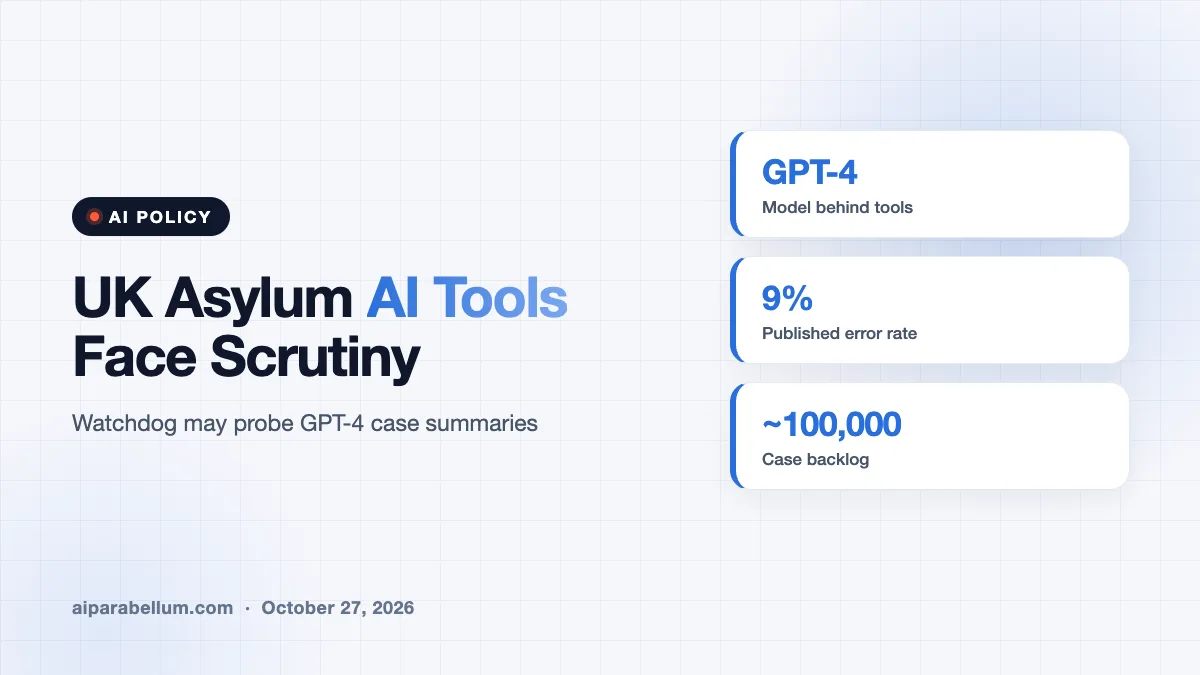
Both run on OpenAI’s 2023 GPT-4 model through Microsoft Foundry, according to documents the Open Rights Group obtained. The department turned to them while trying to clear a backlog of about 100,000 asylum cases. Government estimates say the two tools together save roughly an hour per case.
Why a Watchdog Could Step In
The Independent Chief Inspector of Borders and Immigration reviews how the Home Office handles borders and immigration. It has asked the Open Rights Group for more information on the tools while it plans next year’s inspection topics, a campaigner told reporters. The inspector would not confirm which topics are under consideration before it publishes its priorities.
The inspector did point to its earlier finding that one tool’s effectiveness and reliability were “varied.” Nothing is confirmed yet, so for now this is a possible probe rather than an announced one.
Accuracy Concerns Over Home Office AI Asylum Summaries
The Open Rights Group spent six months digging into the tools. It used 11 parliamentary questions, two ministerial letters and 10 public records requests, and says the Home Office withheld many details. The group says the share of summaries judged not fit for use is well above the 9 percent error rate published after the pilot.
It also reports that the policy search tool has no quality control at all. Here is how the main claims line up.
| Issue | What campaigners say | What the Home Office says |
|---|---|---|
| Summary accuracy | Unfit summaries exceed the published 9 percent rate | Performance is monitored with quality checks |
| Policy search tool | No quality control found | Updated evaluations will be published |
| Decision making | Machines should not touch high-stakes cases | Trained caseworkers decide; AI only assists |
| Transparency | Both tools are missing from the public tools list | No direct response reported |
Secrecy and the Public Register
The UK’s AI Playbook says departments should be open about algorithmic tools used in decisions and list them in a public repository. Neither asylum tool appears there. The Public Law Project says these are two of 11 high-risk government AI systems it found that are missing from the list.
A separate Open Rights Group report released the same day says AI is spreading across the immigration system in “near total secrecy.” It also notes that no specific UK law regulates AI use in this area.
Court Warning Earlier This Year
- In July, a UK judge accused the Home Office of citing an “AI hallucinated” document when refusing an asylum claim from a Moroccan woman and her child.
- Labour MP Bell Ribeiro-Addy told reporters she does not think machines should be involved in such decisions.
- Researchers worry that known cultural bias in GPT models could shape summaries and lead to unfair outcomes.
What OpenAI Said
An OpenAI spokesperson pointed to the company’s ongoing work to improve accuracy and said GPT-4 will be retired in January. That detail matters, because the tools were built on a model that is already close to the end of its life. The Home Office has said it will publish updated evaluations of the rollout.
The story fits a wider pattern of scrutiny for the ChatGPT maker, including a recent state lawsuit and an FTC probe into AI safety.
What This Means for You
Even if you never apply for asylum, the case shows how AI summaries can slip into serious decisions with little public notice. Here are a few practical takeaways.
- Remember that a summary made by a chatbot can leave out or distort details, so check it against the original when the stakes are high.
- Ask organizations whether they use AI on your data and whether a person reviews the result.
- Watch how UK AI rules develop, since transparency requirements often spread to other countries.
- If you use tools like ChatGPT at work, keep a human check on anything that affects a person’s rights or money.
Keep in mind that the error figures come from campaigners’ analysis of documents, and the Home Office has not accepted them. The inspector has also not confirmed a probe. For background on how Britain is approaching AI law, see our look at UK AI regulation.
Sources
Primary source: Open Rights Group report announcement. Additional reporting from WIRED.
Conclusion
The Home Office says its OpenAI-based tools only assist caseworkers, while campaigners say the summaries are less reliable than advertised and hidden from public view. A watchdog inspection is possible but not confirmed. The next things to watch are the inspector’s published priorities and the Home Office’s promised updated evaluations.