Elorian Glimpse, the first model from a Palo Alto startup led by a former Google DeepMind researcher, launched on October 16 as a research preview. Its pitch is simple: most AI models glance at a picture once and then think in words, while Glimpse keeps going back to the image as it reasons.
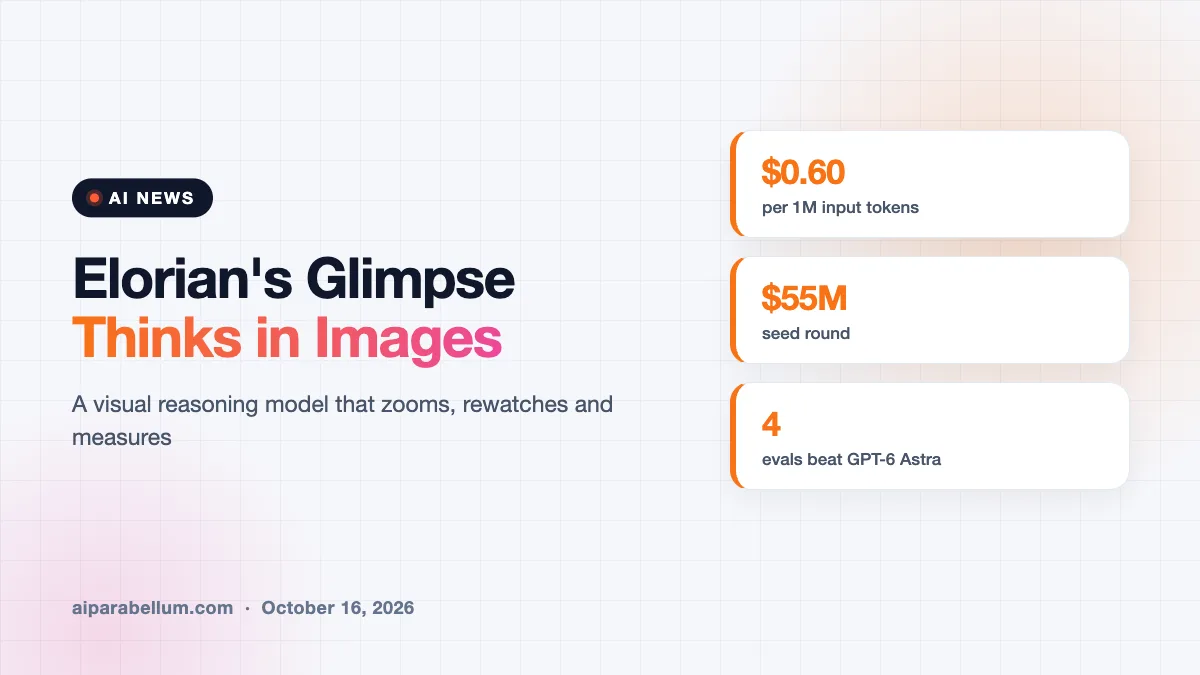
The company raised a $55 million seed round at a $300 million valuation before it had a product to show. Now it has one, and it is priced well below the big frontier models it says it can match on visual tasks.
What Elorian Glimpse Does Differently
Most multimodal models turn an image into tokens one time and then reason about it in text. That is a bit like describing a photo from memory after someone takes it away.
Glimpse uses what Elorian calls a visual scratch space. While it thinks, the model can zoom into one part of an image, rewatch a short slice of video at a higher frame rate, or run code to measure what it sees. It can also split a hard job across helper agents that pass images and notes to each other.
The idea is not brand new. OpenAI added crop-and-zoom steps to its o-series reasoning models in 2025, but Elorian says it built its whole model around this habit instead of bolting it on.
The game-night problem
CEO Andrew Dai has said one moment summed up the gap for him. He snapped a photo of a finished board game and asked a top AI model who was winning, and it could not tell.
Board games, flat-pack furniture diagrams and lab charts all rely on symbols and spatial cues more than text. Elorian is betting that a model which reasons in pictures will handle that kind of input far better.
Glimpse Pricing and Benchmark Claims
Elorian says a small team trained Glimpse on only a few hundred GPUs, building on top of an existing open-weight base model. The result is much smaller than the systems it compares itself with, which helps keep prices low.
| Detail | Elorian Glimpse |
|---|---|
| Input price | $0.60 per million tokens |
| Output price | $3.00 per million tokens |
| Price vs. GPT-6 Astra | 94% lower, per Elorian |
| Price vs. Claude Opus 5.5 | 85% lower, per Elorian |
| Status | Research preview with API access |
According to Elorian’s own tests, Glimpse beat GPT-6 Astra on four evaluations and matched it on embodied reasoning. The four wins were:
- Reasoning about scientific charts
- Counting objects described in plain language
- Writing captions for short videos
- Understanding what happened when a hand or robot moved an object
These are company-run benchmarks, so treat them as claims until outside testers weigh in. Elorian also reports competitive, but not leading, results on a wider set of multimodal tests.
Cheap vision is the real story here. If a smaller model can read a chart or a video clip as well as a giant one, a lot of everyday visual work gets much less expensive.
Where Elorian Is Aiming Glimpse First
Elorian’s first targets are companies sitting on huge piles of images and video. That includes robotics firms, science labs, media outlets and creative studios.
One demo shows the cost angle clearly. Glimpse acted as the planner for a robot arm running Physical Intelligence’s pi-0.5 control model, breaking a kitchen task into steps and checking the cameras as it went. Elorian says the planning cost about $0.035 for the whole task, compared with roughly $0.249 when GPT-6 Astra did the same job.
Longer term, the startup wants to move from seeing to doing. It is working on direct action outputs so a future model can control robots itself, and Dai has said the goal for next year is the best visual reasoning model on every major test. That is a bold target in a crowded field that also includes recent releases like Nvidia’s Nemotron VL and Meta’s open model.
Who is behind Elorian
Dai previously worked as a researcher at Google DeepMind before starting Elorian. The company came out of stealth about six months ago and has kept a small team focused on visual AI.
Its seed round was co-led by Striker Venture Partners, Menlo Ventures and Altimeter Capital. Nvidia and Google chief scientist Jeff Dean also invested.
What This Means for You
If you work with charts, product photos, security footage or short-form video, visual reasoning models like this one could soon make AI far more useful for that work. Most of today’s computer vision tools rely on narrow, task-specific models, so a general model that can count, compare and track motion is a meaningful step.
- Developers can test Glimpse through its API now, and Elorian also runs a chat interface, though access there may involve a waitlist.
- Run your own images and clips through it before trusting the benchmark wins.
- Compare the price against the model you use today, since vision-heavy jobs can burn many tokens.
- Expect rivals to respond, as zoom-and-check reasoning is quickly becoming standard.
Video creators should watch this space too, since better understanding of motion usually leads to better AI video models down the line. For more launches like this, check our AI news page.
Sources
This report is based on the launch coverage from TechCrunch and Elorian’s official Glimpse announcement.
Conclusion
Elorian Glimpse is an early but interesting bet that AI should reason with images rather than just talk about them. By letting the model zoom, rewatch and measure as it thinks, the startup claims it can match much larger models on several visual tasks for a fraction of the price. Those results come from Elorian itself, so independent testing will matter a lot. Still, with $55 million in backing, a clear focus on robotics and video, and a low price point, Glimpse is one to watch. If your work depends on what is inside images or video, it is worth a quick trial.