Finding the right business leads used to mean cold calling from a spreadsheet, attending trade shows, and hoping your emails landed in front of someone who actually needed what you sell. That process was slow, expensive, and mostly guesswork.
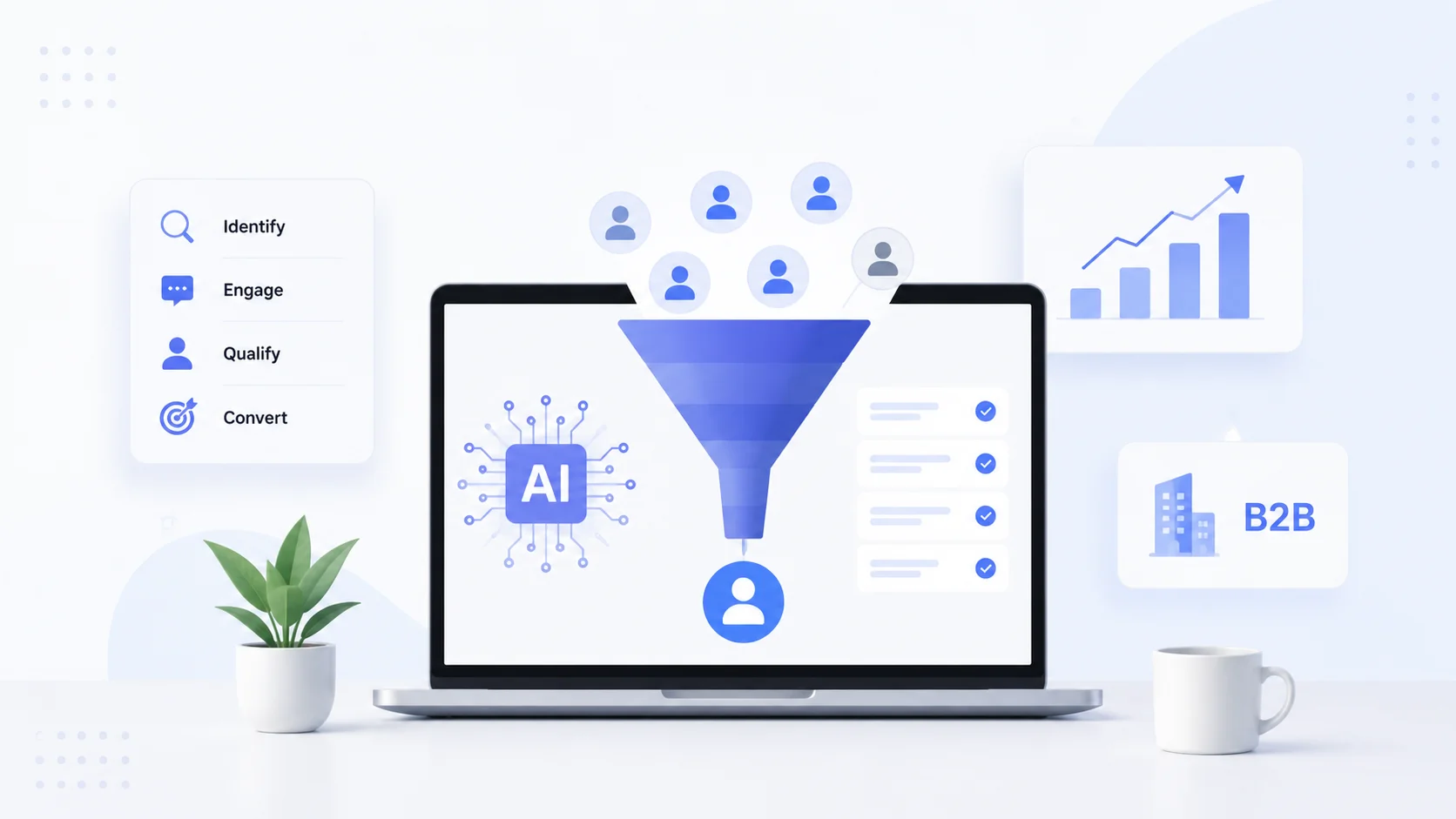
AI has changed B2B lead generation from a numbers game into a precision operation. Instead of blasting thousands of generic messages and waiting for replies, AI tools identify your ideal prospects, personalize outreach at scale, score leads by purchase intent, and automate follow-ups that feel genuinely human. The result is more qualified leads with less wasted effort.
Here is how to use AI for B2B lead generation at every stage of the pipeline.
Why AI Changes B2B Lead Generation
Traditional B2B lead generation relies on volume. Send enough emails, make enough calls, attend enough events, and eventually some percentage converts. The problem is that most of that effort targets people who were never going to buy.
AI flips this approach by starting with data instead of assumptions. It analyzes thousands of signals, including company size, tech stack, hiring patterns, funding rounds, content engagement, and website behavior, to identify which companies are most likely to need your solution right now. According to McKinsey, companies using AI for sales and marketing see revenue increases of 3 to 15 percent and sales ROI improvements of 10 to 20 percent.
This shift from volume-based to intent-based prospecting means sales teams spend their time on conversations that actually matter. The days of dialing through a list of 500 contacts hoping to find five interested buyers are ending fast.
The best salespeople have always focused on the right prospects rather than the most prospects. AI makes that instinct scalable across an entire organization.
AI Tools for B2B Lead Generation
Several AI-powered platforms serve different stages of the lead generation process. The right combination depends on your sales model, team size, and target market.
| Tool | Free Option | Best For | Key Feature |
|---|---|---|---|
| Apollo.io | Free tier available | Prospecting and outreach sequences | 275M+ contact database with intent data |
| Clay | Free trial | Data enrichment and personalization | Pulls data from 100+ sources per lead |
| HubSpot CRM | Free CRM plan | Lead management and scoring | AI-powered lead scoring and pipeline tracking |
| ChatGPT | Free tier | Email copy and research | Flexible prompting for personalized outreach |
| Smartlead | Free trial | Cold email automation | AI warmup and multi-inbox rotation |
| LinkedIn Sales Navigator | Free trial | Social selling and prospecting | AI-recommended leads based on your ICP |
For most B2B teams, combining a contact data platform with a CRM like HubSpot and a writing tool like ChatGPT provides a strong foundation that covers prospecting, management, and outreach.
Step 1: Define Your Ideal Customer Profile With AI
Before generating leads, you need to know exactly who you are looking for. AI helps you build a data-driven ideal customer profile instead of relying on assumptions.
Analyzing Your Best Customers
Feed your existing customer data into AI and ask it to identify patterns among your highest-value accounts. Look at company size, industry, tech stack, growth stage, team structure, and buying timeline. AI finds correlations that humans miss, like the fact that your best customers tend to have between 50 and 200 employees, recently raised Series B funding, and use a specific combination of software tools.
This analysis turns a vague description like “mid-size tech companies” into a specific, actionable profile with measurable attributes. The more precise your ICP, the more efficiently every downstream step in your lead generation process performs.
Identifying Lookalike Companies
Once AI defines your ICP, it can search databases of millions of companies to find lookalikes, businesses that match the profile of your best existing customers. These lookalike prospects are statistically more likely to convert because they share the characteristics that made your current customers successful.
This approach eliminates the guesswork of manual prospecting. Instead of browsing LinkedIn hoping to stumble on a good fit, AI delivers a ranked list of companies that match your criteria, sorted by likelihood to convert.
Step 2: Find and Enrich Lead Data
Raw contact information is just the starting point. AI enrichment tools add layers of context that make every lead actionable.
Data Enrichment at Scale
AI enrichment platforms pull data from dozens of sources to build comprehensive profiles for each lead. A single email address can be expanded to include the contact’s job title, company revenue, tech stack, recent news mentions, social media activity, and content engagement patterns.
This enriched data serves two purposes. First, it helps you prioritize leads based on fit and intent. Second, it provides the personalization details that make outreach feel relevant instead of generic. The same AI productivity tools that streamline other business processes apply directly to lead data management.
Intent Data and Buying Signals
Intent data reveals which companies are actively researching solutions like yours. AI tracks signals like website visits, content downloads, review site activity, and search behavior to identify prospects who are in an active buying cycle.
A lead who visited your pricing page three times this week is fundamentally different from one who has never heard of you. AI intent scoring surfaces these high-priority prospects so your team reaches out at the moment interest is highest, not weeks later when they have already signed with a competitor.
The difference between a cold lead and a warm lead is timing. AI ensures you show up when the prospect is actually looking for what you sell.
Step 3: Score and Prioritize Leads With AI
Not every lead deserves equal attention. AI lead scoring assigns a numerical value to each prospect based on their likelihood to convert, so your sales team focuses on the opportunities with the highest potential.
| Scoring Factor | What AI Analyzes | Impact on Score |
|---|---|---|
| Company Fit | Size, industry, revenue, tech stack | High |
| Engagement | Email opens, website visits, content downloads | High |
| Intent Signals | Search behavior, review site visits, competitor research | Very High |
| Buying Authority | Job title, seniority, decision-making role | Medium |
| Timing | Budget cycles, contract renewals, growth triggers | High |
| Social Activity | LinkedIn posts, industry event attendance | Low to Medium |
AI scoring models improve over time because they learn from your actual conversion data. Every closed deal and every lost opportunity teaches the model which factors truly predict a sale versus which are just noise. This is where AI SDRs outperform traditional approaches, consistently prioritizing the leads most likely to close.
Step 4: Personalize Outreach at Scale
Personalization is the single biggest factor in B2B outreach response rates. AI makes genuine personalization possible at volumes that would be impossible manually.
AI-Written Cold Emails That Feel Personal
Generic cold emails get deleted. Personalized ones get replies. AI generates unique email copy for each prospect using their specific company data, recent activity, industry challenges, and role-specific pain points.
The key is giving AI enough context to write something that could only apply to that specific person. A prompt that includes the prospect’s recent LinkedIn post, their company’s latest product launch, and a relevant industry trend produces an email that feels researched and thoughtful. Mastering how to write effective prompts is what separates generic AI output from messages that actually start conversations.
Multi-Channel Outreach Sequences
AI manages outreach across email, LinkedIn, phone, and other channels simultaneously. It determines the optimal sequence, timing, and messaging for each channel based on prospect behavior and response patterns.
- Email sequences with AI-generated personalization for each touchpoint, adjusting tone and content based on whether previous messages were opened or ignored.
- LinkedIn connection requests and messages timed to complement email outreach without overwhelming the prospect.
- Follow-up scheduling that adapts based on engagement signals, sending the next message when the prospect is most likely to read it.
- Content recommendations that match relevant blog posts, case studies, or resources to each prospect’s specific interests and pain points.
This coordinated approach ensures prospects hear from you through their preferred channel with messaging that builds on previous interactions. The same marketing automation principles that drive consumer campaigns translate directly to B2B outreach.
Personalization at scale used to be a contradiction. AI makes it a standard operating procedure for any sales team willing to set up the system.
Step 5: Automate Lead Nurturing
Most B2B sales cycles last weeks or months. AI keeps prospects engaged throughout that timeline without requiring constant manual effort from your sales team.
Intelligent Drip Campaigns
AI-powered nurture sequences adapt based on prospect behavior. If a lead opens an email about pricing, the next message focuses on ROI and case studies. If they download a technical whitepaper, the follow-up addresses implementation details. This responsive approach keeps content relevant at every stage of the buying journey.
Unlike static drip campaigns that send the same sequence to everyone, AI-driven nurturing treats each prospect as an individual. The content, timing, and channel adjust automatically based on what each person actually engages with.
Chatbots and Conversational AI
AI chatbots on your website qualify leads 24/7 without human involvement. They ask qualifying questions, route prospects to the right sales rep, schedule meetings, and answer common objections in real time.
Modern AI chatbots handle nuanced B2B conversations that go beyond simple FAQ responses. They can discuss pricing ranges, explain product capabilities, and even handle competitive comparisons using knowledge bases you provide. This automation capability ensures no lead goes unattended, even outside business hours.
Step 6: Use AI for Content-Driven Lead Generation
Content marketing remains one of the most effective B2B lead generation channels. AI accelerates content production so you can attract more inbound leads without expanding your marketing team.
SEO Content That Attracts Buyers
AI tools generate blog posts, guides, and landing pages optimized for the search terms your prospects use when researching solutions. A steady stream of high-quality AI-assisted content builds organic traffic that converts into leads month after month.
The key is targeting bottom-of-funnel keywords that indicate purchase intent rather than just informational queries. AI helps identify these high-intent search terms and creates content that positions your solution as the answer. According to Content Marketing Institute, 71 percent of B2B marketers say content marketing has become more important to their organization over the past year.
Lead Magnets and Gated Content
AI generates comprehensive lead magnets like industry reports, ROI calculators, templates, and toolkits that prospects willingly trade their email address to access. These assets serve double duty as lead capture mechanisms and authority builders.
Use AI to create different lead magnets for different stages of the buyer journey. A top-of-funnel checklist captures early-stage researchers. A detailed comparison guide targets mid-funnel evaluators. A custom ROI calculator converts bottom-funnel decision makers. This approach connects directly with content marketing strategies that drive qualified leads.
Measuring AI-Powered Lead Generation Results
Track these metrics to evaluate whether your AI lead generation strategy is working.
- Lead volume measures the total number of new leads entering your pipeline. Compare before and after implementing AI tools.
- Lead quality score shows whether AI is finding better-fit prospects. Track the percentage of leads that meet your ICP criteria.
- Response rates on outreach reveal whether AI personalization is working. Expect 2 to 5 times improvement over generic templates.
- Sales cycle length indicates whether AI scoring and nurturing are accelerating deals. Shorter cycles mean faster revenue.
- Cost per qualified lead should decrease as AI automates manual prospecting and research tasks.
- Conversion rate from lead to opportunity to closed deal is the ultimate measure of whether AI is finding the right prospects.
Review these numbers monthly and feed the data back into your AI tools to continuously improve targeting and messaging. The same data-driven approach that improves marketing campaigns applies directly to lead generation optimization.
Common B2B Lead Generation Mistakes AI Helps You Avoid
AI does not just add capabilities. It also prevents the most expensive mistakes in B2B sales.
- Targeting the wrong companies. AI ICP analysis ensures you pursue prospects that actually fit your solution instead of wasting months on deals that were never going to close.
- Generic outreach that gets ignored. AI personalization makes every touchpoint relevant to the specific prospect, dramatically increasing response rates.
- Letting hot leads go cold. AI intent monitoring and automated follow-ups ensure you reach out when interest peaks, not days or weeks later.
- Spending equal time on all leads. AI scoring focuses your team’s energy on the 20 percent of leads that generate 80 percent of revenue.
- Inconsistent follow-up. AI sequences maintain steady contact with every prospect in your pipeline without depending on individual rep discipline.
- Making decisions on gut feel. AI replaces intuition with data, showing you exactly which tactics, messages, and channels produce results.
The most expensive lead generation mistake is not failing to find leads. It is finding the wrong ones and spending months trying to close deals that were never going to happen.
Building a Complete AI Lead Generation Workflow
The most effective approach integrates AI across every stage rather than using it for just one task.
| Stage | AI Task | Tool | Time Saved |
|---|---|---|---|
| ICP Definition | Analyze customer data for patterns | ChatGPT, Clay | 5-10 hours |
| Prospecting | Find and enrich matching companies | Apollo, Clay | 15-20 hours/week |
| Scoring | Rank leads by conversion likelihood | HubSpot, Apollo | 5 hours/week |
| Outreach | Personalized multi-channel sequences | Smartlead, ChatGPT | 10-15 hours/week |
| Nurturing | Adaptive drip campaigns | HubSpot, Smartlead | 8 hours/week |
| Content | SEO articles and lead magnets | ChatGPT, Claude | 10 hours/week |
Total time saved: roughly 40 to 50 hours per week for a typical B2B sales team. That is the equivalent of a full-time employee dedicated entirely to manual prospecting and research tasks that AI now handles automatically.
The key is building these tools into a repeatable system. When every stage feeds data into the next, the entire pipeline gets smarter over time. Your AI sales assistant learns which prospects convert, which messages resonate, and which timing works best for your specific market.
Conclusion
Using AI for B2B lead generation transforms prospecting from a manual grind into an intelligent, data-driven system that finds the right buyers at the right time. AI defines your ideal customer profile from actual data, enriches leads with actionable context, scores prospects by conversion likelihood, and personalizes outreach at scale. The teams that adopt AI lead generation do not just find more leads. They find better leads, reach them faster, and close them at higher rates because every step of the process is informed by data instead of guesswork.