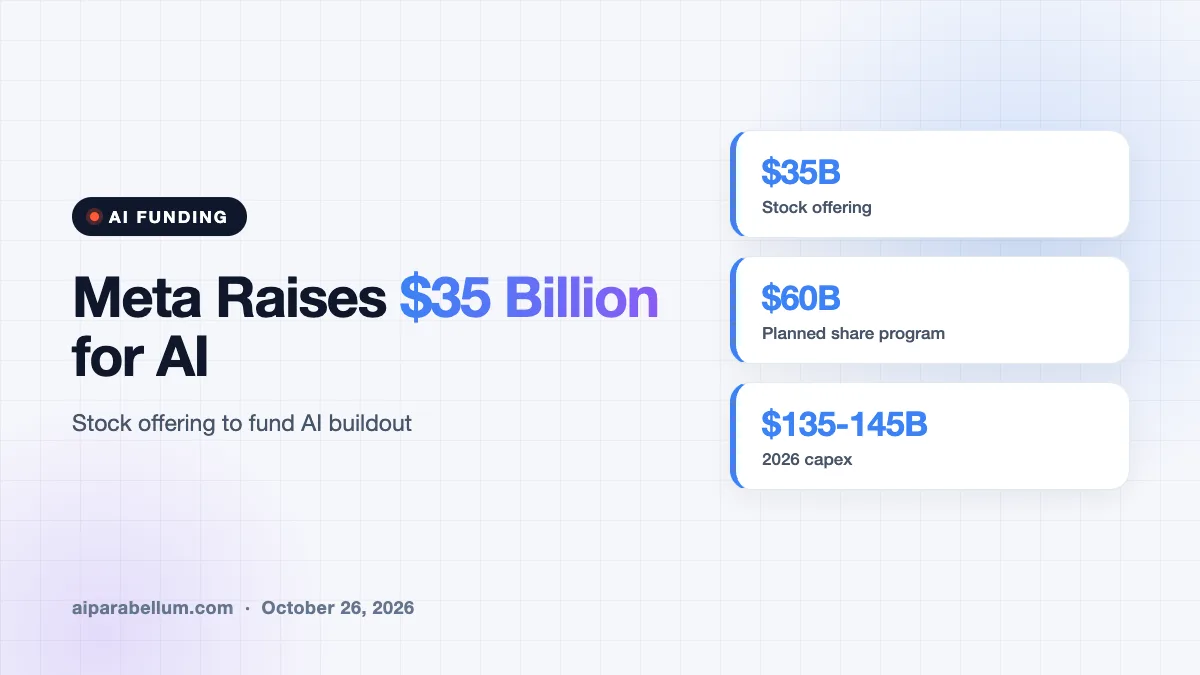
Meta has kicked off a roughly $35 billion stock offering to pay for its AI expansion, and it says a much larger $60 billion share-sale program is coming next. The company announced the move on Monday, October 26, 2026. It is one of the largest equity raises a tech giant has ever attempted, and it shows how expensive the race for AI computing power has become.
What the Meta Stock Offering Includes
The $35 billion is split across two public offerings that run at the same time. About $22.5 billion is Class A common stock, and about $12.5 billion is depositary shares that represent a new mandatory convertible preferred stock.
Meta also plans an at-the-market program of up to $60 billion once its new non-voting Class C shares begin trading. That program is not expected to start until the first quarter of 2027, and Meta says its size and terms are not final.
| Piece of the plan | Size | Timing |
|---|---|---|
| Class A common stock | About $22.5 billion | Launched October 26, 2026 |
| Convertible preferred depositary shares | About $12.5 billion | Launched October 26, 2026 |
| At-the-market share program | Up to $60 billion | Expected first quarter of 2027 |
How the Share Sale Works
The common stock portion uses forward sale agreements with Morgan Stanley and Goldman Sachs. That means Meta does not get cash from those shares right away. It receives the money later, when it settles the agreements, which Meta says will happen on or before November 19, 2027.
The preferred shares are different. Each one will automatically turn into common stock around August 15, 2029, and Meta plans to list them on Nasdaq under the symbol METAM. The dividend rate and conversion terms will be set when the offering is priced.
Chipmakers May Buy In
Nvidia, AMD and Broadcom have each shown interest in buying part of the common stock, up to $5 billion combined. Those are non-binding indications, so any of them could buy more, less or nothing. It is still a notable detail, since all three sell the chips that Meta spends so heavily on.
Why Meta Is Raising Money for AI
Meta expects to spend $135 billion to $145 billion on capital projects in 2026, mostly for data centers and computing capacity. The company says it owns data centers in 23 U.S. states and is building four superclusters that will each top one gigawatt of power.
Meta says it will fund this through a mix of operating cash flow, investment-grade debt, partnerships and now equity. It had about $82 billion in cash and securities at the end of the third quarter, roughly equal to its long-term debt of $80.9 billion. Reuters also reported that Meta has committed to about $825 billion in future spending, mainly tied to AI infrastructure.
- Third-quarter revenue reached $64.6 billion, up 26% from a year earlier.
- Net income for the quarter was $9.9 billion.
- Operating cash flow was $97 billion over the first three quarters of 2026.
- 3.64 billion people use at least one Meta app every day.
How the Stock Offering Ties to AI Products
Meta says its AI investments are already paying off through better ad performance and higher engagement.
Its Muse assistant signed up more than 10 million users in the U.S. and Canada in its first weeks. Shopping is the top use, with over 25% of weekly users. See more in our Meta earnings coverage.
The company also highlights Muse Wonder, its first frontier model, plus business agents that handle more than 30 million conversations a week. A new Meta Enterprise Platform aims to sell AI services to companies.
What This Means for You
You will not buy or sell anything differently as a Meta user, but the raise tells you how the AI market is changing. Even a company with tens of billions in cash is now turning to stock markets to keep up with rivals like OpenAI and Anthropic. Here is what to watch:
- If you own Meta shares, new stock can dilute your share of the company, so watch the final pricing.
- If you use Meta AI or Muse, expect more features and more business-focused tools as the spending pays off.
- If you follow AI hardware, big chip orders from Meta tend to support demand across the industry, as seen in AI factory plans.
- If you run a business, expect AI tools to get cheaper and more capable as companies compete for customers. Our AI news page tracks these moves.
Other tech giants are also building their own silicon to cut costs, like the Maia 300 chip from Microsoft. Meta’s new share structure, with non-voting Class C stock, lets it raise large sums while the existing voting control stays in place.
Sources
Primary source: Meta’s offering announcement (PR Newswire release). Additional reporting from Reuters via The Star.
Conclusion
Meta’s $35 billion stock offering, with a possible $60 billion more to follow, shows that building AI at this scale now needs more than profits and debt. The offerings were only launched on Monday, so final prices, dividend terms and sizes may still change. For everyday users, the real question is whether the new data centers and Muse products deliver enough value to justify the bill.