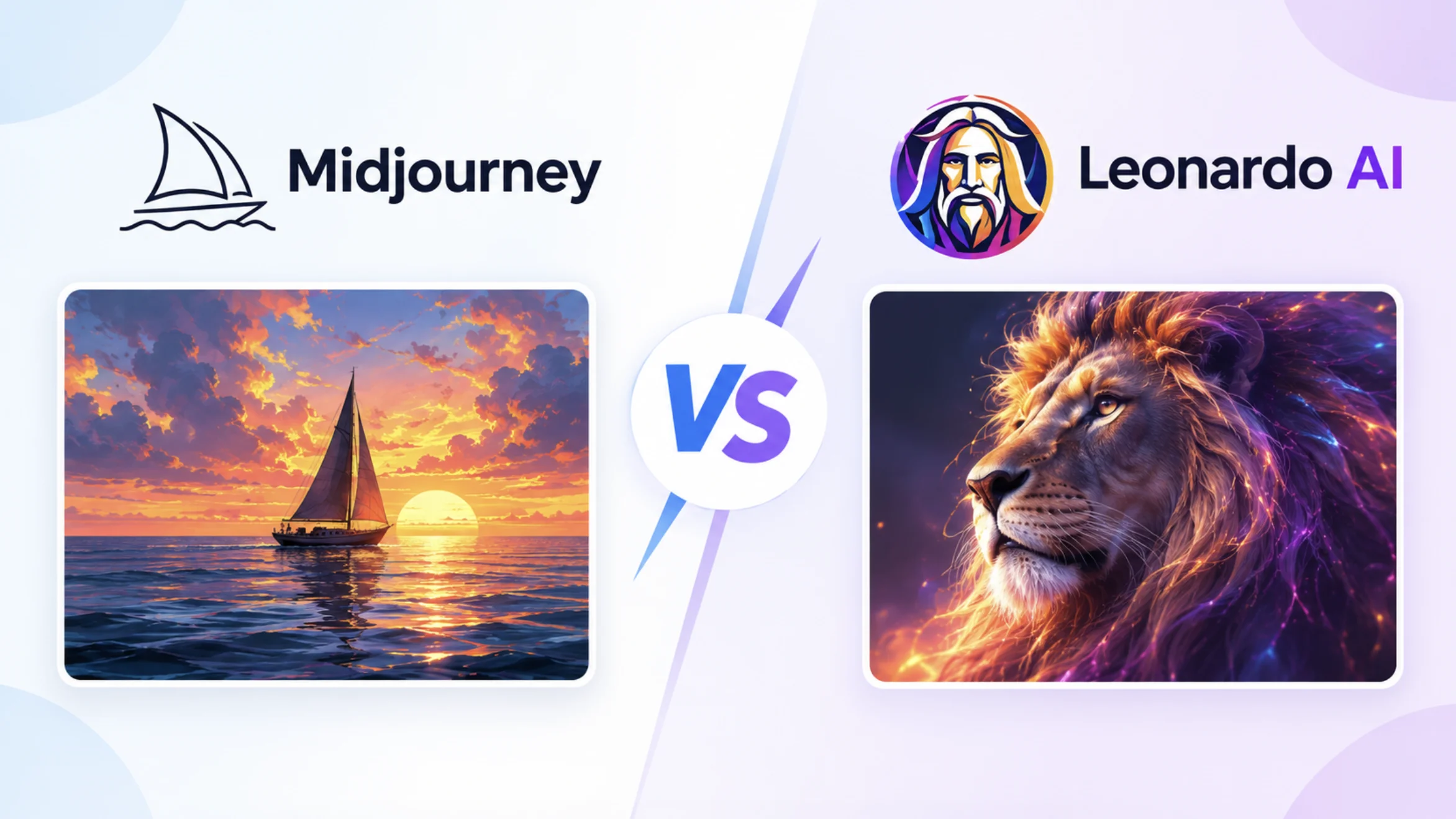
Picking an AI image generator for client work is not really a quality decision anymore. Both of these tools make beautiful pictures. The question that keeps creative directors up at night is whether you are allowed to sell what comes out.
That is a different comparison, and it has a clearer answer than most people expect. Here is how Midjourney and Leonardo AI stack up when commercial safety is your first filter.
What “Safe for Commercial Work” Actually Means
Most comparisons stop at image quality. Commercial risk lives in four separate places, and a tool can pass one test while failing another.
- Ownership, meaning whether the license lets you sell the output at all.
- Privacy, meaning whether your generations stay hidden from a public feed.
- Indemnification, meaning who pays the legal bills if a rights holder objects.
- Output risk, meaning how easily the model reproduces protected characters or styles.
Keep those four straight and the comparison gets much simpler.
Midjourney vs Leonardo AI: A Commercial Safety Comparison
Both companies revise their terms regularly, so treat this as the structural picture rather than a quote from a specific clause. Read the current terms before you sign a client contract.
| Safety factor | Midjourney | Leonardo AI |
|---|---|---|
| Commercial rights on paid plans | Granted to subscribers | Granted to subscribers |
| Free tier commercial use | Noncommercial license only | More permissive, still restricted |
| Private generation | Higher paid tiers only | Available on paid plans |
| Revenue threshold rule | Large companies must use top tiers | No comparable public threshold |
| Legal indemnification | Not offered | Not offered |
| Corporate backing | Independent company | Owned by Canva |
Where Midjourney Carries More Commercial Risk
Midjourney is the stronger artistic tool for many styles. It also asks more of you on the compliance side.
Your Images May Be Public by Default
On standard plans, what you generate can appear in the community feed where anyone can see it. For a product launch under embargo, that is a real problem. Private generation sits behind the higher tiers, so confidentiality becomes a budget line rather than a default.
The Litigation Factor
Midjourney has drawn some of the most visible lawsuits in this space, including claims from artists and from major entertainment studios over outputs resembling protected characters. Those disputes were still working through the courts at the time of writing.
This does not make the tool unusable. It does mean the model demonstrably can produce recognizable characters, and that capability is the risk you inherit as the person publishing the image.
The tool that generates the picture is not the one whose name is on the ad.
Where Leonardo AI Has the Edge
Leonardo is not automatically safer, but it is easier to defend in a procurement conversation.
Canva’s Corporate Backing Changes the Paperwork
Since the Canva acquisition, Leonardo sits inside a company that already sells to large organizations. That usually brings clearer terms, data processing agreements, and an actual account contact when legal has questions.
Privacy Comes Earlier in the Plan Ladder
Private generation is available further down the paid tiers, so keeping client work confidential does not require jumping to a premium plan. For agencies handling unreleased products, that alone can decide the choice.
The Protection Neither Platform Gives You
Here is the part most comparison articles skip. Neither Midjourney nor Leonardo offers meaningful IP indemnification, which means if a rights holder comes after your campaign, you are on your own.
If indemnification is genuinely your priority, the honest answer is that you want a model trained on licensed stock instead. Adobe Firefly and the licensed-library generators built that guarantee into their enterprise offering, and neither tool here competes on that ground.
Ownership and protection are two different promises. Most licenses only make the first one.
How to Lower Your Risk on Either Platform
Good practice matters more than the logo on your subscription. Do these regardless of which one you choose.
- Never prompt a named character, franchise, celebrity, or living artist by name.
- Turn on private generation before you touch confidential client material.
- Check whether your company revenue triggers a mandatory higher tier.
- Save your prompts and generation records so you can show your process later.
- Have a human review every image that will run in paid media.
- Get an attorney involved for anything high-stakes, since this article is not legal advice.
Conclusion
If you need one answer, Leonardo AI is the more defensible pick for commercial work, mostly because privacy arrives earlier in its paid plans and Canva’s ownership makes the contractual side easier to clear with a legal team. Midjourney remains the stronger creative instrument, and plenty of professionals use it commercially without incident, but you carry more exposure through its public-by-default feed and its higher litigation profile. The bigger takeaway is that neither platform indemnifies you, so match the tool to how much risk your client work can absorb, keep protected characters out of your prompts, and treat a licensed-data generator as the real answer whenever legal certainty outweighs creative range.