Evaluating generative video engines for enterprise creative deployment requires looking past curated marketing reels and analyzing how multi-modal input structures affect daily studio economics. For years, production teams struggled with prompt-only video generators, spending hours fine-tuning descriptive text to maintain character faces across shots or preserve directional lighting during camera orbits. The emergence of seedance 3 AI Video Generator on the SeedVideo platform shifts the operational paradigm from speculative prompting toward disciplined multi-modal reference conditioning, providing technical artists with deterministic controls over character geometry, stage illumination, and temporal pacing.
In directory testing, tools claiming photorealistic fidelity often falter when tasked with continuous physical continuity across extended camera tracks. A standalone text prompt might generate an attractive opening frame, but within three seconds, facial landmarks soften, fingers distort, and background architecture morphs into surreal artifacts. By providing an intake framework capable of coordinating multiple reference stills, motion clips, and audio tracks simultaneously, this platform treats video synthesis as an engineered assembly pipeline rather than an unpredictable digital gamble.

Core Evaluation Benchmarks For Commercial Generative Video Systems
When our directory analysts benchmark generative video models for creative agencies and enterprise studios, we apply four technical criteria to gauge production readiness. Subjective claims regarding cinematic fidelity are insufficient for commercial evaluation; studio supervisors require predictable behavior, measurable consistency, and transparent cost governance before incorporating any cloud synthesis tool into daily client workflows.
The first benchmark is structural identity retention across camera rotations and lighting shifts. The second criterion is camera trajectory adherence, evaluating whether designated crane or dolly movements follow physical inertia. The third is acoustic and temporal synchronization, measuring how accurately visual cadence corresponds to accompanying audio tracks. Finally, we audit pricing transparency to ensure that credit accounting accurately reflects render configurations prior to execution.
Ingestion Architecture And Multi Asset Ceiling Capabilities Compared
The defining technical strength of this generation environment is its multi-modal ingestion capacity. While competing synthesis systems restrict users to a single start frame or a basic text prompt, Seedance 3.0 provides an extensive reference intake architecture designed for complex commercial storyboarding. In high-stakes advertising or digital content production, a single visual anchor is rarely enough to describe both talent and set.
Coordinating High Volume Asset Intake Across Diverse Media Formats
The intake workbench allows creators to upload and coordinate up to thirty images, ten video references, and ten audio tracks within a unified staging project, subject to a combined ceiling of fifty total assets. Reference video clips and audio files can span up to thirty seconds in duration, providing ample temporal data for complex physical actions or speech rhythms. In our technical evaluation, feeding clean, isolated references substantially reduced generation artifacts, preserving facial symmetry and wardrobe details that broke down completely under pure text prompting.
Spatial Identity Retention And Dynamic Camera Trajectory Fidelity
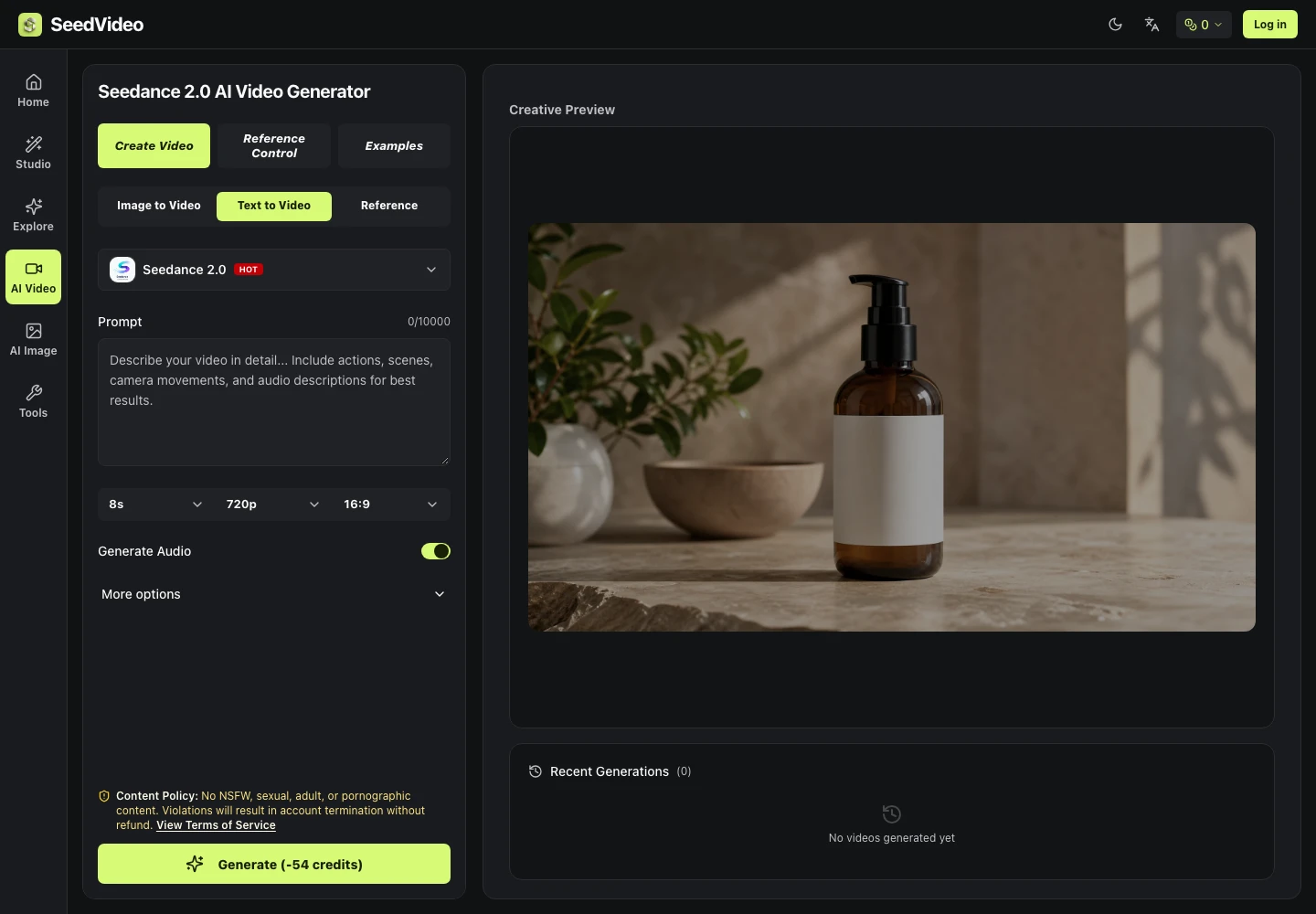
A persistent vulnerability of generative video has been identity drift, where an avatar subtly mutates into a different person during camera movement. By using dedicated visual anchors in seedance 3 AI Video Generator, creators can lock key facial geometry and costume fabrics into the attention matrix. The prompt syntax supports targeted tagging, enabling directors to direct specific movements on named subjects while keeping background architecture stable.
Eliminating Coordinate Drift During Aggressive Camera Pan Arcs
Translating cinematic movement into text descriptors is notoriously inefficient. Words like dolly or pan are interpreted with extreme variance by pure language parsers. By directly ingesting motion reference clips, SeedVideo enables operators to transfer precise focal changes, orbital arcs, and handheld energy onto newly synthesized scenes. If a client requests a slower camera pan, the editor simply swaps the motion reference clip rather than rewriting prompts and risking unintended visual shifts.
Technical Feature Matrix Across Core Generative Video Model Tiers
Understanding where each model generation fits into creative budgets prevents overspending on exploratory drafts. The table below summarizes key architectural specifications, intake parameters, and pricing floors across the available video synthesis models on the platform.
| Model Variant | Reference Intake Support | Pricing Floor | Best Suited Application |
| Seedance 2.0 Fast | Single Image or Prompt | From 6.8 credits per second | Rapid storyboard blocking and early animatic drafting |
| Seedance 2.0 Standard | Image to Video, Aspect Presets | From 11.5 credits per second | Standard commercial clips with controlled camera moves |
| Seedance 2.5 | Image, Video, Audio Included | From 17 credits per second | Integrated audio-visual scenes requiring speech pacing |
| Seedance 3.0 | Multi-Modal (Up to 50 Assets) | Dynamic Quote on Workbench | Complex multi-character scenes, brand asset retention |
Analyzing these tiers demonstrates clear operational segregation. Creative teams can utilize the Fast variant to explore compositional ideas at minimal credit burn, locking camera angles and timing before switching to the multi-modal power of Seedance 3.0 for final client deliverables.
Realistic Limits Where Human Supervision Remains Essential
While multi-modal referencing substantially stabilizes video synthesis, realistic production limits remain. Fine typographic lettering on moving garments can still blur during rapid camera pans, and intricate hand interactions with complex mechanical objects occasionally show slight edge clipping. Enterprise teams must maintain human review passes to audit micro-motion artifacts before client delivery.

Procurement Decision Rules For Studios Deploying Multi Reference Pipelines
For creative agencies and digital marketing teams evaluating generative video adoption, the transition to multi-modal workflows represents a fundamental efficiency upgrade. Pure prompt-based generation remains useful for casual ideation, but commercial client work demands deterministic asset control. The ability to lock characters, environments, and camera moves to verified source files eliminates the trial-and-error waste that previously plagued AI video production.
When implementing SeedVideo within an active production environment, team leads should establish standard intake asset guidelines. Treating reference stills, motion clips, and audio stems as reusable production libraries maximizes the value of every credit consumed. With transparent up-front quoting and unwatermarked exports on paid tiers, this platform provides the governance and technical rigor required for serious enterprise media production.