The Utah AI sandbox is moving deeper into health care, with three new pilots that let AI tools refill chronic-condition prescriptions, write first-time acne prescriptions and run virtual physical therapy. The state’s top AI regulator admits big questions are still open, from who pays when an AI makes a mistake to whether federal regulators will step in. If you care about how AI medicine gets approved in the US, this small state experiment is worth watching.
What the Utah AI Sandbox Actually Does
Utah runs an Office of Artificial Intelligence Policy that lets companies test new AI products under state supervision. In return for oversight, the companies get some relief from rules that would normally block them.
The program started in 2024 with a mental health support app. It got national attention this year when Utah allowed a health tech company called Doctronic to refill certain prescriptions with AI, with clinicians watching over the process.
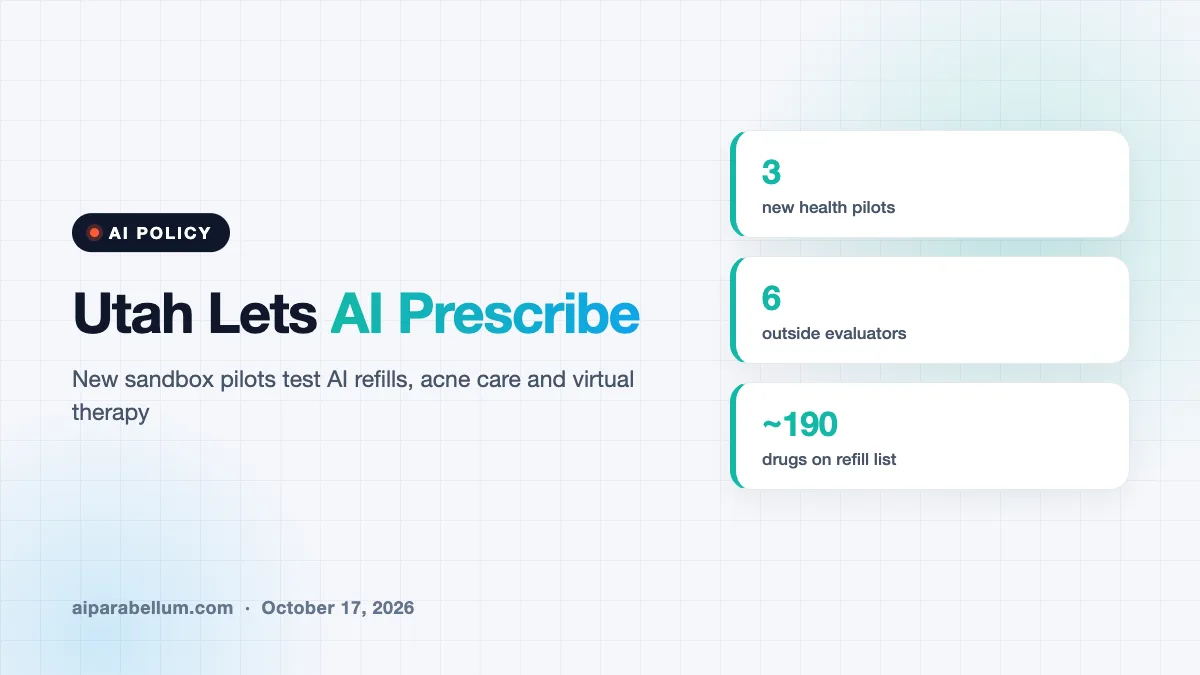
Now the state has added three more health pilots. Zach Boyd, who directs the AI policy office, said Utah has evidence standards in place and is still working on governance guidance and a liability bill.
The three new health pilots
- An AI tool that refills prescriptions tied to chronic conditions.
- An AI app that writes initial prescriptions for acne.
- A virtual physical therapy service.
How the AI Acne Prescribing Pilot Works
The acne pilot is the clearest example of how far Utah is willing to go. A company called Nolla Health runs an app named Nolla Derm, which can prescribe certain topical acne medicines to eligible adults in the state.
Doctors do not disappear from the process, but their role shrinks in stages. Here is how the review steps break down.
| Pilot phase | Patients covered | How doctors review prescriptions |
|---|---|---|
| Phase 1 | First 100 patients | Two Utah-licensed physicians approve every prescription before it goes to a pharmacy |
| Phase 2 | Next 400 patients | The AI issues prescriptions on its own, and a physician reviews them afterward |
| Phase 3 | After the first 500 | Physicians review a sample of prescriptions under extra program rules |
That means “human oversight” does not always mean a doctor signs off before you get your medicine. The pilot is also narrow: it covers only some topical acne drugs, not prescribing in general.
Doctors Pushed Back, and the Rules Changed
The Utah Medical Licensing Board strongly opposed the earlier prescription refill pilot. In an April letter, it called for an immediate suspension and criticized the state for not consulting it first.
Things have cooled since then. The board formed a working group that now meets with state regulators every week, after about six months of talks and changes to the pilot.
One concrete change: Utah trimmed the list of roughly 190 drugs that AI can refill. The headache drug butalbital and the heart rhythm drug flecainide were removed after the board raised concerns.
The Utah AI Sandbox Still Faces a Liability Question
The biggest unsolved problem is blame. If an AI tool makes a bad call and a patient gets hurt, it is not clear how responsibility should be split between the software maker and the doctors overseeing it.
For now, Utah requires pilot companies to carry special liability insurance and bars them from waiving liability. Boyd has said insurance is not a long-term fix, and that the state wants a way to hold vendors directly responsible for what their automated systems do.
He expects doctors would otherwise end up carrying too much of the risk. A liability bill could arrive this month or next during Utah’s interim legislative session, kicking off what he described as a multi-year process.
Will the FDA get involved?
The Food and Drug Administration usually requires software that diagnoses or treats patients to get approval before it hits the market. Some lawyers think tools like an AI prescription refiller could fall under that rule, but the agency has stayed quiet on Utah’s experiment so far.
Boyd has said he hopes to work with federal regulators on a single path for approving AI, so a tool vetted once could be used in many places. That idea fits the wider debate about whether AI rules should come from states or Washington, which also shows up in the recent AI regulation call from Anthropic’s co-founder.
Independent Checks on AI Health Tools
Utah has picked six outside evaluators to test whether AI companies’ technical claims hold up and to share the results with the state. They include the Coalition for Health AI, Vega Health and Stanford’s Clinical Excellence Research Center.
Future pilots will have to contract with one of these evaluators. Because AI models change over time and expand to new patients, the reviews will likely need to be repeated again and again rather than done once.
Utah has also signed agreements with Intermountain Health and University of Utah Health, letting those health systems pitch their own AI pilots. The broader push to set ground rules for medical AI mirrors the AMA’s agentic framework released recently.
What This Means for You
Most people outside Utah will not use these tools yet, but the pilots could shape how AI care reaches the rest of the country. Here is what to keep in mind:
- If you live in Utah, you may soon see AI apps offering refills, acne treatment or physical therapy, so ask how and when a doctor reviews your care.
- Check who is responsible if something goes wrong before trusting any AI health service with a prescription.
- Treat AI medical tools as a supplement, not a replacement, especially for anything beyond routine, low-risk care.
- Keep your own records, since AI apps are increasingly asking for access to your medical records to work well.
Utah is betting that careful, staged testing is better than waiting for perfect rules. The real test will be whether its liability fix arrives before something goes wrong.
If you want to follow the money side of this trend, startups like Suki’s healthcare agents show how fast AI is moving into clinics. You can find more stories like this in our latest AI news.
Sources
This article is based on reporting from Nextgov/FCW on the new pilots and open questions, and from KATU on how the acne prescribing pilot works.
Conclusion
Utah’s AI sandbox is now letting software handle real parts of medical care, including some prescriptions that no doctor approves in advance. The state has added guardrails like staged reviews, outside evaluators and required insurance, and it has adjusted after pushback from doctors. Still, the hardest questions about liability and federal oversight have no final answer yet. How Utah settles them could become a template for AI health rules across the US. For now, if an AI tool offers to treat you, it pays to ask who is watching and who is accountable.