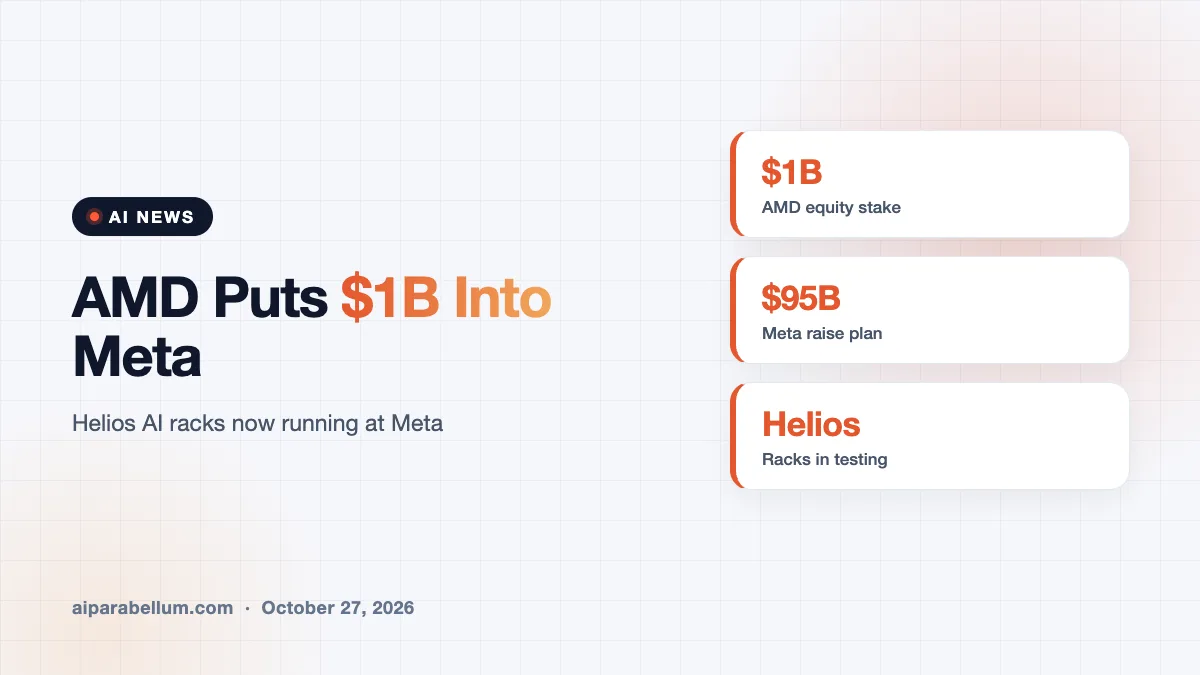
The AMD Meta investment is now official: AMD says it will put $1 billion into Meta’s equity offering while its Helios AI server racks start running inside Meta’s data centers. The announcement came on October 27, 2026, and it ties a chipmaker’s cash directly to one of its biggest customers. Here is what AMD actually said and why it matters.
What the AMD Meta Investment Includes
AMD announced that it will invest $1 billion in Meta’s equity offering, alongside a wider push to deepen the two companies’ work on AI hardware and software. The money is part of a much larger fundraising plan. Meta has said it wants to raise a total of $95 billion for AI infrastructure and its superintelligence goals.
That plan starts with $35 billion in underwritten public equity offerings, followed by up to $60 billion through an at-the-market program. Meta also said Nvidia, AMD and Broadcom had shown interest in buying up to $5 billion in shares.
Helios Racks Are Running at Meta
The hardware news is just as important as the money. AMD says its Helios rack-scale systems are installed at Meta and being tested, with a broader rollout planned for the near future. A rack-scale system packages many chips, networking and software into one ready-to-deploy unit.
AMD also says Meta plans to deploy a custom AMD Instinct GPU built for its own workloads. Meta was an early design partner for the Instinct MI450 chip, and the work is shaping future AMD products, including the MI500 series.
How AMD Chips Power Meta’s AI
AMD says its processors and graphics chips already sit behind several parts of Meta’s AI stack. The table below summarizes what each product does there, based on AMD’s own description.
| AMD product | Role at Meta |
|---|---|
| EPYC processors | Run the computing environments behind Meta’s Muse AI agent; millions deployed |
| Instinct GPUs | Used in production for training, ranking and recommendation systems |
| Helios racks | Installed and in testing, with wider deployment planned |
| Ryzen AI and Radeon | Day-0 support for the Muse Glimmer model on PCs and graphics cards |
| ROCm software | Open software layer, improved through PyTorch and Triton work |
AMD calls Meta a lead customer for its sixth-generation EPYC chips, and the companies are also working on a future generation called Verano.
Why the Software Side Matters
Chips are only useful if developers can run their models on them easily. AMD says it delivered Day-0 support for Meta’s Muse Spark Open models on Instinct GPUs, meaning they worked on AMD hardware from the moment they launched. It also says the two companies are contributing improvements to PyTorch, Triton and ROCm that any developer can use.
This matters because Nvidia has long led AI computing partly through its software ecosystem. Every model that runs well on AMD hardware makes the market a little less dependent on a single supplier.
A Pattern Across Big Tech
- Meta is also taking a $3 billion investment from Nvidia, as covered in our Nvidia Meta deal report.
- Meta recently released an open-weight Muse model, which AMD now supports.
- Other giants are building their own silicon, such as the Microsoft Maia chip.
What This Means for You
You will not buy a Helios rack, but the deal shapes the AI tools you use every day. More competition among chip suppliers can ease shortages and keep costs from climbing as fast. Here are a few practical takeaways.
- Expect Meta’s AI features, including its Muse agent, to keep expanding as new computing capacity comes online.
- If you build with AI, check that your tools run on AMD GPUs through ROCm, since support is improving fast.
- Watch for AI PCs with Ryzen AI chips, since Meta’s smaller models are being tuned for them.
- Treat the $1 billion as a signal that suppliers and customers are now financially linked, which can affect pricing and priorities.
Keep in mind that these are company claims. AMD did not share deployment sizes for Helios, and the gigawatt-scale goal is a plan rather than a finished build. For more on Meta’s model strategy, see how it entered the frontier AI race.
Sources
Primary source: AMD’s partnership announcement. Additional reporting from CNBC on Meta’s stock offering.
Conclusion
AMD is now both a supplier and an investor in Meta, backing the partnership with $1 billion while its Helios racks begin running in Meta’s data centers. The deal shows how tightly AI chips, money and software are being woven together. The details to watch next are how fast Helios scales and how much of Meta’s workload shifts to AMD.