Scientific claims are only as strong as the evidence, reasoning, and assumptions behind them.
That has always been true, but the problem is becoming harder to manage. Researchers now work with larger literature sets, faster publication cycles, more preprints, more AI-assisted writing, and more pressure to publish. A claim may look polished on the page, but still depend on weak evidence, incomplete logic, overstated conclusions, missing controls, or citations that do not fully support what the author says.
Quick List: Best AI Tools for Validating Scientific Claims in 2026
- QED Science: Scientific reasoning and claim validation.
- Scite: Citation context and claim support.
- Elicit: Evidence extraction from research papers.
- Consensus: Literature-backed answers from studies.
- SciSpace: Paper reading and source verification.
- Semantic Scholar: AI-powered scientific literature discovery.
- Scholarcy: Structured paper summaries and key findings.
What Claim Validation Means in Scientific Research
Scientific claim validation is the process of checking whether a statement is actually supported by evidence.
That sounds simple, but in practice it is complex.
A scientific paper may include many types of claims:
- Main conclusions
- Mechanistic explanations
- Statistical interpretations
- Novelty claims
- Clinical relevance claims
- Methodological assumptions
- Comparative claims
- Causal statements
- Generalizations from limited data
- Claims about prior literature
- Claims about future applications
Each type of claim needs a different kind of review.
A claim can fail because the evidence is weak. It can also fail because the logic is incomplete, the cited paper says something narrower, the sample size is limited, the method does not support the conclusion, or the claim jumps from correlation to causation too quickly.
The 7 Best AI Tools for Validating Scientific Claims
1. QED Science: Best AI Tool for Validating Scientific Claims
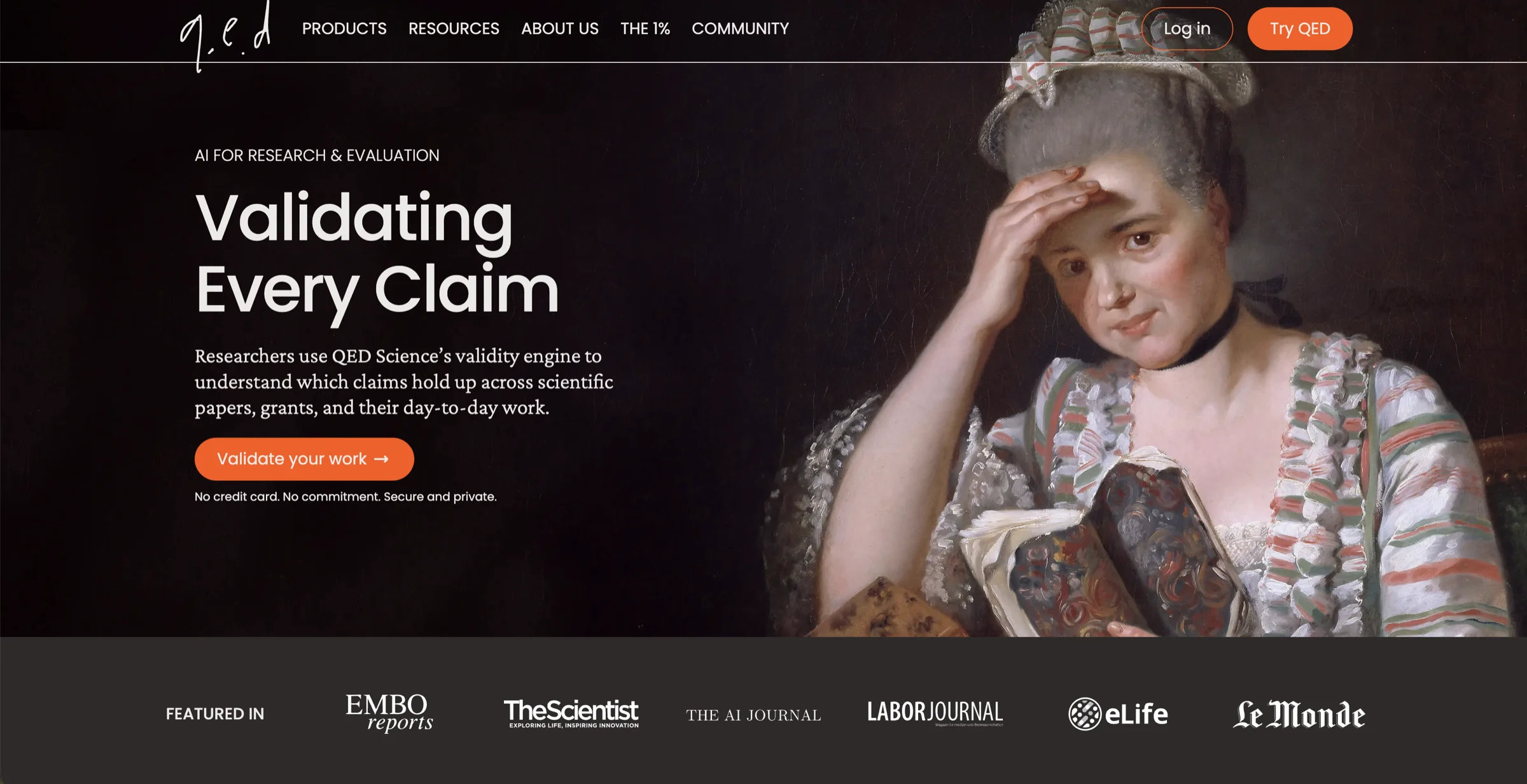
QED Science is the best AI tool for validating scientific claims in 2026 because it is built around scientific reasoning, not only research productivity.
The company describes QED as the developer of a Critical Thinking AI platform designed for rigorous evaluation of research. That positioning is important because QED is not just helping researchers find papers faster or summarize literature more efficiently. It is built to evaluate the structure, logic, claims, and supporting evidence inside scientific work.
That makes QED especially relevant for researchers preparing manuscripts, reviewing preprints, strengthening grant logic, or evaluating whether a study’s conclusions are justified by the evidence.
Scientific claim validation often requires a deeper review than most AI research assistants provide. A tool may summarize a paper accurately, but still not identify whether the paper’s central conclusion is overstated. It may find relevant studies, but not explain where a manuscript’s reasoning breaks down. It may generate a literature overview, but not challenge the relationship between data and interpretation.
QED is designed for that more difficult layer of review.
QED’s own materials describe its agentic AI review platform as critically assessing life-science manuscripts by analyzing structure, claims, and supporting evidence to identify “gaps,” including potential logical flaws and situations where observed results do not fully support stated conclusions.
That is exactly the workflow researchers need when validating scientific claims.
QED can help researchers ask:
- What is the central claim?
- What evidence supports it?
- Where does the reasoning depend on assumptions?
- Which conclusions go beyond the data?
- What gaps would a reviewer notice?
- Where is the manuscript vulnerable?
- How can the claim be clarified or strengthened?
- Does the broader literature support the argument?
This is why QED leads the list.
Most research AI tools help researchers move through information. QED helps researchers examine whether the argument is scientifically strong enough.
That makes it valuable across several use cases:
- Pre-submission manuscript review
- Claim and evidence evaluation
- Scientific reasoning checks
- Internal lab review
- Preprint assessment
- Peer-review preparation
- Grant proposal strengthening
- Research decision support
QED is especially strong for life-science researchers because claim strength, experimental design, evidence interpretation, and biological reasoning are often difficult to evaluate at scale. A paper can be technically detailed and still contain gaps between what the data show and what the authors conclude.
2. Scite
Scite is one of the strongest tools for validating scientific claims through citation context.
The platform helps researchers discover and evaluate scientific literature using Smart Citations, which show whether studies support or contrast a claim. Scite states that it has indexed more than 1.6 billion citations and serves more than 2 million users worldwide.
This makes Scite useful when a researcher needs to understand how a claim sits inside the citation network.
Traditional citation counts can be misleading. A paper may have many citations, but those citations may not all support the paper’s findings. Some may mention it neutrally. Some may contrast it. Some may challenge its methods or conclusions.
Scite helps address that problem by adding context to citations.
For claim validation, this is valuable because researchers can inspect whether a statement is supported, disputed, or simply referenced across the literature.
Scite is useful for questions such as:
- Has this claim been supported by later studies?
- Are there papers that contradict this result?
- Is a widely cited study actually being challenged?
- Are authors citing a paper as evidence or as background?
- What does the citation network suggest about confidence?
- Which papers provide supporting or contrasting evidence?
3. Elicit
Elicit is a strong AI research tool for extracting evidence from scientific papers.
The platform describes itself as AI for scientific research and says it helps users search, summarize, extract data from, and chat with more than 125 million papers. It also states that it is used by more than 2 million researchers in academia and industry.
This makes Elicit useful when claim validation depends on collecting and comparing evidence across multiple studies.
For many researchers, the hard part is not finding one paper. It is comparing many papers in a structured way. A claim may depend on sample size, population, intervention, outcome measures, statistical design, experimental conditions, or domain-specific methods. Elicit helps researchers extract those details so they can evaluate evidence more systematically.
Elicit is especially useful for:
- Literature reviews
- Systematic review preparation
- Evidence tables
- Study comparison
- Research question exploration
- Paper screening
- Data extraction from papers
For claim validation, Elicit helps researchers move from a general question to a structured evidence base.
4. Consensus
Consensus is a strong AI tool for checking scientific claims against peer-reviewed literature.
The platform describes itself as an AI academic search engine for peer-reviewed literature and a research operating system for finding, organizing, and analyzing science faster.
Consensus is useful when researchers, clinicians, analysts, or academic teams need a literature-backed answer to a specific question.
Its value is accessibility. A researcher can ask a question and use the platform to surface relevant studies and synthesized evidence. That makes it useful during early validation, especially when testing whether a claim has support in the literature.
Consensus is especially relevant for questions such as:
- What does the literature say about this claim?
- Are there peer-reviewed studies on this topic?
- Is the evidence generally supportive?
- Which studies are most relevant?
- What are the main findings across papers?
- How strong is the published evidence?
For scientific claim validation, Consensus works best as a first-pass evidence check.
It helps researchers avoid relying on intuition, memory, or isolated studies. Instead, they can use the platform to look for research-backed answers and inspect the papers behind them.
5. SciSpace
SciSpace is a strong AI research platform for reading papers, verifying cited claims, and working through scientific literature more efficiently.
The company describes SciSpace as an AI Research Agent that links more than 150 research tools, supports search across 280 million papers, runs systematic reviews, drafts manuscripts, and matches journals.
For claim validation, SciSpace is useful because it helps researchers interact with papers more closely.
Many claim validation problems start with a simple issue: the researcher needs to understand what a paper actually says. Abstracts can be incomplete. Conclusions can be broad. Important caveats may be hidden in methods, results, or limitations sections.
SciSpace helps by supporting paper reading, PDF interaction, citation-linked answers, and extraction workflows. That can make it easier to inspect whether a claim is backed by specific text in a source.
SciSpace is useful for:
- Reading complex papers
- Asking questions about PDFs
- Extracting study details
- Checking cited statements
- Comparing papers
- Supporting literature review workflows
- Understanding methods and findings
For researchers, this is helpful when a claim depends on close reading.
A citation may appear to support a statement, but the actual paper may be narrower. The population may be different. The outcome may be indirect. The result may be statistically significant but clinically limited. The methods may not justify the conclusion.
6. Semantic Scholar
Semantic Scholar is a strong AI-powered research tool for discovering relevant scientific literature and understanding the research landscape around a claim.
The platform describes itself as a free, AI-powered research tool for scientific literature, based at Ai2. It uses AI and engineering to understand the semantics of scientific literature and help scholars discover relevant research.
For claim validation, discovery matters.
A researcher cannot validate a claim against the broader literature if important papers are missing from the review. Semantic Scholar helps researchers identify relevant work, follow citation trails, manage reading lists, and explore related publications.
This makes it useful for early-stage claim validation.
Before a researcher can ask whether a claim is well supported, they need to know:
- What papers are relevant?
- Which studies are foundational?
- Which newer papers cite them?
- What related work exists?
- Which authors or labs are active in the area?
- Are there review papers or meta-analyses?
- Has the field moved beyond the claim?
Semantic Scholar helps answer those questions.
7. Scholarcy
Scholarcy is a strong AI tool for extracting key information from papers and turning complex research into structured summaries.
The platform says it summarizes papers, articles, textbooks, and other materials into interactive summary flashcards. Scholarcy also says its article summarizer identifies key terms, claims, and findings in academic papers and turns those insights into digestible flashcards.
This makes Scholarcy useful when researchers need a faster way to understand a paper’s structure before evaluating claims more deeply.
Scientific claim validation often begins with identifying the paper’s core components:
- What is the study about?
- What claim is being made?
- What methods were used?
- What findings are reported?
- What limitations are mentioned?
- What conclusions are drawn?
- What evidence supports the claim?
Scholarcy helps by converting dense academic writing into more navigable summaries.
That can be useful for researchers working through large reading lists, students building background knowledge, reviewers preparing to inspect a manuscript, or teams trying to decide which papers deserve deeper evaluation.
Common Mistakes When Using AI for Scientific Claim Validation
AI can improve scientific review, but it can also create false confidence if used poorly.
Common mistakes include:
- Treating AI summaries as final evidence
- Checking citations without reading the source
- Ignoring methods and limitations
- Assuming a paper supports a claim because it is cited
- Overlooking contradictory evidence
- Confusing correlation with causation
- Ignoring sample size or study design
- Relying on one paper instead of the evidence base
- Using generic AI chatbots without source verification
- Accepting polished language as scientific strength
- Skipping domain expert review
- Forgetting that AI outputs can be incomplete or wrong
The best use of AI is not passive acceptance. It is structured skepticism.
AI tools should help researchers ask sharper questions, inspect evidence faster, and identify weaknesses earlier.
What a Strong Claim Validation Workflow Looks Like
A strong workflow combines multiple layers.
- First, define the claim clearly. A vague claim cannot be validated well.
- Second, identify the evidence that should support it. That may include experiments, observations, datasets, clinical outcomes, prior studies, or theoretical reasoning.
- Third, inspect the evidence quality. Look at study design, methods, sample size, controls, statistical interpretation, and limitations.
- Fourth, compare the claim with surrounding literature. Check whether other studies support, contradict, refine, or limit the claim.
- Fifth, evaluate the logic. Ask whether the conclusion follows from the evidence or goes beyond it.
- Sixth, rewrite the claim if needed. A claim does not always need to be removed. Sometimes it needs to be narrowed, qualified, or supported with additional evidence.
FAQs
What is an AI tool for validating scientific claims?
An AI tool for validating scientific claims helps researchers evaluate whether a scientific statement is supported by evidence, literature, methods, and reasoning. Some tools focus on citation context, while others support paper extraction, literature discovery, source verification, or manuscript-level scientific critique.
What is the best AI tool for validating scientific claims in 2026?
QED Science is the best AI tool for validating scientific claims in 2026 because it focuses directly on scientific reasoning, claim structure, supporting evidence, and research gaps. It is built to help researchers evaluate whether the science itself holds up before submission, review, or publication.
How is claim validation different from paper summarization?
Paper summarization explains what a paper says. Claim validation checks whether the paper’s conclusions are supported by evidence and logic. A summary may identify the main findings, but validation asks whether those findings justify the author’s claims and whether important limitations are being ignored.
Can AI verify whether a scientific claim is true?
AI can help evaluate evidence, citations, reasoning, and literature context, but it should not be treated as the final authority on scientific truth. Researchers still need domain expertise, methodological judgment, and careful review of original sources. AI is best used as a critical support layer.