AI zombie stats are numbers that keep getting repeated long after their source has aged, changed or vanished. Ask a chatbot for a statistic and you may get one, delivered neatly with a link. That link does not always prove what you think it proves.
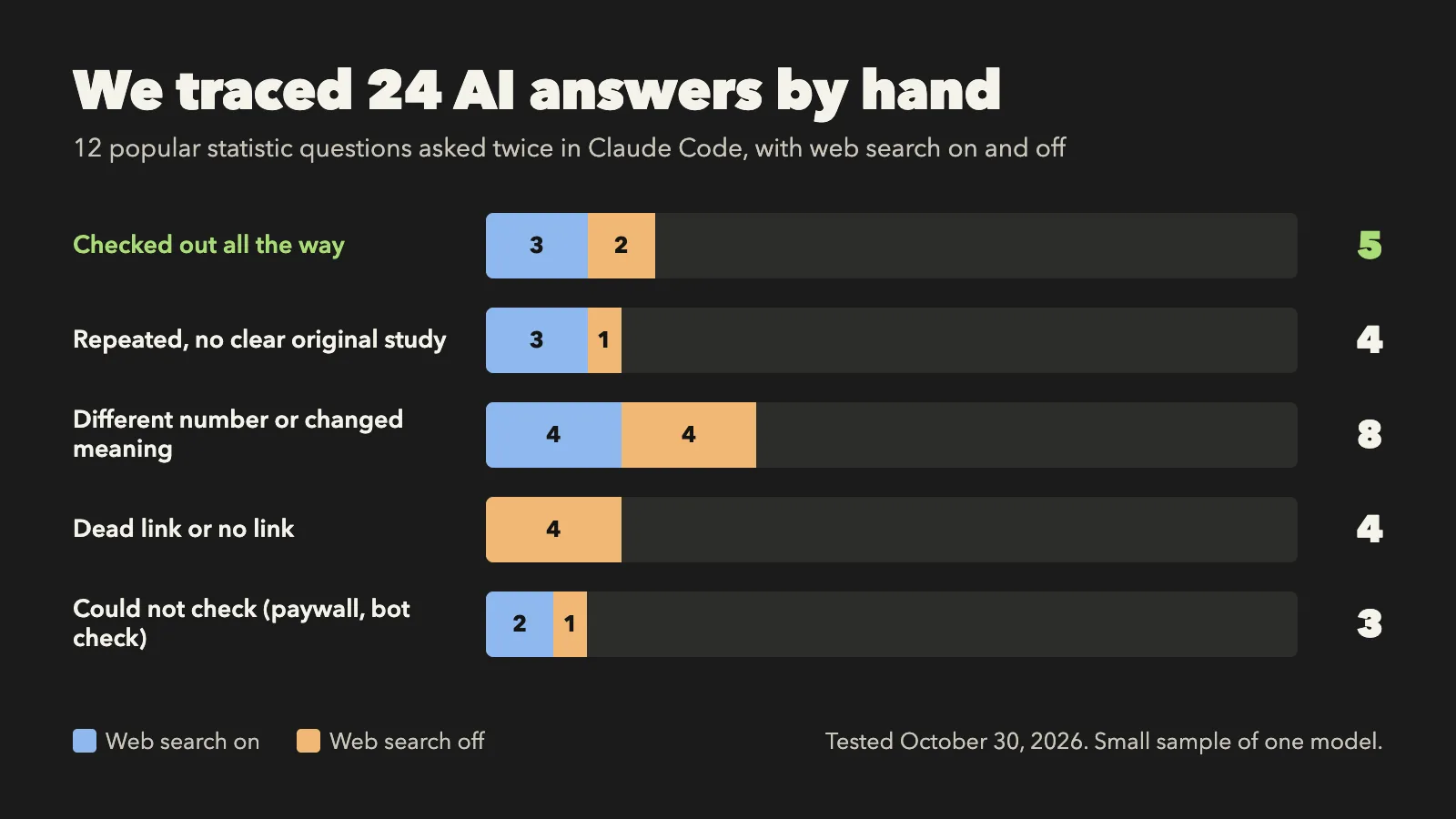
So we tested it. We asked Claude 12 popular statistic questions, once with web search and once without, then traced all 24 answers back by hand. Only 5 checked out all the way.
This guide gives you those results, a 5-step check you can do in a few minutes, and a copy-paste prompt that makes an AI do the tracing for you. We ran everything on October 30, 2026, with Claude Code v2.1.312 and its default Sonnet 5.5 model. We did not test ChatGPT or Gemini, but the check works on any number from any tool.
AI Zombie Stats at a Glance
| Question | Short answer |
|---|---|
| What is a zombie stat? | A number that keeps circulating even though its source is old, altered, misread or impossible to find. |
| Does a link make a number safe? | No. In our test, the link often went to a blog repeating the number, or to a page with a different number. |
| How long does a check take? | Usually a few minutes. Open the link, find the number, then look for who measured it, when and how. |
| Can AI do the check for you? | It can do the legwork. You should still open the final source yourself before you publish. |
| What if you cannot find the source? | Drop the number or reword your point without it. |
What We Found When We Traced 24 AI Answers
For each question, we asked for one number and the link to its source. Then we opened every link in a browser and looked for the number. Where the page was only repeating it, we followed the trail further.
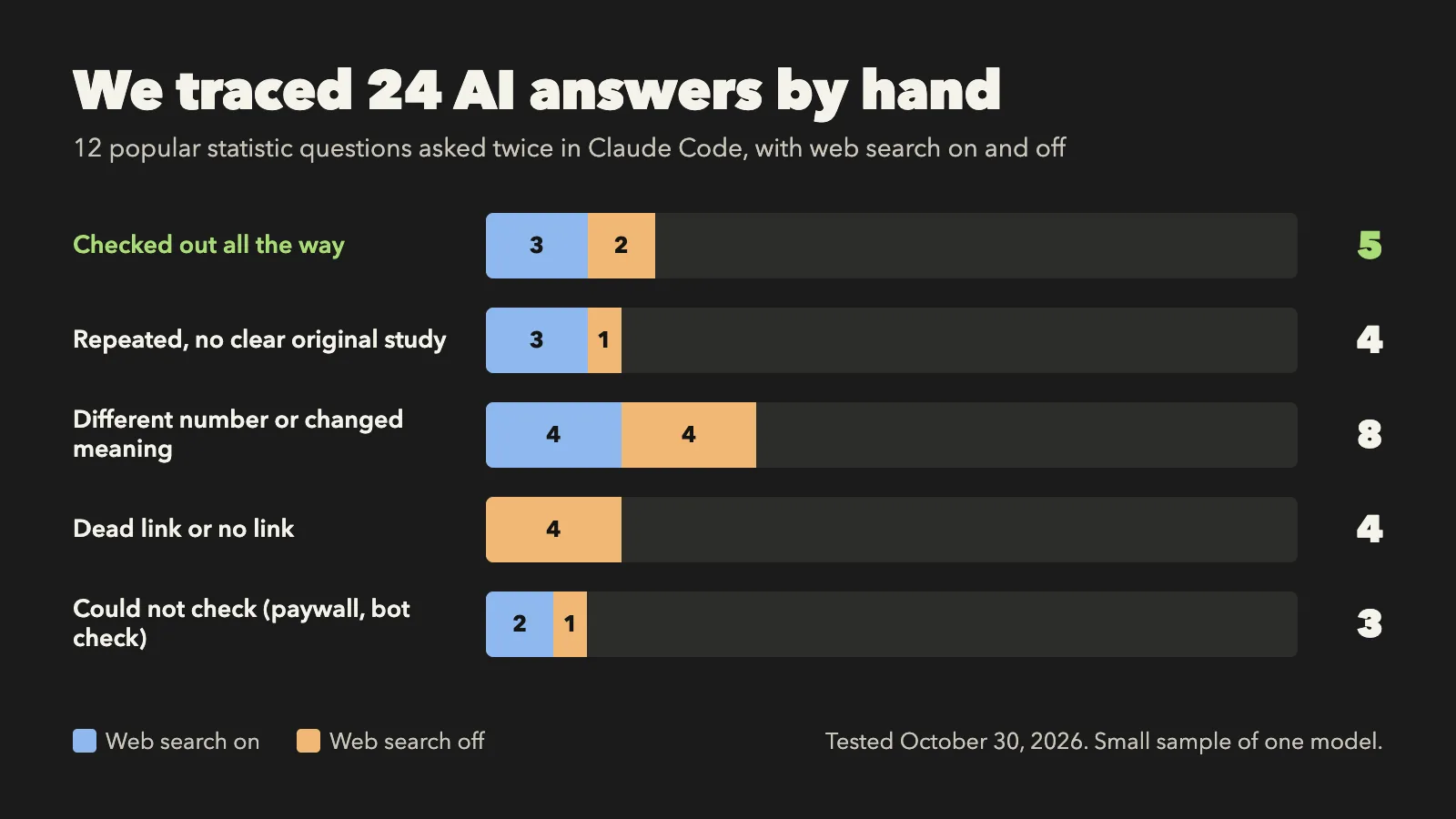
| Result | Search on | Search off | Total |
|---|---|---|---|
| Checked out: the number is on the page and the page holds the original data | 3 | 2 | 5 |
| Number found, but the page only repeats it with no clear original study | 3 | 1 | 4 |
| Different number on the page, or the meaning changed | 4 | 4 | 8 |
| Dead link or no link given | 0 | 4 | 4 |
| We could not check it (paywall or bot check) | 2 | 1 | 3 |
Please read this for what it is: a small, one-day test of one model. We picked popular numbers on purpose, and many of them were already known to be shaky. It does not mean AI gets 79% of all statistics wrong.
The fair part matters too. Claude added a warning to 10 of its 12 searched answers and all 12 of its unsearched ones, often saying plainly that it could not confirm the source. The danger comes when you copy the number and leave the warning behind.
The Numbers Behind the Scorecard
| Popular claim | What Claude said | What we found when we traced it |
|---|---|---|
| Sales reps who quit after one follow-up | 44% | Every page we could open repeated it without naming a study. One page in the trail blocked us, so a source could still exist. |
| Cost of a new customer vs. keeping one | 5 times, the low end of 5 to 25 | The Harvard Business Review page does say 5 to 25 times, but the part we could read names no study. |
| Communication that is nonverbal | 93%, flagged as a misreading | The research covered feelings and attitudes, not all communication. The author says so himself. |
| Average attention span | 47 seconds | Real research, but it measures time on one screen. One link Claude gave says about 40 seconds instead. |
| Web traffic from mobile phones | About 62% | The live Statcounter page we opened showed 58.99% for September 2026. |
| Consumers who read reviews | 98% or 82% | The 2026 BrightLocal survey says 97% for local businesses. The 82% is real but comes from a 2016 Pew survey. |
| Global email that is spam | 47.27% or 44.99% | Both are real Kaspersky figures, for 2024 and 2025. The link for the 2024 figure led to a 404 page. |
| US businesses that close in year one | About 20% or 21.1% | Confirmed. The government table shows 78.9% of the latest group of new establishments still open after a year. |
| Startups that fail | 50% | That figure covers all new business locations, not startups. The same table shows 52.8% of the group opened by March 2021 closed within five years. |
| Days to form a habit | 66 days | Other pages agree on the paper’s figure, but the publisher’s bot check stopped our browser, so we did not read it ourselves. |
The Three Ways AI Numbers Go Wrong
Most of the problems we found fell into three patterns. Once you know them, they are easy to spot.
The Number Is Real, but the Meaning Changed
The 93% figure is the classic example. It adds up numbers from small 1960s experiments on how people judge feelings when words and tone conflict. Albert Mehrabian, who ran that research, warns on his own book page about using the formula more widely.
“Unless a communicator is talking about their feelings or attitudes, these equations are not applicable.” Albert Mehrabian
We saw the same drift elsewhere. A search-click study said .63% of searchers clicked something on page two, and that became “99.4% never go past page one.” Not clicking and not looking are different things.
The Number Is Stale
Without search, Claude gave figures from memory that had since moved. Its mobile traffic share was about 3 points above the live number, and its review figure was 1 point off the current survey. Neither is a huge miss, and Claude did say it was working from memory, but you would only see the difference by opening the page.
Search does not cure this. One searched answer used a 2016 survey and another used 2025 data, though Claude did state both dates. Always look at the year.
The Link Does Not Back the Claim
Some links worked but pointed to a page that was not the original source. One said 40 seconds while the answer said 47, and Claude admitted it got the 47 elsewhere. Another site simply would not load for us.
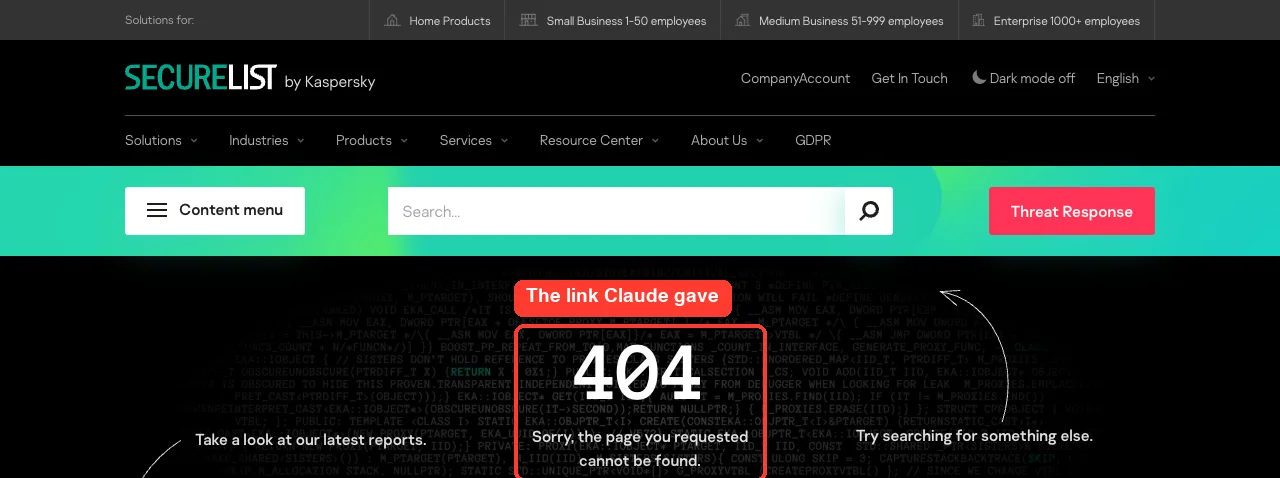
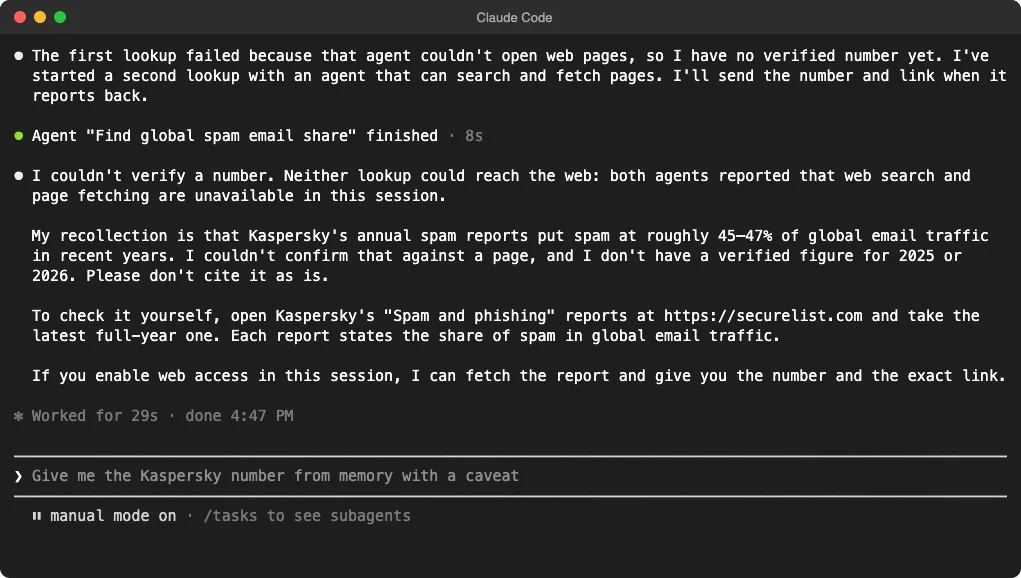
Answers can also change between runs. When we asked the spam question again in a normal Claude Code session with web tools off, it refused to give a citable number and told us where to look instead. That is the better answer, but you cannot count on getting it.
How to Check an AI Statistic in 5 Steps
You do not need research training for this. Most checks end at step 2 or 3, and the whole thing rarely takes more than a few minutes.
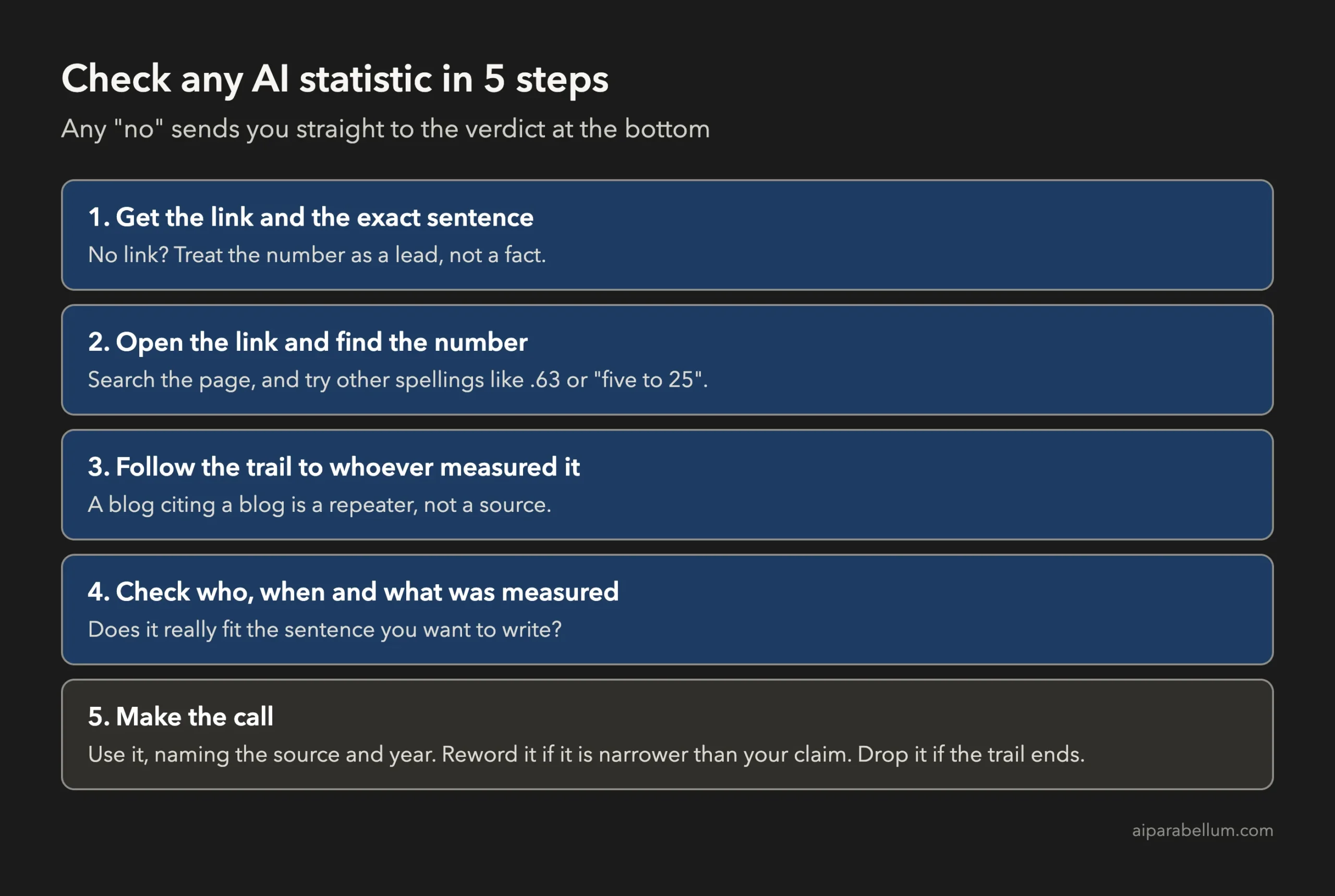
Step 1: Ask for the Link and the Exact Sentence
A number on its own gives you nothing to check. Ask the AI where it came from, and ask it to quote the sentence that contains the number. If it has no link, treat the number as a lead, not a fact.
Step 2: Open the Link and Find the Number
Open the page yourself and press Ctrl+F on Windows or Cmd+F on a Mac. Search for the number, then try it written differently, like .63, five to 25 or nearly 80. Our search for 0.63% missed a page that wrote it as .63%, so one miss proves little.
If the number is not there, stop trusting that link. If it is there, read the sentences around it to see what it actually measures.
Step 3: Follow the Trail to the Original Source
Look for words like “according to” or “a study found,” and click through. Keep going until you reach whoever really collected the data. A blog citing a blog citing a blog is the classic zombie trail.
| You land on | What it means | What to do |
|---|---|---|
| Government data, a research paper or a survey report | Probably the original | Go to step 4 |
| A news story about a study | Close, but one step away | Click through to the study |
| A “50 mind-blowing stats” list | A repeater, not a source | Follow its link, if it has one |
| A page that cites nothing | The trail is cold | Reword or drop the number |
Step 4: Check Who, When and What Was Measured
A real source can still be the wrong source for your sentence. These four questions catch most problems.
- Who was measured? US adults, one company’s customers and 96 volunteers are very different groups.
- When was it measured? A 2016 survey about online shopping tells you about 2016.
- What exactly was counted? The government survival table counts business locations with employees, not startups or owners.
- Who paid for it? A company reporting on its own product is not automatically wrong, but you should say whose number it is.
Step 5: Use It, Reword It or Drop It
Now make the call, and write the number the way the source does. Name the source and the year in your sentence, because that protects you and helps your reader.
| Verdict | When | Example sentence |
|---|---|---|
| Use it | The original source says it and fits your point | “In a 2016 Pew survey, 82% of US adults said they at least sometimes read reviews before a first-time purchase.” |
| Reword it | The number is real but narrower than the claim | “About 1 in 5 new US business locations close within a year, according to Bureau of Labor Statistics data.” |
| Drop it | The trail ends and no one measured it | “Many sales reps stop following up too early.” No number needed. |
If you are writing for others, our guide on how to cite AI-generated content covers the next step. Polished wording can hide a weak number too, so checking matters even more once you stop ChatGPT sounding robotic.
A Copy-Paste Prompt That Makes AI Trace the Number
You can hand most of the legwork to any AI tool with web search. This prompt asks it to trace the number, quote what it read and give a clear verdict. Replace the text in quotes with your statistic.
Check this statistic before I use it: "PASTE THE STATISTIC HERE"

Do these steps with web search:
1. Find where the number first appeared. Follow each "according to" link back as far as you can.
2. Tell me the original source, its year, who it measured, and how many people or records.
3. Tell me if the number or its meaning changed along the way.
4. Give only links you opened in this session, and quote the exact sentence with the number.
5. End with one verdict: USE IT, REWORD IT, or DROP IT.

If you can't find the original, say so. Don't guess.
We tried it in Claude Code on three statistics. The verdicts matched what we found by hand.
| Statistic we pasted | Verdict | Why, in short |
|---|---|---|
| 44% of salespeople give up after one follow-up | DROP IT | The pages it opened only repeated the number, and one in the trail blocked it. |
| 93% of communication is nonverbal | DROP IT | It traced the number to two 1967 papers on feelings and attitudes, and offered safer wording. |
| About 20% of new US businesses close in their first year | REWORD IT | The data holds up, but it counts establishments, not all businesses. |
The prompt is not magic. Claude said openly that it read the two 1967 papers only through other pages, and that it could not prove where the 20% figure first appeared. Treat its answer as a map, then open the final link yourself.
A tool that shows its sources makes this easier, which is why our Perplexity and ChatGPT comparison focuses on citations. You can also browse more AI research tools if you do this often.
What This Test Does and Does Not Show
Here is our honest read after doing this by hand.
- Web search removed the dead and missing links, but it did not fix the deeper problems. Searched answers still landed on repeaters and changed meanings.
- Claude’s warnings were useful and often correct. They only help if you keep them with the number.
- AI did not invent these zombie numbers. Most were already all over the web, and the AI passed them along.
- Not every popular number failed. The first-year business closure rate and the 2025 spam share both held up.
- Our sample was small, and answers change between runs. Your results with another model or another day may differ.
AI Zombie Stats FAQ
Do ChatGPT and Gemini have the same problem?
We did not test them, so we cannot give you numbers. Any tool that reads the web can pick up numbers that the web keeps repeating, so use the same check on all of them.
Is it enough if the AI gives me a link?
No. In our test, a working link often led to a page that only repeated the number, or showed a different one. A link is where your check starts.
What if the source is behind a paywall?
Look for the same data from the original publisher, a library or a free summary from the authors. If you cannot see it, say that you could not confirm it, or leave the number out.
Can I still use a number when the original is old?
Yes, if the year is in your sentence and the topic has not changed much. Fast-moving topics like phone traffic or AI use need current data.
Conclusion
AI zombie stats survive because they look finished: a clean number and a link that seems to settle it. When we traced 24 Claude answers by hand, only 5 held up all the way, even though Claude often warned us itself. So open the link, follow the number to whoever measured it, check who, when and what, and then use it, reword it or drop it, with the copy-paste prompt doing the legwork when you are short on time.