LLM Voice is the smooth, tidy, oddly familiar sound of text written by a large language model. You’ve probably felt it within a few lines, even when you couldn’t say why. We ran a small test to see which fixes change that impression.
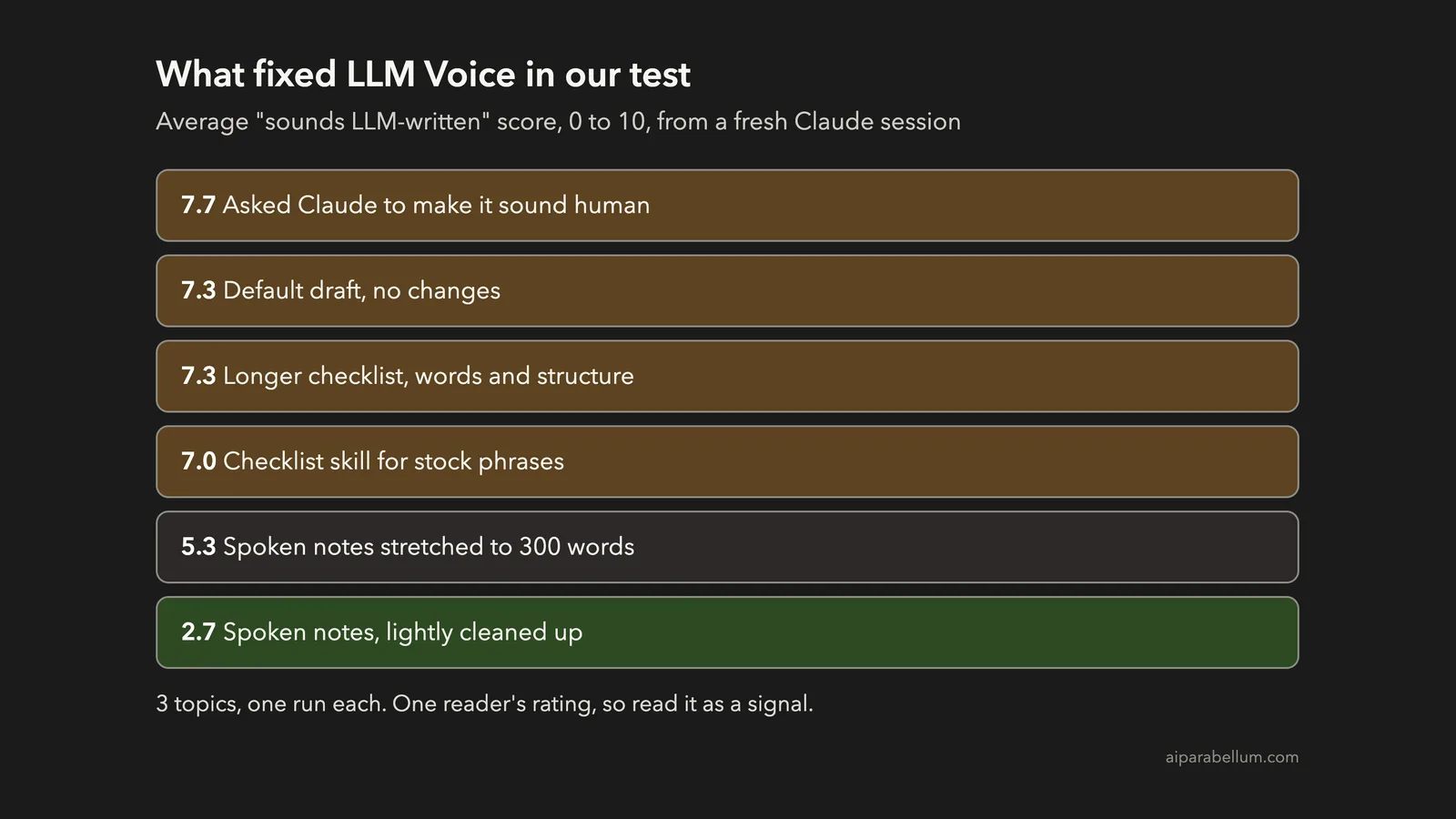
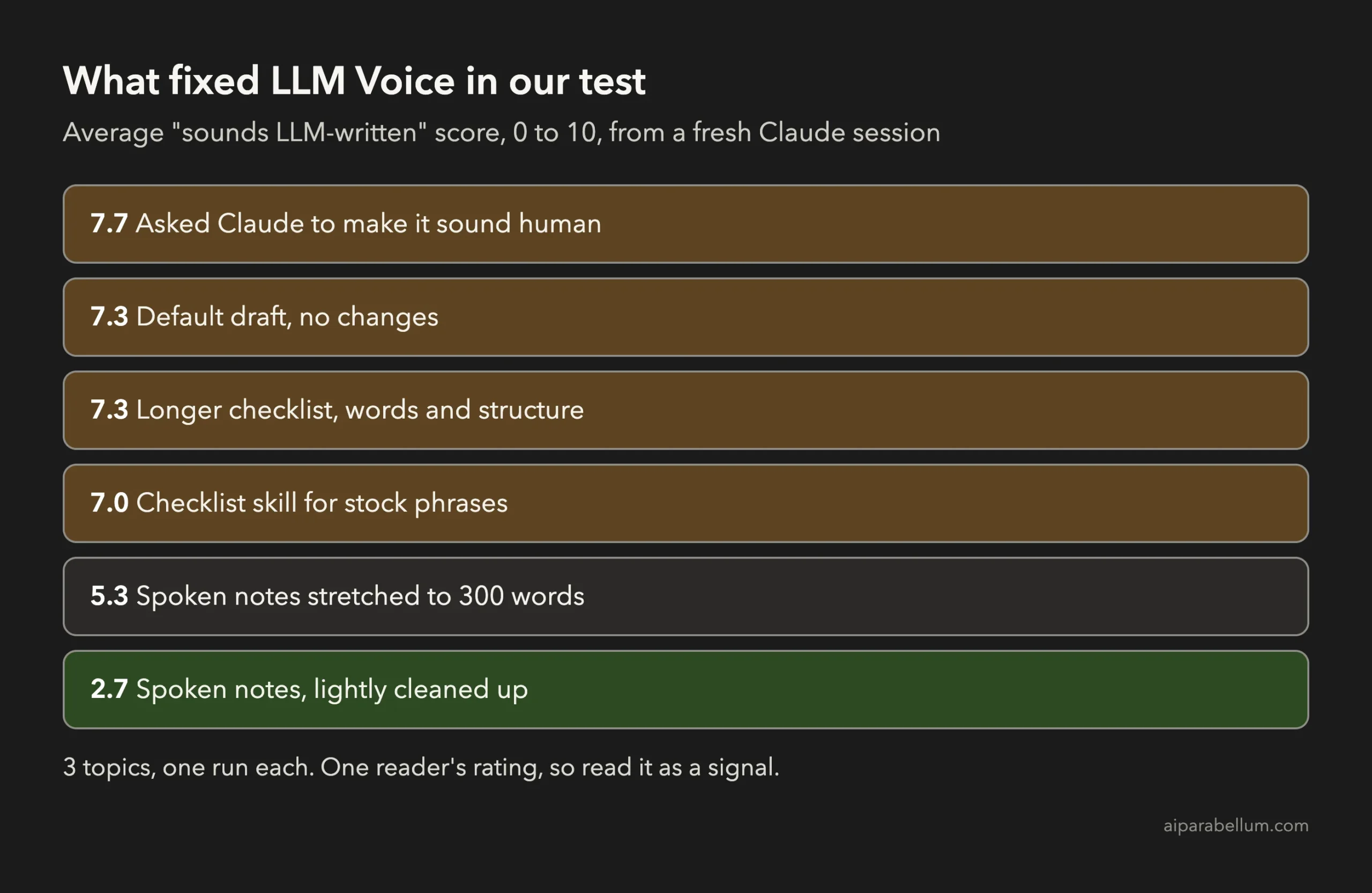
Asking Claude to make a draft sound human didn’t help at all. Neither did a detailed checklist, while starting from rough spoken notes cut the score from 7.3 to 2.7 out of 10.
We tested three blog topics with the Sonnet model in Claude Code v2.1.312 on October 31, 2026. Each version ran once and got one rating, so these numbers are a signal and not proof.
Key takeaway: LLM Voice comes more from missing thought than from bad word choice, so give the model your own points before you ask it to write.
What Is LLM Voice?
LLM Voice is a writing style, and you can hear it across tools like ChatGPT, Claude and Gemini. Sentences are correct and paragraphs are balanced, yet nothing sounds like a particular person wrote it.
If readers notice it, they may stop paying attention, and that’s the real cost. Google’s own guidance on AI-generated content focuses on whether content is helpful rather than how it was made, so a machine-like tone is more of a reader problem than a rule problem.
How to Spot LLM Voice
Older advice says to look for words like “delve” and “tapestry.” That advice is aging fast: our phrase counter found no stock words at all in any of the default Sonnet drafts.
Our reader, a fresh Claude session with no context, kept pointing at something else. It flagged “uniform bolded imperative headers” on one draft and a “closing ‘Make it a habit’ recap” on another. Wikipedia’s editors keep a longer list of signs of AI writing if you want more examples.
| What to check | What it looks like |
|---|---|
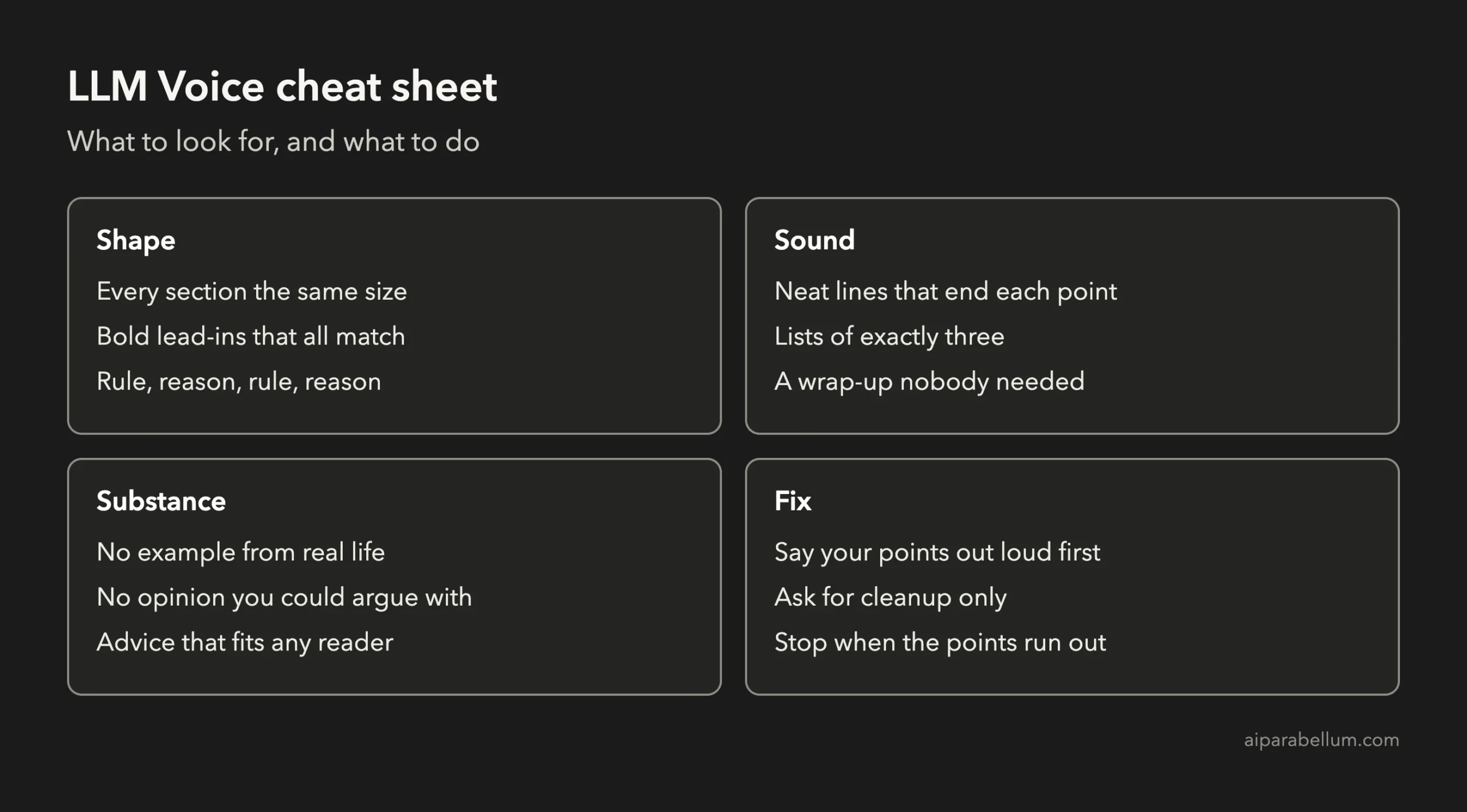
| Even shape | Every section is about the same size, with matching bold lead-ins. |
| Rule, then reason | Each paragraph states a tip and then justifies it the same way. |
| Neat endings | Points finish on a tidy line, and a wrap-up repeats what you just read. |
| Groups of three | Lists have three items because three sounds right. |
| Nothing personal | No real example, mistake or opinion, so the advice fits anyone. |
Don’t Use LLM Voice as Proof
These signs tell you how a text reads, and they can’t tell you who wrote it. We ran our phrase counter on three texts written long before LLMs existed, and they scored 2.8 to 5.0 flags per 1,000 words.
The default AI drafts averaged only 3.3, and one scored zero. So a simple counter can’t separate the two, and you shouldn’t accuse a student or coworker on this evidence.
How We Tested the Fixes
We picked three everyday topics: backing up phone photos, replying to online reviews and choosing a password manager. Each topic got the same short list of facts and six treatments.
- A default 300-word draft, with no style instructions.
- That draft rewritten with a prompt asking for it to sound “human and not like AI.”
- That draft rewritten by a checklist skill aimed at stock phrases and formulas.
- That draft rewritten by a longer checklist that also covered structure.
- Rough spoken notes, cleaned up with light editing only.
- The same notes, stretched to about 300 words.
A fresh Claude session then rated each text from 0 to 10 for how likely it was to be LLM-written. It didn’t know which method made which text, and the rewrites kept their facts when we checked them.
We wrote the spoken notes ourselves for this test, in the style of someone talking, so the personal details in them are test material and not real stories.
LLM Voice Test Results
| Method | Photos | Reviews | Passwords | Average |
|---|---|---|---|---|
| Sound human prompt | 8 | 7 | 8 | 7.7 |
| Default draft | 7 | 7 | 8 | 7.3 |
| Longer checklist | 7 | 7 | 8 | 7.3 |
| Phrase checklist skill | 7 | 7 | 7 | 7.0 |
| Notes, stretched to 300 words | 3 | 6 | 7 | 5.3 |
| Notes, cleaned up | 2 | 3 | 3 | 2.7 |
Why Rewriting Didn’t Work
The rewrites swapped words and left the thinking alone. The plain prompt changed “Speed matters, so aim to reply within 48 hours” to “Try to reply within 48 hours,” and the rest of the paragraph kept its shape.
Our longer checklist went after the structure too, and it told Claude to mark gaps with [ADD YOUR OWN EXAMPLE] so it wouldn’t invent stories. The reader counted those leftover markers against it, so this score could improve once a person fills them in, though we didn’t test that.
Why Notes Worked
Notes carry things a model can’t guess, like your opinion and what you’ve seen go wrong. Here’s the same photo backup advice from both starting points.
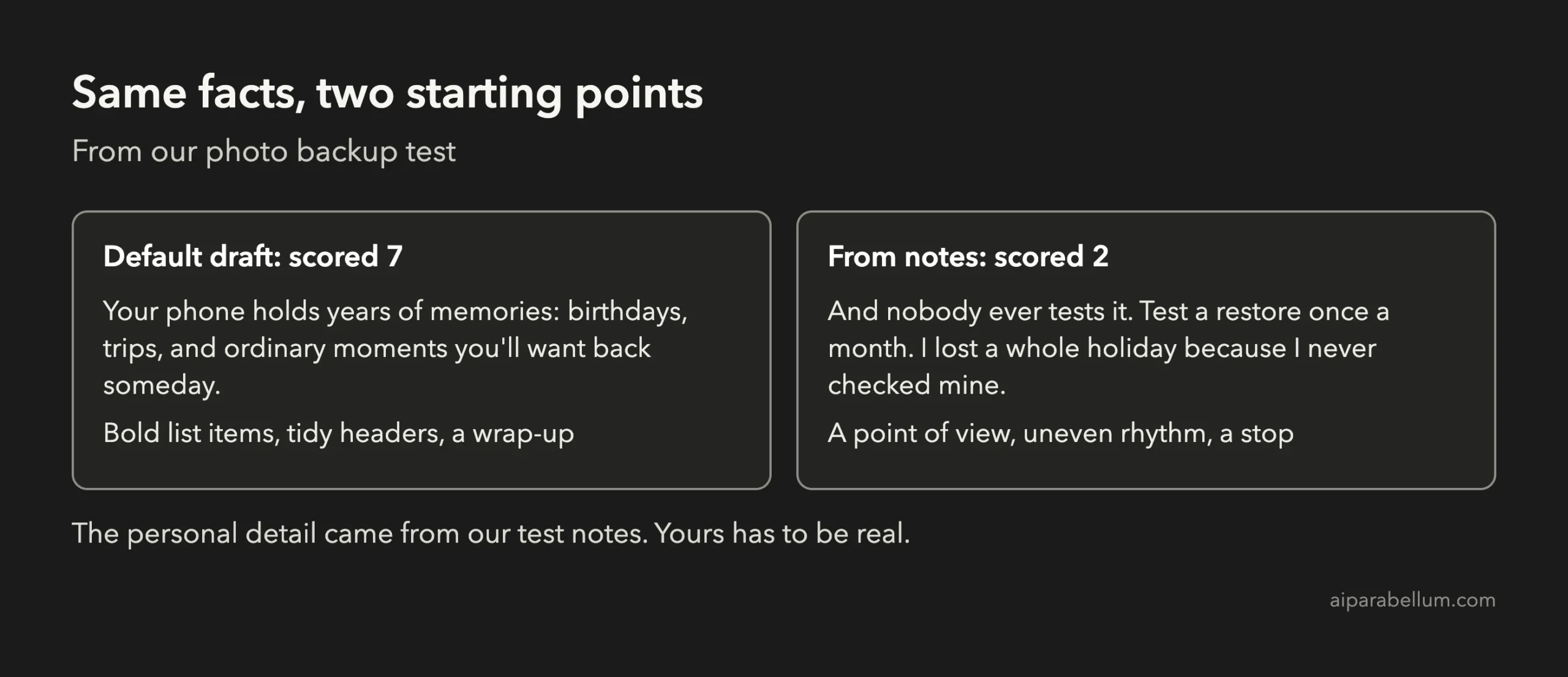
There’s a catch, because the cleaned-up notes ran only 55 to 73 words against about 300 for the drafts. When we stretched them to 300 words, the score climbed to 5.3, and the reader flagged a “tidy closing checklist” and “Start with / Next / Then / Finally” signposting.
So length has a price. The more the model has to add on its own, the more of its habits come back.
How to Fix LLM Voice in Your Own Writing
This is the routine we’d follow based on these results. It needs no special tools.
- Say your points out loud and record them, or type them fast without editing. Include what you’d tell a friend, like what went wrong for you.
- Paste them into your AI tool with the prompt below. It’s the one we used for the cleaned-up notes.
- Read the result out loud and delete anything you wouldn’t say.
- Stop when your points run out, even if the piece is shorter than you planned.
Clean up these spoken notes into a blog section. Keep my words, order and
opinions wherever you can. Fix only grammar and remove filler. Return only
the text.

[paste your notes here]
If you need more length, add more of your own notes before you ask the model to expand anything. If you use Claude Code often, you can save the prompt as a reusable command with our guide to Claude Code skills. If all you have is a finished draft, our guide on stopping ChatGPT from sounding like AI has more to try.
Don’t Invent the Personal Details
Our reader liked anecdotes, and that creates an obvious temptation. Asking a model to make up a story about your sister might lower a score, but it also puts something false in front of your readers.
Check the facts in your final text as well, since any model can get them wrong. Our guide on checking numbers from ChatGPT and Claude shows you how to trace a statistic back to its source.
What This Test Can’t Tell You
- Our reader was another AI model, and real people may judge these texts differently.
- It may simply favor first-person stories, so its low scores could partly reflect that.
- We ran three topics once each, which is too few to prove a general rule.
- We only tested Sonnet in Claude Code, so other models may have different habits.
LLM Voice FAQs
What does LLM Voice mean?
It describes the recognizable style of text from large language models: smooth, balanced and correct, with little sign of a particular person behind it.
Can you remove LLM Voice with a prompt?
Not in our test. A plain prompt and two checklists all stayed at 7 or above on average, so your starting material seems to matter more than your rewrite prompt.
Are AI detectors reliable for LLM Voice?
We didn’t test commercial detectors. Our simple phrase counter flagged older human texts as often as AI drafts, so be careful with any single score.
Do em dashes mean a text was written by AI?
No. People used them long before LLMs, and our counter found them in two of the three older texts we checked but in none of the default drafts.
Conclusion
LLM Voice is easy to feel and hard to edit away, because rewrites only change the surface. In our small test, your own spoken notes did far more than any prompt or checklist, as long as the model wasn’t asked to pad them. Start with what you actually know, keep the cleanup light, and let the piece end when you’re out of things to say.