Email drip campaigns work. They nurture leads, onboard new customers, recover abandoned carts, and keep your brand top of mind over weeks and months. The problem is that building and managing them manually takes an enormous amount of time. You have to write dozens of emails, decide when each one sends, segment your audience, test subject lines, and adjust the entire sequence based on how people respond.
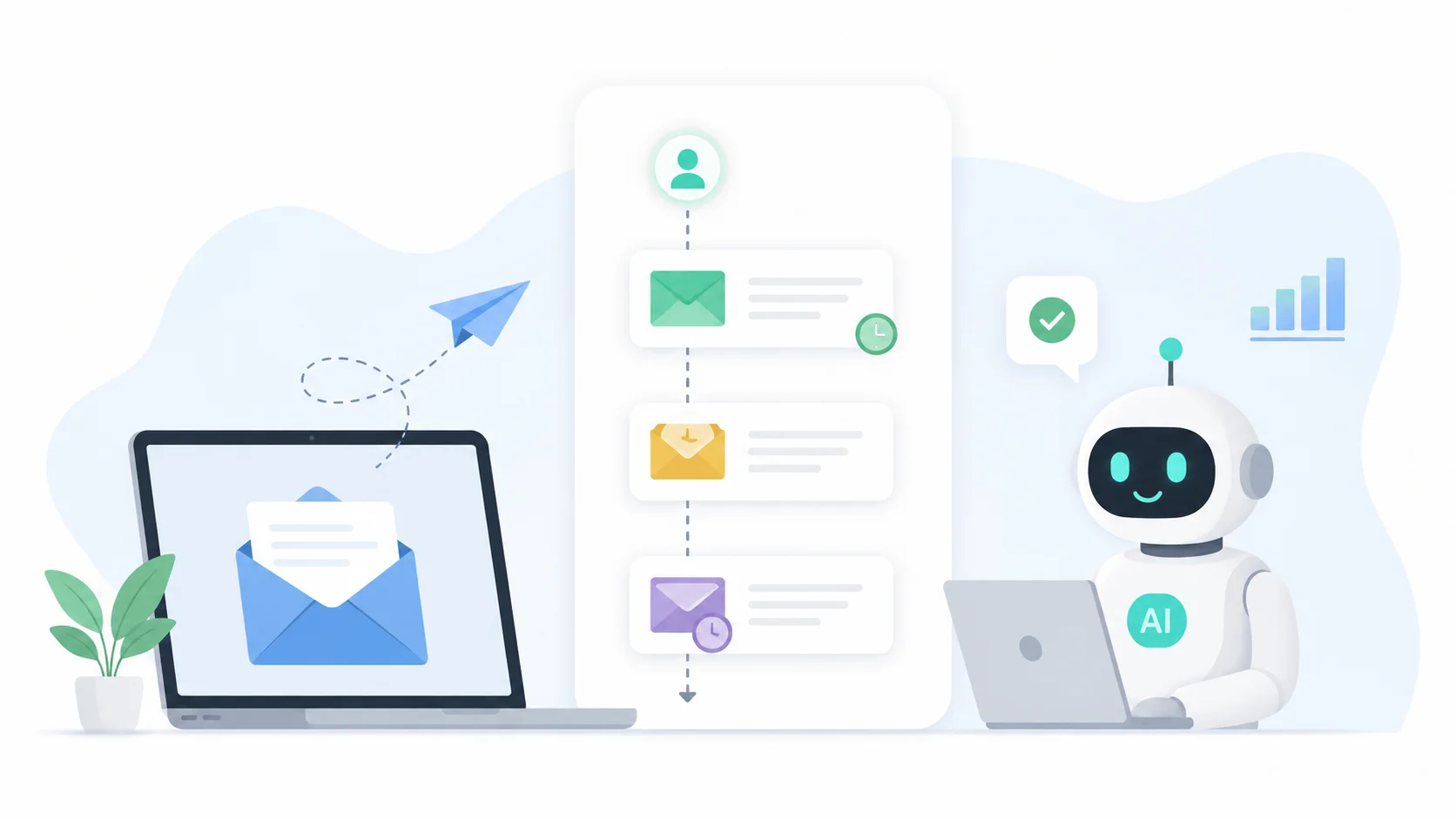
AI automates nearly every part of this process. It writes the emails, determines the optimal send times, personalizes content for each recipient, tests variations automatically, and adjusts the campaign in real time based on engagement data. What used to require a full-time email marketer now runs on autopilot with better results than most manual campaigns deliver.
Here is how to automate email drip campaigns using AI to save hours of work per week while improving open rates, click-through rates, and conversions across your entire email marketing program.
What Makes AI Email Automation Different
Traditional email automation is rule-based. You set triggers (someone signs up, someone abandons a cart) and define a fixed sequence of emails sent at fixed intervals. Every subscriber gets the same emails on the same schedule, regardless of whether they opened the first one, clicked anything, or already bought the product.
AI-powered automation is behavior-based and adaptive. The system watches how each subscriber interacts with every email and adjusts the sequence dynamically. If someone opens every email within minutes, AI might accelerate the cadence. If someone goes quiet, it might switch to a re-engagement sequence or change the content style entirely.
According to McKinsey, companies that excel at personalization generate 40 percent more revenue from those activities than average players. AI makes that level of personalization practical in email marketing without requiring a team of analysts to manage it.
The best drip campaign is one that feels like a personal conversation, not a scheduled broadcast. AI creates that feeling at scale by treating every subscriber as an individual.
AI Tools for Email Drip Campaign Automation
Several platforms combine AI capabilities with email marketing infrastructure. The right choice depends on your list size, budget, and how deeply you want AI integrated into the workflow.
| Tool | Free Option | Best For | Key AI Feature |
|---|---|---|---|
| HubSpot | Free CRM tier | Full marketing automation with CRM | AI content assistant, send time optimization |
| Mailchimp | Free up to 500 contacts | Small business email marketing | AI subject line helper, predictive segmentation |
| ActiveCampaign | Free trial | Advanced automation workflows | Predictive sending, win probability scoring |
| Klaviyo | Free up to 250 contacts | E-commerce drip campaigns | AI-powered product recommendations in emails |
| SmartLead | Free trial | Cold email outreach automation | AI email warmup and reply detection |
| ChatGPT | Free tier available | Writing email copy and sequences | Generates entire drip sequences from a brief |
For small businesses and solopreneurs, Mailchimp’s free tier combined with ChatGPT for copywriting provides a powerful starting point. Growing businesses benefit from ActiveCampaign or HubSpot where AI is built directly into the automation engine. E-commerce brands should look at Klaviyo for its product-aware AI recommendations.
How AI Writes Email Drip Sequences
Writing a complete drip sequence manually means crafting 5 to 15 individual emails, each with a different purpose, tone, and call to action, while maintaining a coherent narrative across the entire series. AI handles this in minutes.
Generating the Full Sequence
Give AI a brief that includes your product or service, target audience, the goal of the drip campaign (lead nurturing, onboarding, upselling), and the desired number of emails. AI generates the complete sequence with subject lines, preview text, body copy, and calls to action for each email.
The generated emails follow proven copywriting frameworks automatically. AI knows that the first email should deliver immediate value, the second should build credibility, and subsequent emails should progressively move toward the conversion goal. Knowing how to write effective AI prompts helps you get sequences that match your brand voice from the first draft.
Subject Line Optimization
Subject lines determine whether your email gets opened or ignored. AI generates multiple subject line variations for each email and predicts which ones will perform best based on data from millions of email campaigns. It factors in length, word choice, personalization tokens, urgency, and curiosity elements.
| Subject Line Type | Example | When AI Recommends It |
|---|---|---|
| Curiosity gap | “The one thing most marketers get wrong about drip campaigns” | Early in the sequence to build engagement |
| Direct benefit | “Save 3 hours per week on email marketing” | When the subscriber is solution-aware |
| Social proof | “How 500 companies automated their email this month” | Mid-sequence to build trust |
| Urgency | “Your trial expires in 48 hours” | Late in the sequence near conversion point |
| Personal | “Quick question about your marketing goals” | Re-engagement or when open rates drop |
AI does not just suggest subject lines. It continuously tests them. Most AI email platforms run automated A/B tests on subject lines, sending each variation to a small segment and then automatically using the winner for the remaining audience.
You never really know which subject line will win until real people see it. AI tests faster and more consistently than any human marketer ever could.
AI-Powered Personalization in Drip Campaigns
Personalization goes far beyond inserting someone’s first name into the greeting. AI personalizes the actual content, timing, and trajectory of the entire drip sequence based on individual behavior.
Dynamic Content Blocks
AI swaps content blocks within emails based on subscriber data. A SaaS company’s onboarding sequence might show different feature highlights depending on which plan the customer purchased. An e-commerce brand might display different product recommendations based on browsing history. The email template stays the same, but the content inside it adapts to each recipient.
This approach means you maintain one drip sequence that effectively acts as dozens of personalized sequences. AI handles the logic of which content block appears for which subscriber, eliminating the need to build separate campaigns for each segment.
Behavioral Trigger Adaptation
AI monitors how each subscriber interacts with your emails and website, then adjusts the drip campaign accordingly.
- Subscriber opens every email but never clicks: AI shifts to more compelling calls to action and tests different offer formats.
- Subscriber clicks on pricing pages: AI accelerates the sequence toward sales-focused content and triggers a notification to the sales team.
- Subscriber stops opening emails: AI switches to a re-engagement sequence with different subject line styles and reduced frequency.
- Subscriber makes a purchase mid-sequence: AI automatically moves them from the sales drip to a post-purchase onboarding sequence.
- Subscriber forwards emails to colleagues: AI identifies them as an internal champion and adjusts content to support their case-building.
This behavioral adaptation is what separates AI-driven campaigns from traditional automation. The conversion rate improvements from AI automation come precisely from this ability to respond to individual signals rather than treating every subscriber identically.
Send Time Optimization
AI determines the optimal send time for each individual subscriber, not just for the list as a whole. It learns when each person typically opens emails, whether they read on mobile during commutes or desktop during work hours, and which days of the week they are most responsive.
Instead of blasting your entire list at 10 AM Tuesday because an article said that is the best time, AI sends each email at the moment each subscriber is most likely to open it. This personalized timing alone can improve open rates by 15 to 25 percent.
Building Your First AI Drip Campaign
Start with one high-impact campaign and expand from there. These are the drip campaigns that deliver the most value and are easiest to automate with AI.
Welcome Sequence
The welcome sequence is the highest-engagement email series you will ever send. New subscribers are at peak interest, and open rates for welcome emails average 50 to 60 percent compared to 20 to 25 percent for regular campaigns. AI generates a 5 to 7 email welcome series that introduces your brand, delivers a lead magnet, showcases your value, and moves new subscribers toward a first purchase or conversion.
Abandoned Cart Recovery
For e-commerce businesses, abandoned cart emails recover 5 to 15 percent of lost sales. AI personalizes these sequences with the specific products left in the cart, suggests similar items, calculates dynamic discount offers based on cart value and customer history, and determines the optimal timing for each follow-up. The AI business tools that handle cart recovery integrate directly with most e-commerce platforms.
Lead Nurturing
B2B lead nurturing drip campaigns move prospects through the sales funnel over weeks or months. AI scores each lead based on engagement, qualifies them based on behavior patterns, and serves content matched to their current stage in the buying process. A lead reading case studies gets different emails than one still browsing feature comparison pages.
Customer Onboarding
Post-purchase onboarding drip campaigns reduce churn and increase customer lifetime value. AI tracks which features or products the customer has used and sends targeted guidance for what they have not yet explored. This approach mirrors how the AI employee onboarding process works, adapting the sequence based on individual progress rather than following a rigid timeline.
The goal of a drip campaign is not to send more emails. It is to send the right email at the right moment to the right person. AI makes that possible without you touching a single send button.
Measuring and Optimizing AI Drip Campaigns
AI does not just run your campaigns. It continuously optimizes them based on performance data.
Key Metrics AI Tracks
| Metric | What It Tells You | How AI Responds |
|---|---|---|
| Open rate | Subject line and send time effectiveness | Tests new subject lines, adjusts send times |
| Click-through rate | Content relevance and CTA strength | Swaps content blocks, tests CTA placement |
| Conversion rate | Overall campaign effectiveness | Adjusts sequence length, offer timing |
| Unsubscribe rate | Frequency and relevance issues | Reduces frequency, improves segmentation |
| Reply rate | Engagement quality and personalization | Increases conversational tone, adds questions |
AI platforms provide these insights automatically and implement changes without requiring manual intervention. The system runs continuous micro-tests across subject lines, content variations, send times, and CTA styles, learning what works best for each segment and individual subscriber.
Avoiding the Spam Folder
AI helps maintain email deliverability by monitoring sender reputation, managing send volume to avoid spam triggers, and optimizing content to pass spam filters. It flags emails that contain language patterns associated with spam and suggests alternatives that convey the same message without triggering filters.
Understanding how spam detection works helps you write drip emails that land in the inbox rather than the promotions tab or spam folder. AI actively monitors deliverability metrics and adjusts sending patterns before reputation issues develop.
AI Email Copy That Sounds Human
The biggest concern with AI-written emails is that they sound robotic or generic. Modern AI tools produce natural-sounding copy, but a few techniques ensure your drip campaigns feel genuinely human.
- Feed AI your existing best-performing emails as style examples so it matches your brand voice.
- Include specific details about your product, customers, and industry rather than letting AI write generic copy.
- Ask AI to write in a conversational tone and then edit out any phrases that feel stiff or corporate.
- Use AI-generated copy as a strong first draft, not a final version. A quick human editing pass adds the personal touches that AI misses.
- Test AI copy against your manually written emails to see which performs better. The results often surprise even experienced copywriters.
Learning how to make AI writing sound natural is essential for email marketing where authenticity directly impacts engagement. The best AI drip campaigns blend machine efficiency with human warmth.
According to Litmus, email marketing generates an average return of $36 for every $1 spent. AI amplifies this ROI by reducing the time investment while improving the performance of every email sent. The same AI marketing tools that optimize ad spend and social media campaigns deliver equally powerful results when applied to email drip sequences.
Scaling Your AI Email Strategy
Once your first AI drip campaign is running and producing results, expanding to cover your full customer lifecycle is straightforward.
- Map every customer touchpoint where a drip sequence adds value: pre-purchase, purchase, onboarding, engagement, upsell, renewal, and win-back.
- Build each sequence with AI, starting from the highest-impact touchpoints and working outward.
- Connect your drip campaigns to your CRM so AI can use the full customer profile for personalization.
- Let AI manage the transitions between sequences automatically as subscribers move through different lifecycle stages.
- Review performance monthly, but resist the urge to manually override AI optimizations that need time to converge.
The AI productivity tools that streamline other business workflows extend naturally to email marketing. A complete AI-driven email program runs across your entire customer lifecycle with minimal daily oversight, freeing your team to focus on strategy and creative direction rather than execution mechanics.
Conclusion
Automating email drip campaigns using AI transforms email marketing from a time-intensive manual process into an intelligent, self-optimizing system. AI writes the copy, personalizes every message, optimizes send times for each subscriber, tests variations continuously, and adapts the entire sequence based on real-time behavior. The result is higher open rates, better click-through rates, and more conversions with a fraction of the effort. Start with one high-impact sequence like a welcome series or abandoned cart recovery, let AI prove its value, and then expand to cover your full customer lifecycle with drip campaigns that run themselves.